What Happens After the Audit
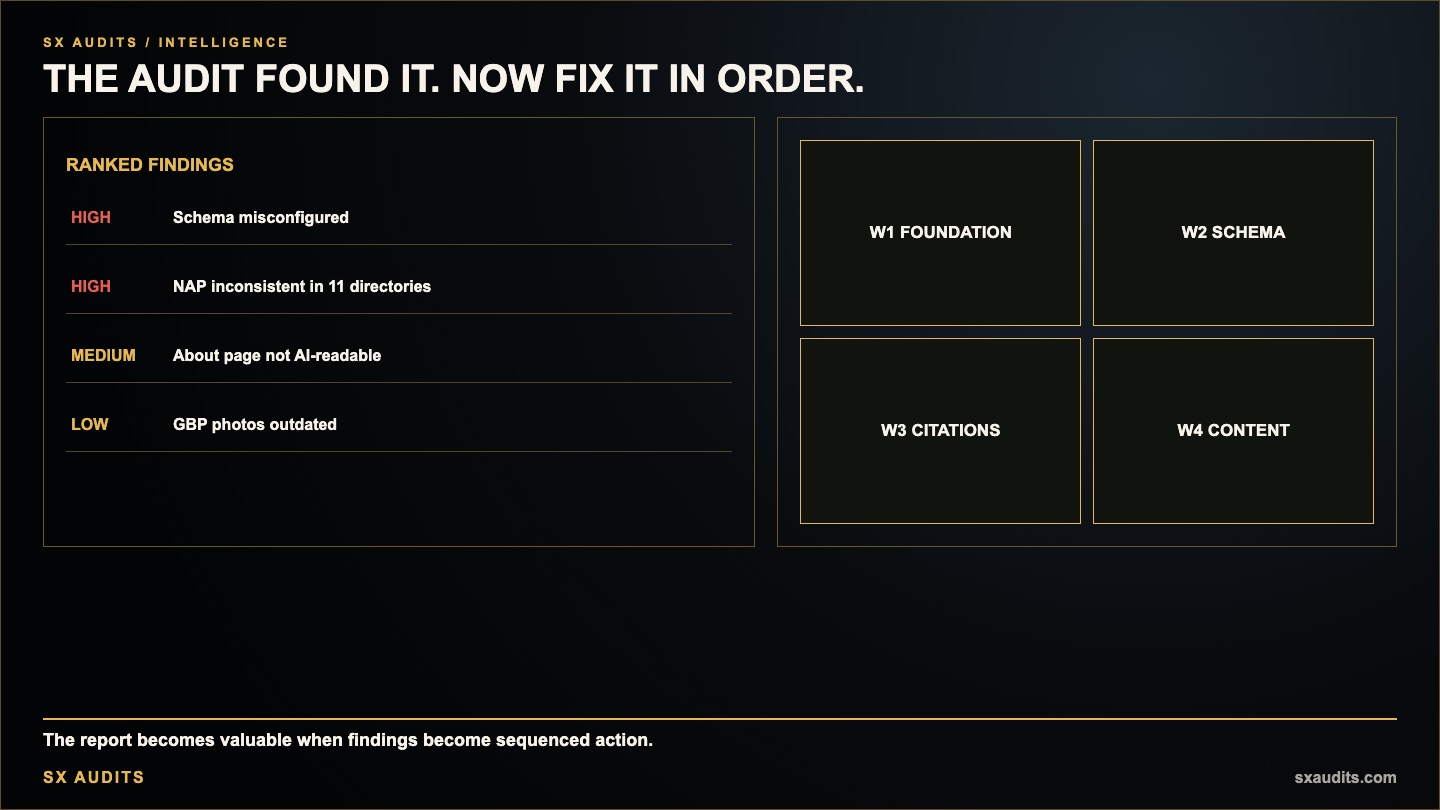
A dermatologist in Dallas received her audit on a Wednesday morning. The findings were specific: her schema markup was misconfigured and producing validation errors; her NAP was inconsistent across eleven directories, including Apple Maps where she had a 2019 business address; she didn't appear in any AI category recommendations despite being the highest-rated dermatologist in her zip code; and her About page was written in language that AI systems couldn't excerpt in any useful form.
She read the report. She understood the findings. And then she didn't know what to do next.
Not because the findings were unclear — they were specific and prioritized. But because she had a full practice, a team to manage, and no in-house person whose job it was to implement the technical fixes the report outlined.
The audit told her exactly what was wrong. The question of what to do about it was a separate problem.
The Gap Between Diagnosis and Implementation
The most common outcome after a digital audit is partial implementation: one or two findings addressed immediately, the rest deferred indefinitely. The highest-priority fix — which is often the least visible one, like schema misconfiguration or data aggregator inconsistency — gets deferred because it is technical and requires someone who knows what to do with it. The lower-priority but more visible fix — like adding photos to the GBP — gets addressed first because it is accessible and feels productive.
This is a predictable outcome of receiving a diagnosis without a clear implementation path. The audit produces the diagnosis. The implementation path determines the results.
Start With The Highest-leverage Technical Fixes First
The prioritization in the audit report is intentional — findings are ordered by revenue impact per unit of effort, not by complexity or visibility. The highest-leverage fixes are almost always the technical foundation items: schema markup configuration, NAP inconsistency in major directories, and GBP completeness. These have outsized impact on AI visibility because they affect the basic entity signals AI systems use to decide whether to cite and recommend a business at all. A business that addresses these three areas before anything else will see more impact from those fixes than from any amount of content creation or social posting.
Most High-impact Fixes Are One-time Actions
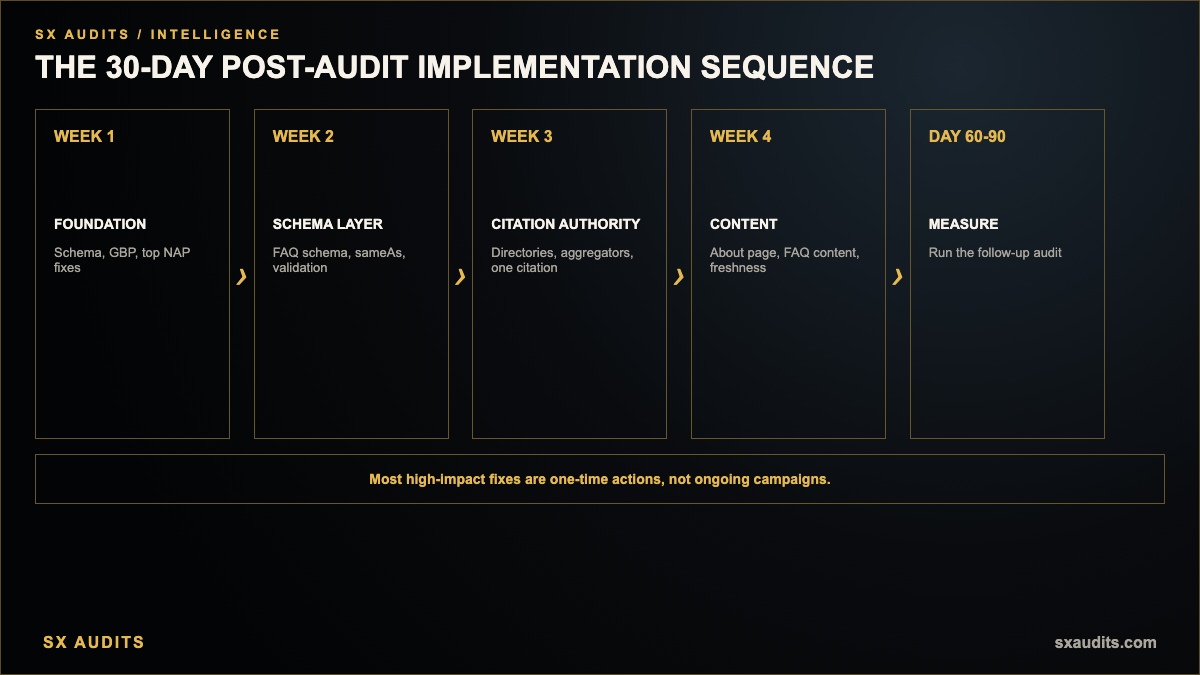
The highest-priority findings in most audits are fixable in a bounded amount of work — not ongoing commitments. Correcting schema markup on a website is a one-time technical action. Updating NAP across directories is a several-hour task, not a recurring one (though it requires quarterly maintenance). Adding FAQ content to a website is a one-time content project. These are not campaign investments or monthly retainers — they are specific, time-bounded fixes that, once implemented, continue producing results without ongoing maintenance. This is different from content marketing or social media, which require continuous production to maintain results.
The 30-day Implementation Sequence
The implementation sequence that produces the fastest measurable improvement for most businesses follows a four-week framework. Week 1: fix the foundation — correct schema markup errors, update GBP to complete and accurate, update the two to three highest-discrepancy NAP listings. Week 2: extend the schema layer — add FAQ schema to service pages, correct sameAs links in Person or LocalBusiness schema, test all structured data through Google's Rich Results Test. Week 3: build citation authority — update professional directory listings, address data aggregator inconsistencies, identify and pursue one high-authority third-party citation. Week 4: improve content citability — rewrite About page in structured, quotable language, add one FAQ page addressing new client questions, ensure all key pages are updated within the last 90 days. The AI visibility improvements from this sequence typically become measurable within 45–60 days.
Implementation Requires A Designated Owner
The dermatologist's problem was not motivation or understanding — it was capacity. The findings were clear. The implementation required a designated owner: someone with access to the website backend to fix schema, someone with the time to work through the directory list, someone to rewrite the About page. If that person is not the business owner, the implementation requires either a staff member with a defined scope or a specific engagement with a technical implementer. The audit does not include implementation — it provides the diagnosis that makes implementation efficient and targeted. Businesses that move fastest are those that identify the implementation owner before the report arrives.
The Follow-up Audit Is The Measure Of Progress
AI visibility changes are not immediately visible in traditional analytics. Schema fixes don't produce a traffic spike the next day. NAP corrections don't cause a sudden jump in Google Maps ranking. The improvement is cumulative — AI systems update their entity models over weeks, not hours, as they recrawl and reprocess the updated signals. The way to verify that implementation is working is a follow-up audit 60–90 days after the first one. This is not an upsell — it is the measurement step. A second audit run against the same framework produces a new score, identifies what changed, and confirms whether the implementation addressed the right issues in the right sequence.
The Post-Audit Implementation Checklist
Week 1 — Foundation:
- Fix schema markup errors identified in the audit (use Google's Rich Results Test to verify)
- Complete your GBP: every field, services listed, updated description, recent photos
- Correct NAP for the two to three directories with the highest discrepancy
Week 2 — Schema Layer:
- Add FAQ schema to service pages with Q&A content
- Verify sameAs links in your schema connect to your LinkedIn, GBP, and website
- Test all structured data and resolve any remaining validation errors
Week 3 — Citation Authority:
- Update professional association directory listings
- Submit corrections to the primary data aggregators (Neustar, Infogroup, Acxiom)
- Identify one high-authority third-party citation opportunity (guest article, industry profile, podcast)
Week 4 — Content Citability:
- Rewrite your website's About or bio page in clear, quotable, structured language
- Add one FAQ page addressing your three most common new client questions
- Ensure all primary service pages have been updated within the last 90 days
Day 60–90:
- Commission a follow-up audit to measure the score change and identify remaining gaps
What to Do If You Can't Implement It Yourself
The audit report is structured for independent implementation by anyone who can access the relevant platforms — Google Business Profile, the website backend, and a web browser. The schema fixes can be implemented by most web developers in under two hours. The NAP corrections require time and access, not technical expertise. The content rewrites require someone who can write clearly in your voice.
If your team doesn't have the capacity for any of these, the audit findings are specific enough to hand to any competent implementer with clear instructions about what to prioritize. You are not starting from a broad brief — you are starting from a ranked list of specific actions.
The dermatologist found a web developer on Upwork and paid $350 to implement the schema fixes. She updated her GBP and top four directory listings herself in about three hours over two evenings. She rewrote her About page in an afternoon. The total implementation cost was under $600. Within 60 days, she was appearing in AI category recommendations for the first time.
The audit cost $[X]. The implementation cost $600. The new patient inquiries from AI-driven discovery are still compounding.
Want to know exactly where your business stands with AI search?
We run the full diagnostic and deliver a findings report in 72 hours. No discovery call. No commitment.
Book the Audit →Related intelligence · selected for this topic
Framework developer and systems thinker specializing in AI implementation and decision architecture. Creator of the AI Council methodology — a structured multi-model framework used to surface deeper insights in complex decisions. The audit intelligence at Sovereign X Audits is built on these same principles.
aicouncilconductor.com →Find out exactly where your business stands.
We audit your digital infrastructure, AI visibility, and brand presence — and show you exactly what it's costing you.