
What Is Digital Sovereignty and Why Your Audit Should Check for It
A commercial cleaning company in Orlando had built its entire client acquisition process on a Google Business Profile. Strong reviews, high Maps ranking, consistent inquiry volume from local search. No website. No directory presence. No schema markup. No presence on any platform outside of Google.
In March, the GBP was suspended as part of Google's address verification sweep. The business effectively disappeared from local search overnight. The owner appealed. The process took six weeks. During those six weeks, no new client inquiries arrived through the channel that had been generating 80% of their business development.
The GBP was eventually reinstated. But the incident revealed something the business had not understood about its digital presence: it did not own it. It rented it, from a platform, under terms the platform could change or enforce without notice.
What Digital Sovereignty Means
Digital sovereignty is the degree to which a business's digital infrastructure is owned, controlled, and resilient to platform policy changes versus dependent on third-party platform access.
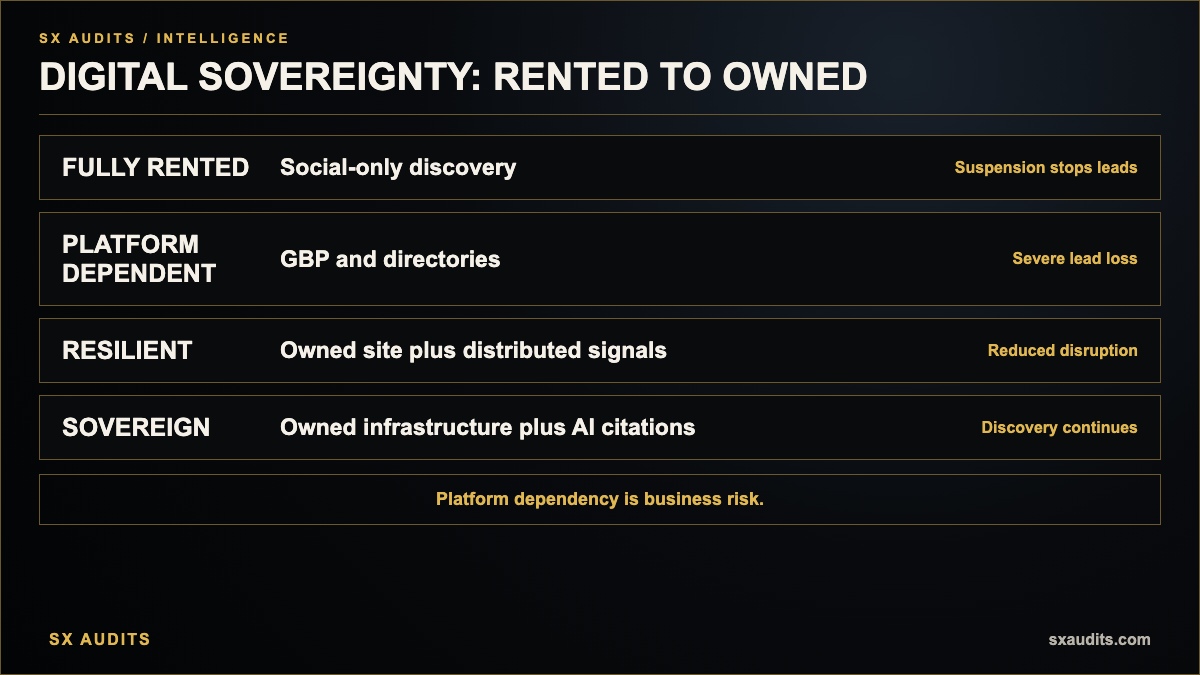
The spectrum runs from fully rented to fully owned:
Fully rented: A business whose entire digital presence exists on platforms it does not control — Google Business Profile, social media accounts, third-party review platforms — without a website, without schema markup, without directory diversity. One platform action removes the entire presence.
Partially owned: A business with a website it owns, some directory diversity, and platform presence. Resilient against single-platform failures. Dependent on some external platforms for discovery.
Largely owned: A business with a self-hosted website, schema markup configured for AI citation, NAP consistent across 30+ directories, an owned email list, direct booking capability, and platform presence as supplementary rather than primary. Platform changes affect distribution but do not remove the business from discoverability.
Fully sovereign: In addition to the above, the business has AI platform visibility through structured entity data, an llms.txt file guiding AI crawlers, owned content assets that generate citations across multiple platforms, and a reputation and review infrastructure that does not depend on any single review platform.
Google Can Suspend Your GBP Without Notice; Sovereign Infrastructure Survives It
Google's GBP suspension rate increased more than 80% between Q1 2023 and Q2 2024. Appeals that previously resolved in 5 days now take 5 weeks or more. 42% of address verification failures occur in businesses with correct addresses. The enforcement is real, the appeals process is slow, and the impact on non-sovereign businesses — those depending entirely on GBP for discovery — is complete loss of local search visibility until reinstatement. A business with a sovereign digital infrastructure — website with schema markup, 30+ consistent directory citations, AI platform visibility, owned contact and booking infrastructure — loses a channel but does not lose discoverability.
AI Platform Visibility Is The New Sovereign Layer
In 2025 and 2026, AI platforms have become a primary discovery channel for professional services and local businesses. Unlike a Google Business Profile, AI citation is not subject to suspension or platform enforcement — it is earned through structured entity data, third-party citation, and content quality. A business with strong AI platform visibility has built a discovery channel that no platform can unilaterally remove, because the visibility exists across multiple AI systems and is earned through infrastructure configuration rather than platform registration. AI visibility is the most sovereign form of digital discovery currently available.
Most Digital Audits Do Not Assess Sovereignty; They Assess Channel Performance
Standard digital audits evaluate how well each channel is performing. They check GBP status, organic rankings, paid traffic, social media engagement. They do not assess the dependency risk of the channel mix — whether the business is dangerously concentrated in a single platform that it does not control. A sovereignty assessment asks: if Google suspended this GBP tomorrow, what would happen to lead volume? If the business's primary social platform changed its algorithm or terms, what would happen to discovery? If paid advertising were turned off, what organic and AI discovery would remain? These are risk questions that a channel performance audit does not ask.
Sovereignty Is Built Incrementally; The Audit Establishes The Baseline
Digital sovereignty is not a binary state achieved in one configuration. It is built across multiple infrastructure layers over time: website ownership, schema markup, directory diversity, AI platform citation, owned contact infrastructure, content assets. The SX Audit's sovereignty assessment establishes the current baseline — how dependent is the business on any single platform it does not control? — and identifies the highest-priority sovereignty improvements. For many small businesses, the first priority is simply having a website they own and a directory presence they have verified. For more mature digital presences, the priority is AI citation infrastructure and reduced GBP dependency.
Sovereignty Reduces Business Risk As Well As Improving Discovery
Digital sovereignty is not just a marketing performance question. It is a business continuity question. A business that generates 80% of its new client inquiries from a single platform it does not control has a concentration risk that no amount of marketing optimization can address. An adverse platform action — policy enforcement, algorithm change, suspension — creates an immediate revenue impact. Distributing discovery infrastructure across owned assets and multiple platforms is a risk management strategy as much as a visibility strategy. The audit that checks for sovereignty is the audit that considers the business's resilience, not just its current performance.
What the Sovereignty Assessment Includes
The sovereignty component of an SX Audit evaluates:
Platform dependency mapping: What percentage of discovery traffic and lead volume comes from channels the business does not own? What is the impact of losing the single most important channel?
Owned infrastructure inventory: Website (owned vs. hosted on a platform), email list (owned and portable), direct booking capability (platform-dependent vs. business-controlled), schema markup and AI entity configuration.
Discovery channel diversity: How many distinct discovery pathways exist — organic search, Maps pack, AI citation, directory referral, direct navigation, referral? Is any single pathway responsible for more than 60% of lead volume?
AI sovereignty score: Does the business have AI citation infrastructure that persists independently of platform registrations? Schema markup, llms.txt, content citability, third-party citations across authoritative sources?
Want to know exactly where your business stands with AI search?
We run the full diagnostic and deliver a findings report in 72 hours. No discovery call. No commitment.
Book the Audit →Related intelligence · selected for this topic
Framework developer and systems thinker specializing in AI implementation and decision architecture. Creator of the AI Council methodology — a structured multi-model framework used to surface deeper insights in complex decisions. The audit intelligence at Sovereign X Audits is built on these same principles.
aicouncilconductor.com →Find out exactly where your business stands.
We audit your digital infrastructure, AI visibility, and brand presence — and show you exactly what it's costing you.