What Revenue Leak Detection Actually Means
The phrase "revenue leak" typically shows up in conversations about billing errors, discount abuse, or sales process gaps. In the context of digital infrastructure, it means something different and harder to see: revenue that never enters the funnel because the infrastructure that should have guided it there is broken.
A business that appears in ChatGPT for its category isn't just generating AI citations — it's recovering revenue that was leaking to competitors who did appear. A business with consistent NAP across 30+ directories isn't just maintaining citations — it's preventing the local ranking suppression that was costing it Maps pack placements. A business with accurate schema markup isn't just improving AI readiness — it's recovering the AI Overview real estate that its misconfigured markup had been forfeiting.
Revenue leak detection, as practiced at Sovereign X Audits, is the systematic identification of the infrastructure failures that are costing a business qualified leads — and the quantification of the scope of that loss.
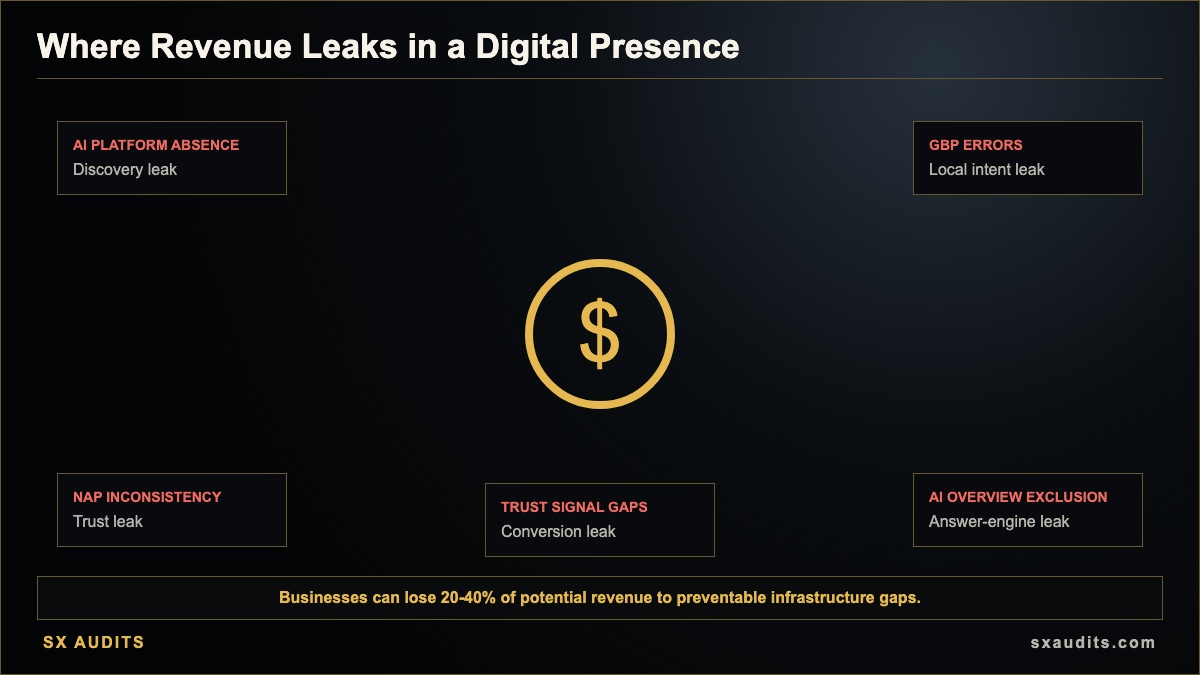
Where Revenue Leaks in a Digital Presence
The AI platform leak: A business that is absent from ChatGPT, Perplexity, and Google AI Overviews for its category queries is missing the highest-intent, highest-converting discovery channel. AI-referred visitors convert at 4.4× the rate of traditional organic search visitors. Every month of AI platform invisibility is a month of high-value leads being delivered to whatever competitor is appearing in those recommendations instead.
The GBP leak: A business with an incorrect category, outdated hours, suspended profile, or incomplete service information is sending prospective clients to a trust gap at the exact moment they are evaluating whether to reach out. 63.6% of consumers check reviews and business information before contacting a business — GBP errors are visible to every one of them.
The NAP inconsistency leak: Inconsistent Name, Address, and Phone data across directories does not just create confusion — it suppresses Google Maps local pack rankings. A business that is losing Maps pack placement due to NAP drift is losing the 44% of local search clicks that the Maps pack captures, to competitors whose NAP is consistent.
The AI Overview leak: Google AI Overviews now appear for 68% of local searches. A business that ranks at position 3 in organic results, below an AI Overview that does not mention it, receives substantially fewer clicks than the same position without an AI Overview. The "leak" is the traffic that used to come from that organic position but now goes to the AI Overview's citations — typically businesses that have configured structured content for AI Overview eligibility.
The trust signal leak: Unanswered reviews, an empty review profile, outdated photos, incomplete bio information, and inconsistent brand signals across directories create a trust gap that prospective clients encounter during pre-contact research. 97% of consumers research a business online before contacting it. Trust signal gaps convert a consideration-stage prospect into a no-contact decision.
Revenue Leaks Are Invisible In Standard Analytics
A business's Google Analytics dashboard shows sessions, bounce rate, and contact form submissions. It does not show the prospective clients who asked ChatGPT for a recommendation and received a competitor's name. It does not show the local searcher who encountered an outdated GBP and chose a competitor with complete information. It does not show the AI Overview impressions that went to other businesses because schema markup was misconfigured. Revenue leaks do not appear in standard analytics because they occur upstream of the analytics tracking — before a session is recorded, in the discovery channels that don't require a website visit.
The Scale Of The Leak Is Quantifiable Once The Infrastructure Is Mapped
Industry data shows businesses lose 20 to 40 percent of potential revenue through preventable digital infrastructure gaps. For a professional service business with an average client value of $5,000 and a current client acquisition rate of 5 new clients per month, a 20% improvement in AI discovery infrastructure could represent one additional client per month — $60,000 in annual revenue at the conservative end of the estimate. Revenue leak detection puts a framework around this calculation: here are the specific infrastructure failures, here is their estimated scope of impact, and here is the priority order in which fixing them produces the fastest recovery.
Most Revenue Leaks Are Structural, Not Strategic
The most common response to declining new client inquiries is a strategic one: more content, better campaigns, a new website, an expanded ad budget. These are strategic interventions on top of a structural problem. Schema markup is not a strategy — it is a structural configuration. NAP consistency is not a campaign — it is a technical accuracy requirement. AI platform invisibility is not a messaging problem — it is an infrastructure gap. Revenue leak detection distinguishes between structural failures (which require technical fixes) and strategic underperformance (which requires campaign or content adjustments), and identifies which one is driving the problem.
The Audit Prioritizes Leaks By Revenue Impact
Not all infrastructure gaps produce equal revenue impact. A minor page speed issue on a desktop-only page has less revenue impact than a GBP showing the wrong category that every mobile local searcher sees. The revenue leak detection framework within an SX Audit ranks findings by their estimated impact on lead volume — the highest-priority fix is the one that, when addressed, is most likely to produce a measurable increase in new client inquiries. This is the prioritization output that turns a list of infrastructure problems into an action sequence.
Fixing The Leaks Doesn't Require More Marketing Investment; It Requires Less
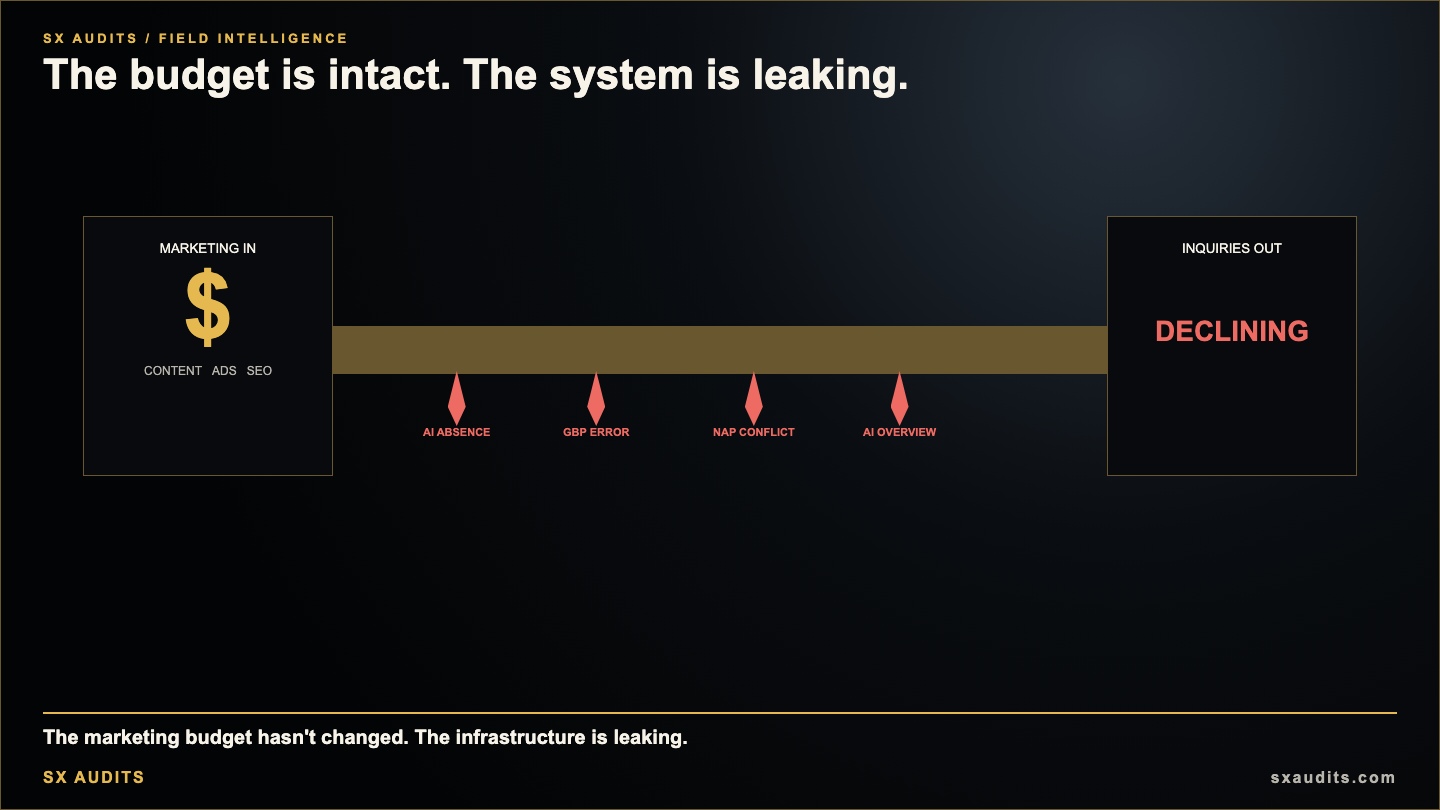
The counterintuitive implication of revenue leak detection is that recovering leaking revenue does not require more spend on marketing — it requires fixing the infrastructure problems that are preventing existing marketing investment from working. A business that increases its content production while its schema markup is misconfigured is amplifying what is already being amplified to an invisible audience. A business that fixes the schema markup first, then resumes existing content investment, gets different results from the same investment. Revenue leak detection identifies what to fix so that what is already being invested starts working correctly.
What Revenue Leak Detection Produces
The revenue leak detection component of an SX Audit delivers:
Leak identification: The specific infrastructure failures that are suppressing lead volume, documented with evidence of the gap and its likely mechanism of impact.
Scope estimation: A conservative and realistic estimate of the lead volume impact — how many additional qualified prospects per month would the corrected infrastructure likely produce?
Priority sequence: The three to five fixes that produce the highest lead recovery per unit of effort, in priority order.
Recovery timeline: A realistic expectation of how long each fix takes to implement and how quickly its impact on lead volume is expected to materialize.
Want to know exactly where your business stands with AI search?
We run the full diagnostic and deliver a findings report in 72 hours. No discovery call. No commitment.
Book the Audit →Related intelligence · selected for this topic
Framework developer and systems thinker specializing in AI implementation and decision architecture. Creator of the AI Council methodology — a structured multi-model framework used to surface deeper insights in complex decisions. The audit intelligence at Sovereign X Audits is built on these same principles.
aicouncilconductor.com →Find out exactly where your business stands.
We audit your digital infrastructure, AI visibility, and brand presence — and show you exactly what it's costing you.