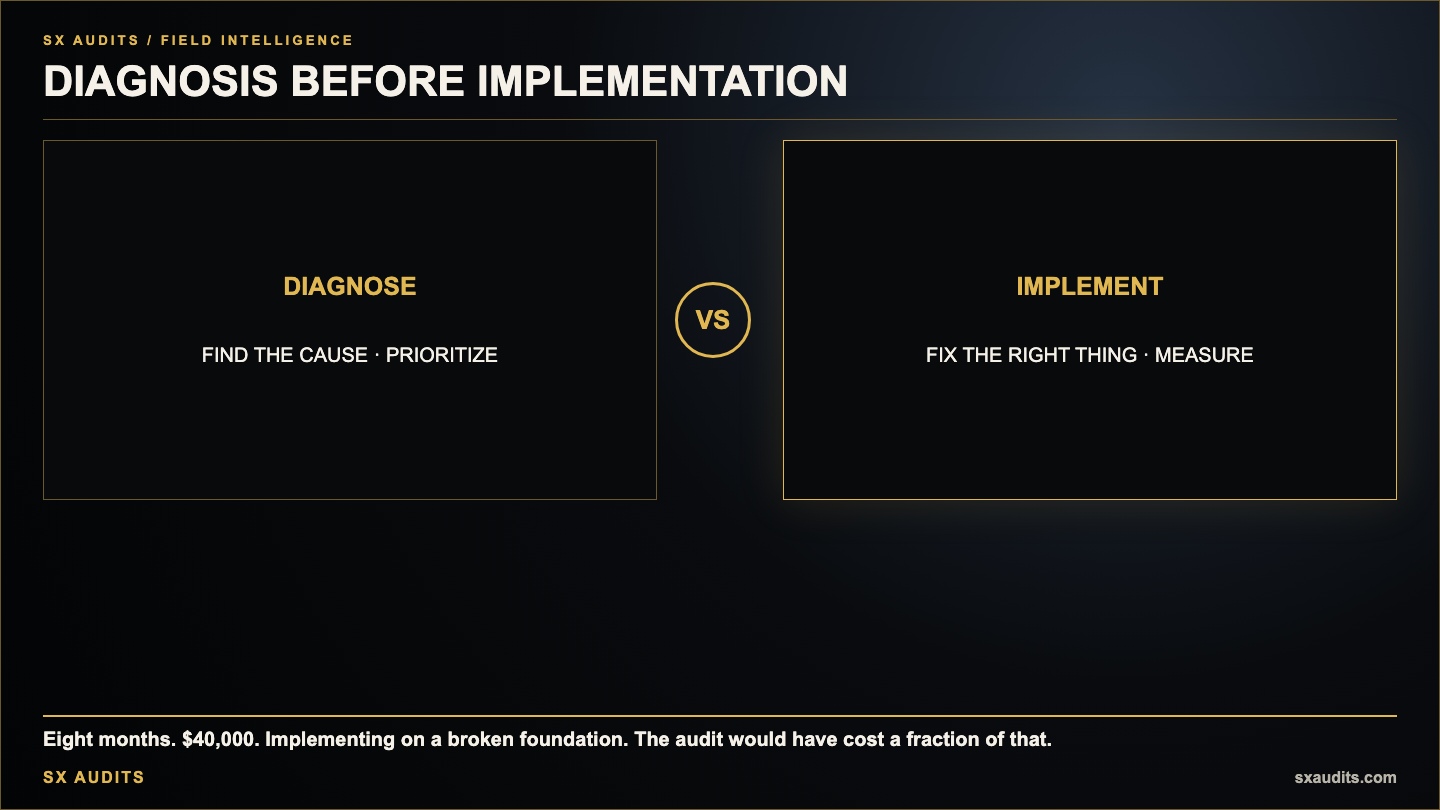
Why Diagnosis Has to Come Before Implementation
A financial advisor in Atlanta had been working with a marketing agency for eight months. The agency had rebuilt his website, created a posting schedule for LinkedIn, and set up a Google Ads campaign. His monthly spend was $3,200 for the agency retainer plus $1,800 in ad spend.
His new client inquiries had not meaningfully increased.
When we ran his digital audit, the issue was not his website design or his content strategy. The issue was that his NAP was inconsistent across fourteen major directories — remnants of a business address change he had made two years prior — and his Google Business Profile had been silently operating in an unverified state for 11 months. AI systems querying his name were returning a thin, partially inaccurate summary because his schema markup was absent and his LinkedIn was listing a specialization he had pivoted away from.
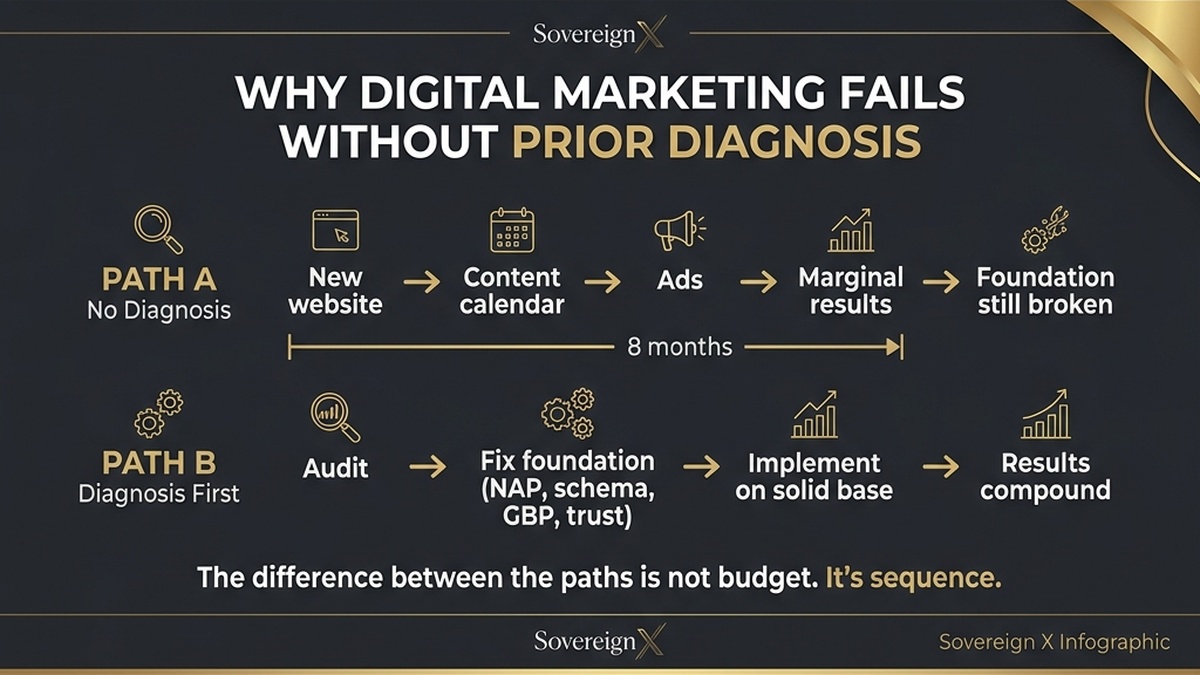
The agency had been building on a broken foundation. Eight months and $40,000 later, the foundation was still broken.
Why Implementations Fail Without Prior Diagnosis
There is a pattern that plays out repeatedly in small business digital marketing: a business identifies that its online presence isn't working well and hires someone — an agency, a freelancer, a marketing coordinator — to fix it. The fixing begins immediately: new website, content calendar, ad campaigns, social media posting. Six months later, the results are marginal.
The reason is almost always the same. The implementation addressed the visible symptoms — outdated website, sparse content, low ad spend — without diagnosing the underlying infrastructure problems that were preventing any of those tactics from working.
A new website installed over a broken NAP foundation doesn't fix the citation confusion that is suppressing local rankings. A content calendar published to a website without schema markup generates articles that AI systems can't cite. Ad campaigns driving traffic to a business with trust gap issues — unanswered reviews, incomplete GBP, inconsistent directory information — pay for clicks that the infrastructure can't convert.
Implementation without diagnosis is expensive experimentation. Diagnosis first makes every subsequent dollar spent more efficient.
The Five Most Common Infrastructure Problems Are Invisible To Surface-level Audit
The issues that most frequently suppress small business digital visibility are: NAP inconsistency across directories (present in approximately 70% of small businesses audited), missing or misconfigured schema markup (present in over 80% of small business websites), GBP incompleteness or silent verification failures (present in over half of all GBP profiles), absence of AI-readable structured content (present in the vast majority of websites built before 2024), and outdated or conflicting information across platforms (the LinkedIn describing a role the business moved away from, the GBP listing a phone number changed in 2023). None of these show up in a visual audit of the website. All of them materially suppress visibility.
Implementation Costs Are Wasted When Built Over Broken Foundations
The financial advisor's situation — $40,000 in implementation cost on a broken foundation — is not unusual. It is the predictable outcome of starting with tactics rather than diagnosis. Content marketing that produces excellent articles generating citations to a website with no schema markup produces fewer AI citations than a mediocre website with correct structured data. Ad spend driving traffic to a business with 3.1 stars and 6 reviews loses conversions to the competitor with 4.7 stars and 200 reviews — regardless of the quality of the ad creative. Google Ads campaigns sending traffic to slow-loading, mobile-unfriendly landing pages produce high bounce rates that lower Quality Scores and increase cost-per-click over time.
Diagnosis Produces A Prioritized Action Sequence, Not Just A List Of Problems
A proper digital audit doesn't just identify what's wrong — it identifies what to fix first. The 20% of issues that are suppressing 80% of the visibility gap are almost never evenly distributed. For most small businesses, the highest-leverage fixes are in this order: NAP consistency and GBP optimization (because these affect local search rankings and AI citation simultaneously), schema markup implementation (because it affects both structured data and AI readability), and trust signal development (because it affects conversion for all traffic, paid and organic). Content strategy and advertising come after these foundations are in place — not before.
The Audit Pays For Itself By Preventing Misallocated Spend
A $500 digital audit that identifies eight months of wasted agency spend is among the highest-ROI investments a small business can make. This is not a rhetorical claim — it is a direct comparison. The financial advisor spent $40,000 implementing on a broken foundation. An early audit would have cost a fraction of that and redirected the implementation spend to the actual problems. For businesses already running ads, already working with agencies, already investing in content — an audit that reveals the foundation they're building on is the prerequisite to any of that investment working.
The Correct Sequence Has Never Been Complicated
The sequence that produces results: diagnose (understand exactly what is broken and in what order it should be fixed) → fix the foundation (NAP, schema, GBP, trust signals) → amplify (content, advertising, AI optimization, social distribution). Most businesses either skip the first step entirely, or conduct a surface-level "audit" that misses the infrastructure issues entirely. The actual sequence is straightforward. The discipline to follow it — to not start with the fun, visible tactics before the unglamorous foundation work is done — is what separates businesses that see results from businesses that wonder why nothing is working.
What Proper Diagnosis Covers
Layer 1 — Technical Foundation:
- Schema markup presence and configuration
- Website technical performance (speed, mobile, indexability)
- GBP status, verification, and completeness
Layer 2 — Consistency and Entity Signals:
- NAP consistency across the 30+ most important directories
- Name, specialty, and description consistency across LinkedIn, website, and GBP
- Photo consistency as an entity validation signal
Layer 3 — Trust Signals:
- Review volume, recency, and average rating
- Review response rate
- Third-party citations and press mentions
Layer 4 — AI Visibility:
- How the business appears in ChatGPT, Perplexity, and Google AI Overviews
- Accuracy and completeness of AI-generated descriptions
- Category recommendation presence vs. competitors
Want to know exactly where your business stands with AI search?
We run the full diagnostic and deliver a findings report in 72 hours. No discovery call. No commitment.
Book the Audit →Related intelligence · selected for this topic
Framework developer and systems thinker specializing in AI implementation and decision architecture. Creator of the AI Council methodology — a structured multi-model framework used to surface deeper insights in complex decisions. The audit intelligence at Sovereign X Audits is built on these same principles.
aicouncilconductor.com →Find out exactly where your business stands.
We audit your digital infrastructure, AI visibility, and brand presence — and show you exactly what it's costing you.