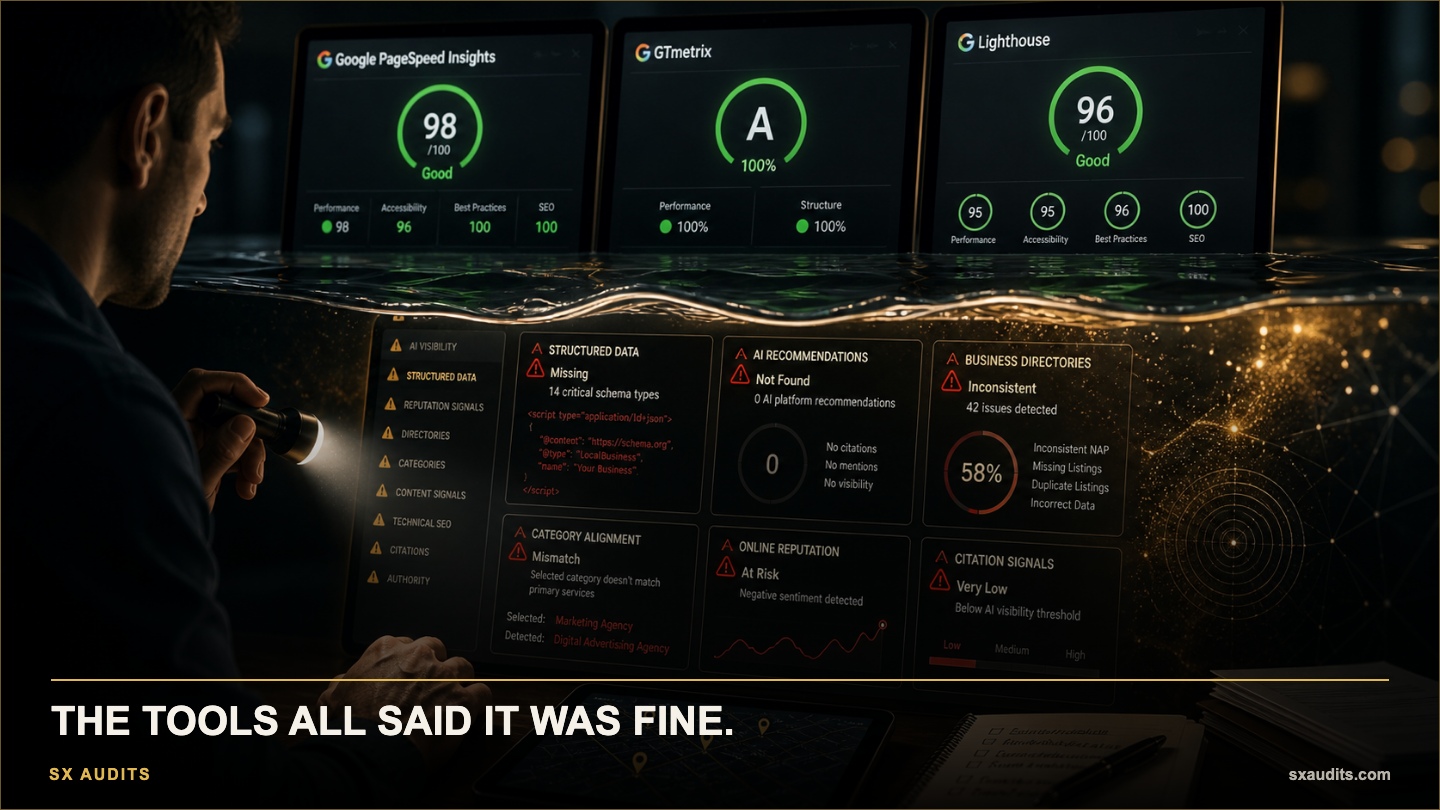
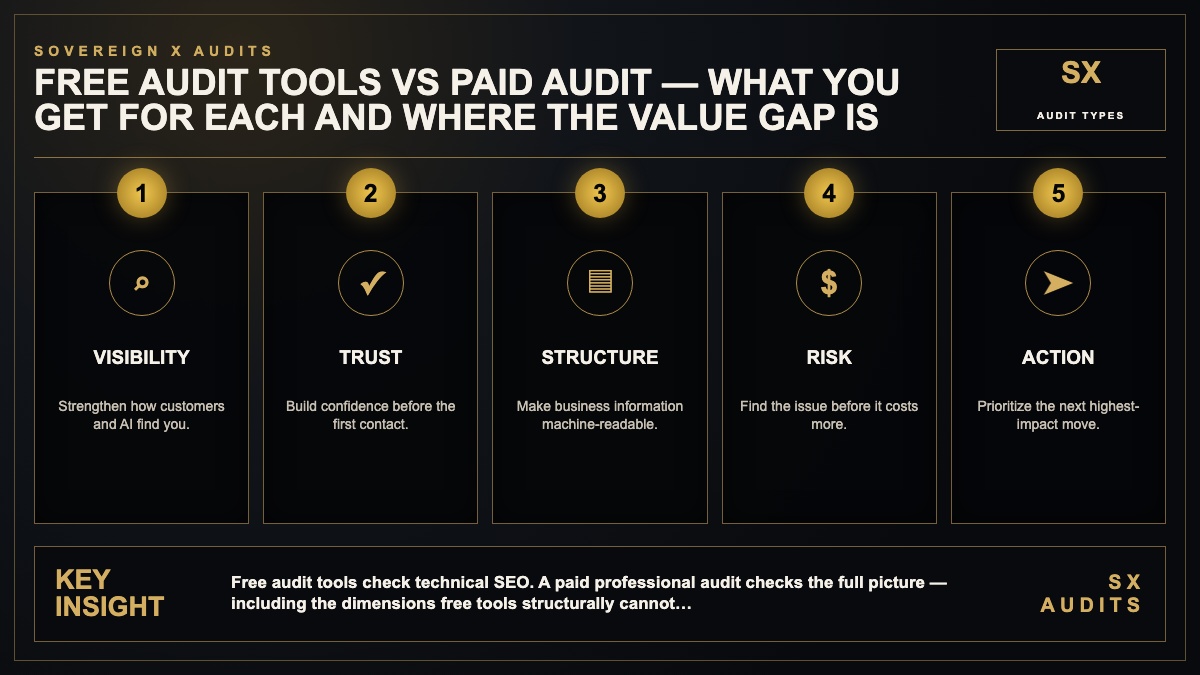
Free Audit Tools vs Paid Audit — What You Get for Each and Where the Value Gap Is
A veterinary practice in Sacramento ran their website through three free tools before concluding their digital presence was in reasonable shape. Google Search Console showed no critical errors. PageSpeed Insights returned acceptable scores. Screaming Frog's free version confirmed no broken links on the site's 40 pages. The tools agreed: no critical problems.
When the practice manager asked why a competitor with a lower-traffic website was consistently appearing in ChatGPT recommendations for "veterinarian Sacramento" and they were not, no free tool could provide an answer. The questions that mattered most — about schema configuration, AI platform visibility, NAP consistency across directories, GBP category accuracy — were outside the scope of every tool they had used.
The tools hadn't lied. They had correctly reported what they were designed to measure. The problem was not in what the tools reported; it was in what they couldn't see.
What Free Tools Actually Check
The most useful free audit tools available today cover a specific and valuable scope. Google Search Console: indexation status, crawl errors, manual action penalties, Core Web Vitals, and organic search performance. Google PageSpeed Insights: page load performance, Core Web Vitals scores, and mobile usability. Screaming Frog (free tier, up to 500 URLs): broken links, redirect chains, missing meta tags, duplicate content, and basic on-page issues. Google's Rich Results Test: whether existing structured data validates correctly. GTmetrix: page speed analysis and performance waterfall.
These tools are not inadequate tools. They are accurate tools with a defined scope. That scope is: technical website performance. They detect what is wrong with a website. They do not detect what is missing from the full digital presence.
Free Tools Detect Errors; They Do Not Audit What Isn't There
The most consequential digital visibility problems for small businesses are often absences, not errors. Your website may have no broken links, no crawl errors, and no manual penalties — and simultaneously have no schema markup, no AI platform visibility, and NAP inconsistency across twelve directories. Free tools detect that something is wrong. They cannot detect that something critical is not there. Schema markup is not present at all on most small business websites — a free tool scan returns nothing wrong, because there is nothing to scan. The absence is invisible to the tool. A professional audit specifically checks for the structural elements that must be present for AI citation and local discovery, identifying what is missing rather than only what is broken.
68% Of SEO Professionals Consider Premium Tools Essential — And They Still Miss The AI Layer
A 2023 survey found that 68% of SEO professionals consider premium platforms essential for comprehensive audits. Those premium platforms — Semrush, Ahrefs, Screaming Frog paid tier — provide substantially deeper technical coverage than free tools: larger crawl volumes, competitive analysis, backlink profiling, and prioritized recommendation outputs. What even premium self-service tools do not provide: a manual AI visibility test across ChatGPT, Perplexity, and Google AI Overviews running standardized query sets; a 30+ directory NAP consistency check; GBP category accuracy verification; and an interpretive diagnosis that identifies not just what the data shows but what it means for the specific business's lead acquisition. The data gap between free and paid tools is significant. The gap between any self-service tool and a professional audit is different in kind, not just degree.
The Interpretation Gap Is As Large As The Coverage Gap
Free tools return lists. Professional audits return diagnoses. PageSpeed returns a score of 63. A professional audit identifies that the score is driven by an uncompressed hero image, that the actual user impact is minimal on the practice's service area (high-bandwidth urban area), and that three other findings in the audit — GBP category mismatch, absent schema markup, and zero AI platform citations — are substantially more likely to be suppressing leads than the page speed score. Prioritization is the interpretation layer. Free tools and self-service platforms output data; professional auditors convert data into a prioritized action sequence aligned with the specific business's growth objectives.
Free Tools Validate What You Have; They Don't Find What You're Missing In AI Search
Nearly 50% of Google searches now include an AI Overview. AI search traffic grew over 600% between January 2025 and early 2026. Companies with strong AI visibility see 23% higher organic traffic growth than those with limited AI presence. None of this can be assessed with free tools. AI visibility requires manually running standardized query sets across platforms, recording citation frequency and sentiment, assessing schema markup for entity recognition, evaluating third-party citation quality, and benchmarking against competitors who are appearing. Enterprises typically use five to seven different tools for comprehensive audits — and none of those tool stacks, on their own, replicate the combination of AI platform testing, entity diagnosis, and interpretive prioritization that a professional audit delivers.
The Cost-benefit Calculation Favors Professional Audit For Any Business Where Leads Have Value
A professional digital audit costs a defined amount. Free tools are free. The question is not which option spends less money — it is which option finds the problems that are costing leads. For a professional service business where a single new client is worth $3,000 to $50,000 in annual revenue, the question is whether any of the critical AI visibility, GBP, or NAP issues a professional audit finds — and free tools don't — would account for even one missed client per quarter. For most businesses in competitive categories, the answer is yes by a substantial margin. The cost of a professional audit is not an expense. It is the diagnostic fee that precedes the largest revenue recovery opportunity in the business's digital infrastructure.
Tool Comparison: What Each Covers
| Capability | Free Tools | Premium Self-Service Tools | Professional Audit | |---|---|---|---| | Website crawl (errors, broken links) | ✓ | ✓ | ✓ | | Page speed & Core Web Vitals | ✓ | ✓ | ✓ | | Backlink profile | ✗ | ✓ | ✓ | | Keyword rankings | ✗ | ✓ | ✓ | | Schema markup validation | Basic | Partial | ✓ Full | | Google Business Profile audit | ✗ | ✗ | ✓ | | NAP consistency (30+ directories) | ✗ | ✗ | ✓ | | AI platform visibility testing | ✗ | ✗ | ✓ | | Prioritized action sequence | ✗ | Partial | ✓ | | Third-party citation analysis | ✗ | ✗ | ✓ |
Want to know exactly where your business stands with AI search?
We run the full diagnostic and deliver a findings report in 72 hours. No discovery call. No commitment.
Book the Audit →Related intelligence · selected for this topic
Framework developer and systems thinker specializing in AI implementation and decision architecture. Creator of the AI Council methodology — a structured multi-model framework used to surface deeper insights in complex decisions. The audit intelligence at Sovereign X Audits is built on these same principles.
aicouncilconductor.com →Find out exactly where your business stands.
We audit your digital infrastructure, AI visibility, and brand presence — and show you exactly what it's costing you.