What Voice Agent Compatibility Means and Why Your Audit Should Include It
A property management company in Phoenix decided to implement an AI voice agent. The decision made business sense: 200+ calls per week, 60% of them routine inquiries about availability and maintenance requests, a receptionist who was frequently on hold when a second call came in.
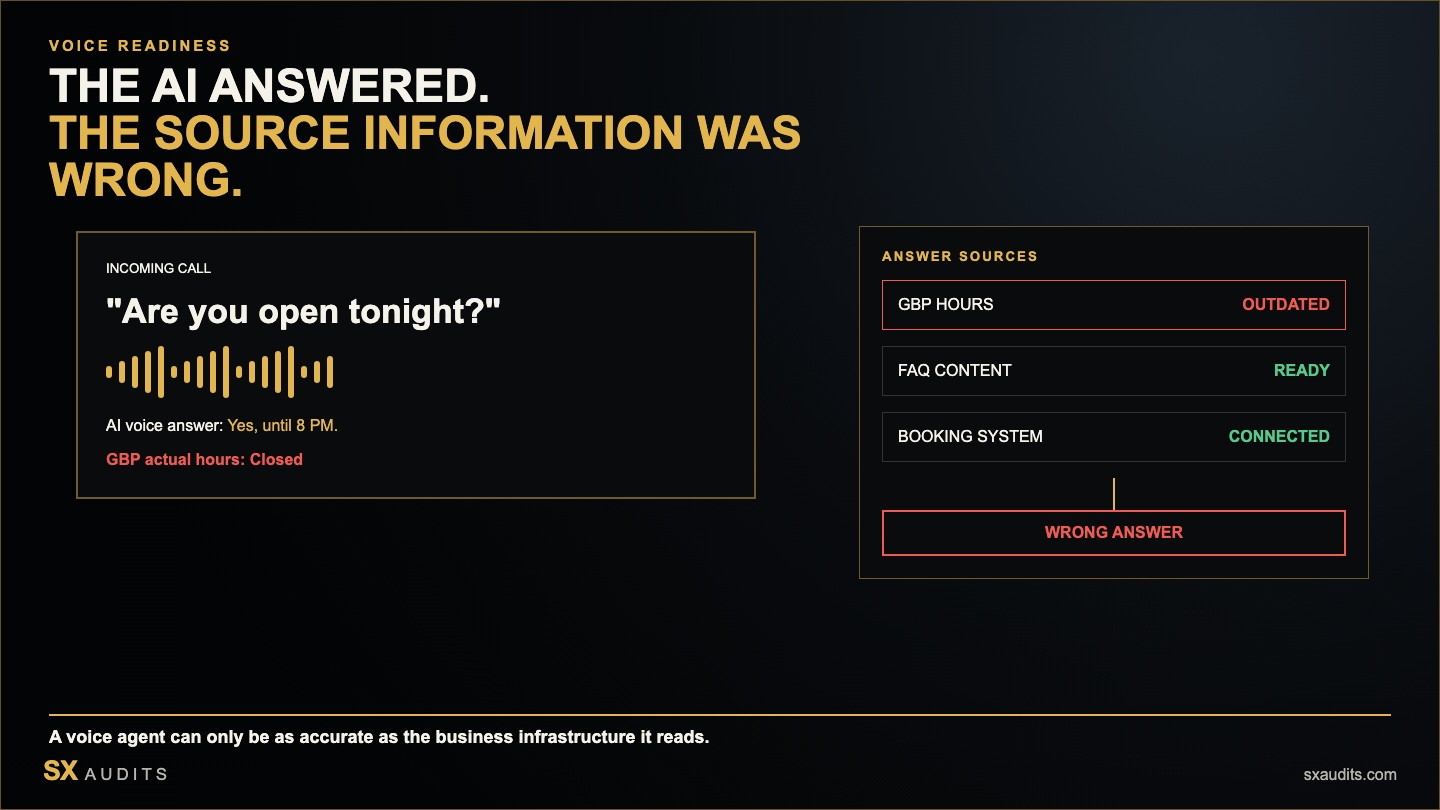
They contracted an AI voice platform at $249 per month. The implementation went technically. The agent answered calls. And then the problems began: the agent gave callers incorrect hours because the AI was pulling from a Google Business Profile that had never been updated since the company expanded its service hours. It referenced a service fee the company had changed eight months earlier. When callers asked about properties in a specific neighborhood, the agent couldn't answer because the website had no structured content about service areas.
The AI voice agent was functional. The infrastructure it was drawing from was not.
What Voice Agent Compatibility Actually Means
AI voice agents draw information from the same digital infrastructure signals that determine AI search visibility: Google Business Profile attributes, schema markup on the website, FAQ content structure, and the consistency of information across third-party sources. A voice agent that answers "what are your hours?" pulls from GBP if that's the most accessible structured source. A voice agent that answers "what areas do you serve?" pulls from service area schema or structured content on the website. A voice agent that provides pricing information may reference data it encountered in training or real-time web access — which means the accuracy depends on whether that information is current, consistent, and structured in a way the AI can reliably access.
Voice agent compatibility is the assessment of whether a business's digital infrastructure is configured to support accurate, consistent, and useful AI voice responses — before the voice agent is deployed.
Most AI Voice Implementations Fail For Infrastructure Reasons, Not Technology Reasons
The AI voice agent technology itself is mature. Sub-one-second response times, 57+ language capability, calendar integration, CRM sync — the technology performs reliably for routine call handling. The failure modes are almost always infrastructure: outdated GBP information feeding the agent incorrect data, unstructured website content that the agent cannot access for service inquiries, no FAQ schema that allows the agent to answer common questions with consistency, and incomplete or conflicting NAP data that causes the agent to give different answers to the same caller on different days. Voice agent compatibility auditing identifies these infrastructure gaps before they become failure modes.
The Same Schema That Supports AI Citations Supports Voice Agent Accuracy
The structured data configuration that allows ChatGPT and Perplexity to accurately describe a business is the same configuration that allows an AI voice agent to accurately answer questions about that business. LocalBusiness schema with accurate service area, hours, and contact information; FAQ schema on service pages; consistent NAP across authoritative directories; and a GBP with complete and current attributes — these are the infrastructure components that both AI citation and AI voice accuracy depend on. A business that has configured for AI search visibility is substantially closer to AI voice compatibility than one that has not.
The Average Small Business Loses $126,000 Annually From Missed Calls — Voice Compatibility Determines Whether AI Answering Recovers That Revenue
The business case for AI voice agents is compelling: $126,000 in average annual revenue lost from missed calls, an AI agent that answers every call on the first ring at $49 to $299 per month, and 70 to 80 percent of routine calls that AI can handle without human intervention. But the revenue recovery from AI voice implementation is only achievable if the agent is giving accurate, useful answers. An AI voice agent that gives callers wrong hours, incorrect service information, or incomplete responses to basic inquiries does not recover missed call revenue — it creates missed call revenue from a different failure mode. Voice compatibility auditing is what ensures the implementation works.
Voice Compatibility Auditing Has Three Components
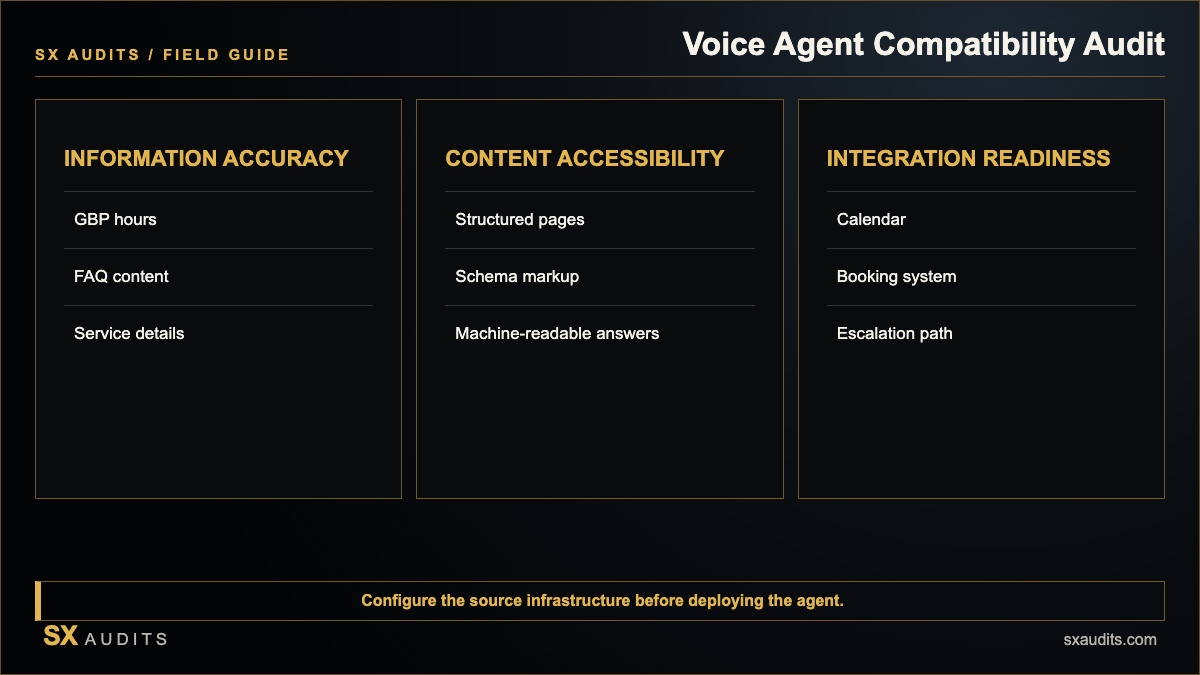
A voice compatibility assessment evaluates three dimensions. Information accuracy: Is the GBP, website FAQ content, and structured schema current and consistent with actual business operations? Will an AI voice agent drawing from these sources give callers accurate information? Content accessibility: Is the information an AI voice agent would need to handle routine inquiries — hours, services, pricing, service area, booking process — structured in a way that AI systems can reliably access and interpret? Integration readiness: Does the business's calendar, booking system, or intake process have the technical configuration to support direct AI voice integration — or would the agent's routing capabilities have no functional target to route to?
Voice Compatibility Is The Emerging Frontier Of Digital Infrastructure Audit
Most digital audits do not assess voice compatibility. The assessment is new enough that methodology for it is not yet standard in the audit industry. This is a gap with real cost: businesses that deploy AI voice agents on unaudited infrastructure incur the full implementation cost and receive partial or negative results. Businesses that audit voice compatibility before implementation configure the infrastructure correctly, then deploy — and recover the call revenue the agent is designed to capture. SX Audits includes voice compatibility assessment as part of the full digital and AI readiness audit because the infrastructure requirements overlap substantially, and because the cost of deploying without the assessment is high.
What a Voice Compatibility Assessment Checks
GBP accuracy: Are hours, services, service area, contact information, and special attributes current and consistent?
FAQ content structure: Is common inquiry information — booking process, pricing, service types, service area, prerequisites — present on the website in a format accessible to AI?
Schema markup for voice: Is LocalBusiness schema, FAQ schema, and service schema configured with enough detail and accuracy to support AI voice response generation?
NAP consistency: Is the business's name, address, and phone number consistent across the sources an AI voice agent would reference?
Integration readiness: Does the calendar or booking system support direct AI integration? Is there a structured intake pathway the voice agent can route callers to?
Want to know exactly where your business stands with AI search?
We run the full diagnostic and deliver a findings report in 72 hours. No discovery call. No commitment.
Book the Audit →Related intelligence · selected for this topic
Framework developer and systems thinker specializing in AI implementation and decision architecture. Creator of the AI Council methodology — a structured multi-model framework used to surface deeper insights in complex decisions. The audit intelligence at Sovereign X Audits is built on these same principles.
aicouncilconductor.com →Find out exactly where your business stands.
We audit your digital infrastructure, AI visibility, and brand presence — and show you exactly what it's costing you.