Why Most Audits Deliver a PDF and Disappear
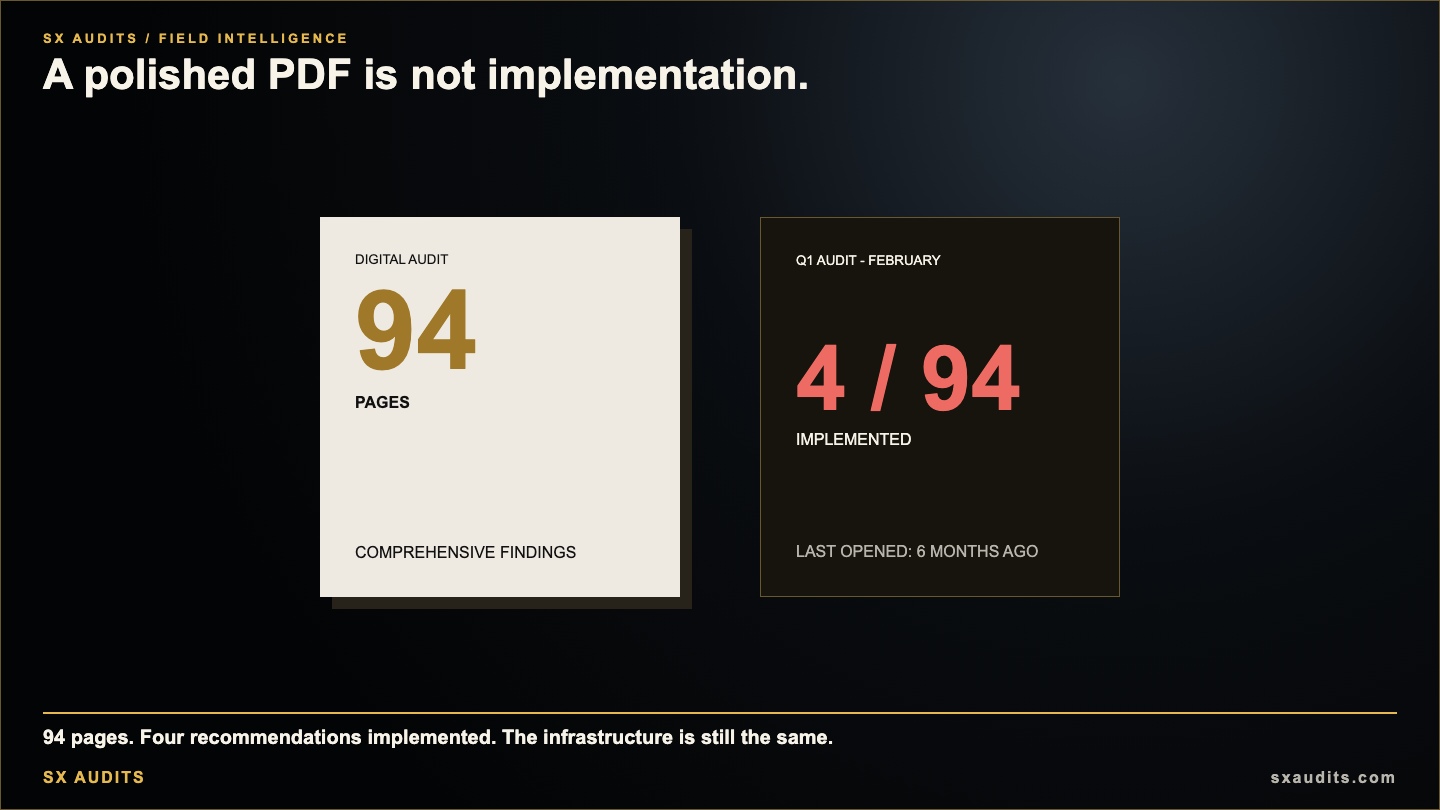
A marketing director at a dental group in Phoenix received a 94-page audit report in February. It was detailed, well-formatted, and visually professional. It covered technical SEO, content gaps, backlink opportunities, social presence, and competitive positioning. She read it over a weekend. She highlighted the sections that seemed most urgent.
By April, two of the sixty-three recommendations had been implemented. By August, four. By the following February, the report was in a folder on her desktop, largely unimplemented, and the firm had just commissioned a new audit from a different provider.
This is the standard audit outcome. The report is delivered. The findings are real. The implementation doesn't happen — and the provider, having delivered the document, has fulfilled their engagement.
Why the PDF Model Fails
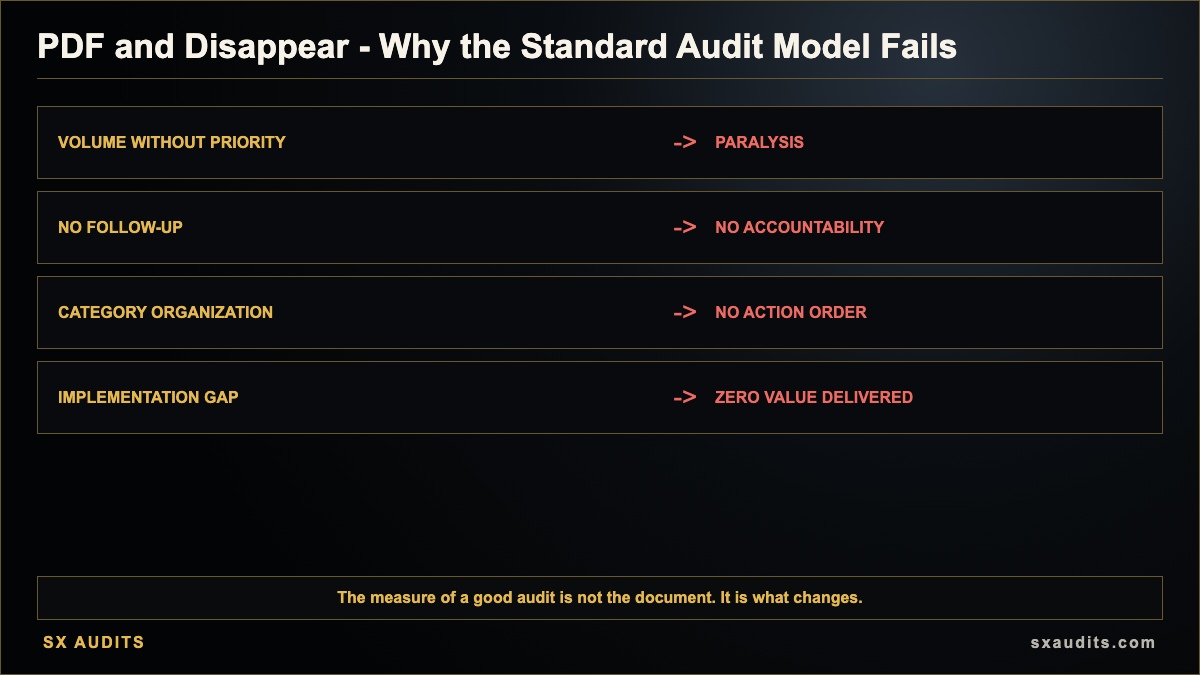
The PDF audit model has a structural problem: it confuses delivery with value. The value of a digital audit is not the document. It is the infrastructure improvement that the document was supposed to produce. A 94-page report delivered and unimplemented has produced no value — the infrastructure is in the same state it was before the audit, and the client has spent money, time, and attention to receive a file they couldn't act on.
This happens for predictable reasons. The audit is produced at the level of ambition of the audit — which is designed to show comprehensiveness and justify the fee. A comprehensive report generates comprehensive overwhelm. Sixty-three recommendations with no priority sequence, no implementation timeline, and no follow-up mechanism is not a plan. It is a list. Lists do not get implemented.
The second reason: audit firms are not accountable for implementation. Their engagement ends at delivery. Their incentive is to produce a document that looks thorough and professional — not one that is actionable and complete. Thoroughness and actionability are different qualities. The 94-page report may be thoroughly thorough and thoroughly difficult to act on simultaneously.
The Average Digital Audit Implementation Rate Is Well Below 50%
Research across the audit and consulting engagement category consistently finds that fewer than half of audit findings are implemented within twelve months of delivery. The more recommendations in a report, the lower the implementation rate — not because clients are irresponsible, but because volume without prioritization is paralyzing. A report that identifies 63 issues is not three times more actionable than a report that identifies 21 issues. It is likely less actionable, because the cognitive load of determining where to start exceeds what a non-specialist client can navigate without further guidance.
Prioritization Is The Missing Element In Most Audit Deliverables
The dental group's marketing director could not determine which three of the sixty-three recommendations to implement first to produce the greatest improvement in new patient acquisition. The audit did not tell her — it listed findings by category, not by business impact. The correct audit deliverable is not a comprehensive list of everything that is imperfect. It is a prioritized sequence of the three to five fixes that produce the greatest improvement in the metric the client cares about most. Everything else is secondary. Prioritization is not a formatting choice — it is the difference between an audit that produces action and one that produces a folder.
Sx Audits Delivers Findings In The Order They Should Be Implemented
The deliverable from an SX Audit is not organized by audit category (technical, content, GBP, AI, etc.). It is organized by business impact — the most consequential finding appears first, with the implementation action clearly stated, the expected timeline for impact noted, and the supporting detail available for context. A client receiving this deliverable does not need to read the whole document before acting. The first item is the first action. The second item is the second action. The sequence is the plan.
Follow-up Audit Accountability Replaces Ongoing Retainer Dependence
The standard model for generating ongoing value from an audit is to sell a retainer: monthly check-ins, quarterly reporting, ongoing optimization. This model benefits the agency more than the client — it creates dependency rather than capability. SX Audits' model uses a follow-up audit at 60 to 90 days post-implementation as the accountability mechanism: were the priority fixes implemented? What did they produce? What has drifted since the initial audit? What is the next priority? This creates a point-in-time accountability cadence without an ongoing contract — and it means the follow-up audit is diagnostic rather than performative.
The Measure Of A Good Audit Is Not The Document; It Is What Changes
The marketing director's 94-page report was impressive. It was not useful. The measure of a useful audit is not the quality of the document — it is whether the client's digital infrastructure is in a better state three months after receiving it. An audit that produces four implemented recommendations out of sixty-three has produced four units of improvement. An audit that produces three prioritized, clearly specified, immediately actionable recommendations with a follow-up diagnostic at 60 days has produced three units of improvement — and a mechanism to ensure they were implemented and to identify the next three. Volume of findings is not correlated with improvement in infrastructure.
What SX Audits Delivers Instead
A prioritized finding sequence: The most impactful fix first, with the specific action required, the expected scope of impact, and a realistic implementation timeline. Not organized by audit category — organized by business impact.
Implementation-ready specification: Each priority finding includes enough specificity to implement without further consultation. What to fix, how to fix it, and what outcome to expect. Not a recommendation to "improve schema markup" — a specific identification of what schema is missing, what it should contain, and how to configure it.
A 72-hour delivery commitment: The findings arrive when the client can act on them — not weeks after the moment of decision. Speed is a quality signal. A firm that takes three weeks to deliver audit findings is a firm that has not built the methodology for efficient diagnosis.
A follow-up audit window: At 60 to 90 days post-implementation, a follow-up diagnostic confirms what improved, identifies any new drift, and establishes the next priority. The first audit is not a one-time transaction — it is the beginning of an infrastructure improvement cadence.
Want to know exactly where your business stands with AI search?
We run the full diagnostic and deliver a findings report in 72 hours. No discovery call. No commitment.
Book the Audit →Related intelligence · selected for this topic
Framework developer and systems thinker specializing in AI implementation and decision architecture. Creator of the AI Council methodology — a structured multi-model framework used to surface deeper insights in complex decisions. The audit intelligence at Sovereign X Audits is built on these same principles.
aicouncilconductor.com →Find out exactly where your business stands.
We audit your digital infrastructure, AI visibility, and brand presence — and show you exactly what it's costing you.