Why We Don't Do Discovery Calls Before Delivering Your Audit
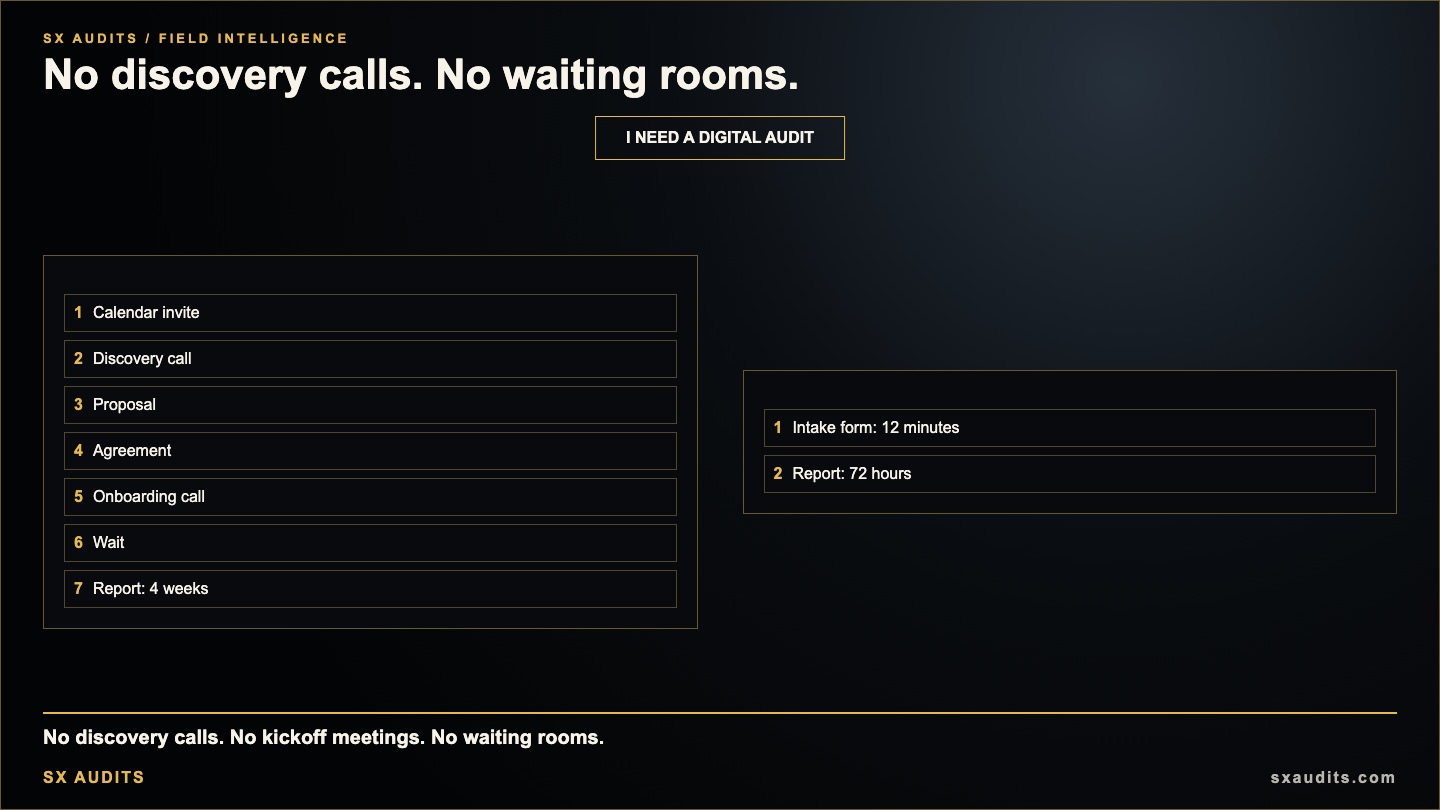
A business development consultant in San Francisco had been considering commissioning a digital audit for several months. Every time she looked into it, the process was the same: book a discovery call, have a 45-minute conversation about her business goals and history, wait a week for a proposal, sign an agreement, wait for an onboarding call, then wait another two to three weeks for a report.
By the time anything useful arrived, she had spent a month and several hours in meetings — none of which had produced anything actionable. The friction was enough that she kept putting it off.
She found our intake form. Filled it out in 12 minutes. Received her audit in 68 hours.
No call. No meeting. No waiting room.
What a Discovery Call Is Actually For
Discovery calls serve a legitimate purpose in certain service contexts — particularly those that require deep customization, extended engagement, or complex scoping before any meaningful work can begin. A year-long brand strategy engagement needs a discovery call. A custom software development project needs a discovery call. A digital audit does not.
A digital audit evaluates your business's public-facing digital presence against a structured set of criteria. The evaluation framework does not change based on your business history, your marketing goals, or your past agency experience. The criteria being evaluated — schema markup, NAP consistency, GBP completeness, AI visibility, trust signals — are the same for every business in every industry. What changes is the specific findings. And those findings come from the audit itself, not from a conversation about your business.
A discovery call before an audit is asking a business to explain their problem before receiving the diagnosis. It is the equivalent of a diagnostic lab requiring you to explain your symptoms before they run the tests.
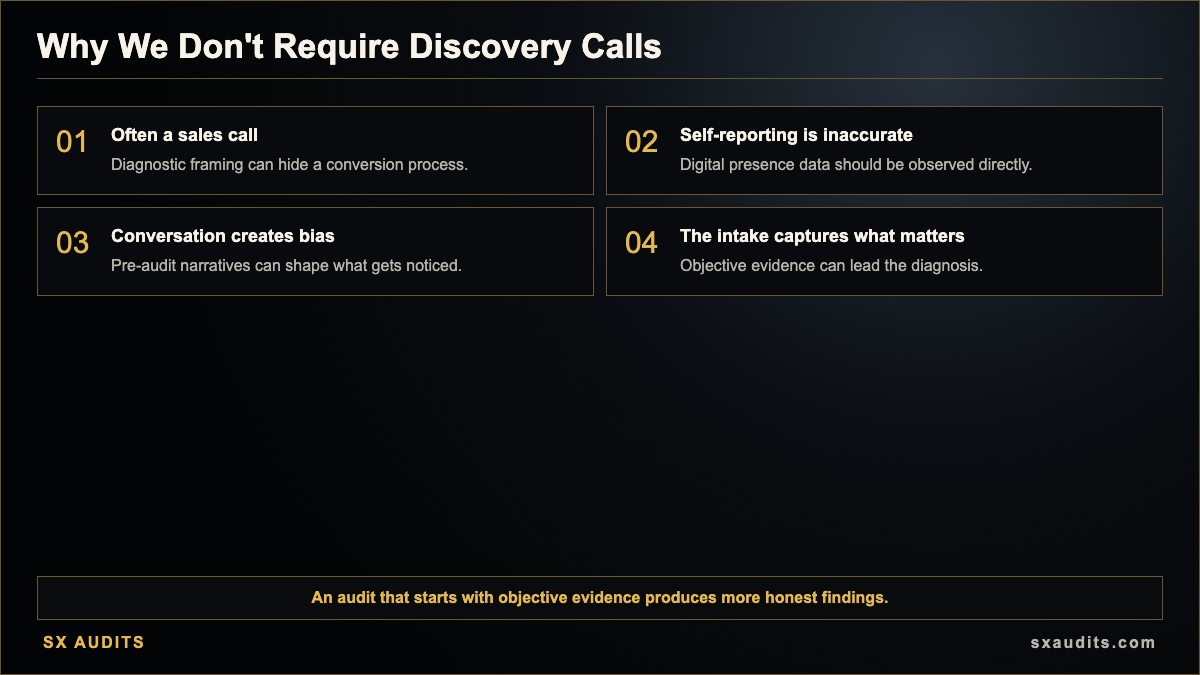
Discovery Calls Are Often Sales Calls In Diagnostic Framing
The primary function of a pre-audit discovery call at many agencies is qualification — determining whether the prospect has sufficient budget for the proposed engagement, whether the scope justifies the retainer, and whether the business represents the right profile for an extended client relationship. This is a legitimate business development process, but it is not a precondition for delivering useful audit findings. When the audit itself is the deliverable — not a retainer, not an ongoing engagement — there is no scoping required and no qualification threshold.
Pre-audit Conversations Can Introduce Confirmation Bias
When a business owner explains their digital challenges in a discovery call — "I think my GBP is the main issue" or "we've been told our website needs to be rebuilt" — they are providing framing that can influence the shape of the audit that follows. An auditor inclined toward relationship management may emphasize findings that confirm the client's existing beliefs rather than surfacing the actual highest-priority issues. The most honest audit is one that starts with the objective evidence — what is actually broken in the public-facing presence — without the prior influence of the business owner's pre-existing theory.
The Intake Form Captures What Actually Needs To Be Known
The information that materially affects a Sovereign X audit is limited: your business name, primary website URL, and the city or market you primarily serve. This information can be captured in a form. It does not require a call. Everything else the audit needs — your GBP listing, your schema configuration, your directory consistency, your review profile, your AI citation patterns — is available publicly and is more accurately assessed by direct evaluation than by a business owner's self-reported account of their digital presence.
Eliminating Friction Is A Commitment To The Client's Time
A discovery call, a proposal, and an onboarding meeting consume 2–3 hours of the client's time before they have received anything useful. For a professional services practitioner whose time is their primary asset, that is a material cost. The no-call approach is not primarily a competitive positioning choice — it is a value statement about whose time matters in the service relationship. You have a visibility problem. You need a diagnosis. You should be able to receive one without investing your hours in process overhead.
Self-reported Data About Digital Presence Is Often Inaccurate
Business owners frequently underestimate the severity of their visibility problems and overestimate what they have in place. This is not because they are uninformed — it is because most digital infrastructure issues are invisible without specific technical evaluation. A business owner who believes their NAP is consistent has likely never checked it across 30 directories. A business owner who believes their schema markup is in place may have installed a plugin that appeared to work but is producing structured data errors. A business owner who believes their GBP is active and verified may have a profile that has been in an unverified state for months. The audit tells the truth. A discovery call collects the business owner's beliefs about the truth — which is a less reliable starting point.
How Our Process Works Instead
Step 1 — Intake form (12 minutes) You provide your business name, website URL, primary market, and industry. That is all we need to begin.
Step 2 — Audit (hours 1–72) We run your public-facing digital presence through our structured evaluation framework. AI platform testing, schema audit, NAP consistency check, GBP assessment, trust signal review, first-page brand audit.
Step 3 — Report delivery You receive a scored report with findings organized by priority and impact. Each finding includes a specific description of the issue, the revenue or visibility cost estimate, and the recommended action.
Step 4 — If you have questions The report is designed to be self-explanatory. If you have specific questions about findings, those can be addressed directly without requiring a scheduled call. But most clients have what they need to act on the report immediately upon receiving it.
Want to know exactly where your business stands with AI search?
We run the full diagnostic and deliver a findings report in 72 hours. No discovery call. No commitment.
Book the Audit →Related intelligence · selected for this topic
Framework developer and systems thinker specializing in AI implementation and decision architecture. Creator of the AI Council methodology — a structured multi-model framework used to surface deeper insights in complex decisions. The audit intelligence at Sovereign X Audits is built on these same principles.
aicouncilconductor.com →Find out exactly where your business stands.
We audit your digital infrastructure, AI visibility, and brand presence — and show you exactly what it's costing you.