What Most Digital Audits Miss — and Why It Costs Businesses More Than the Audit Itself
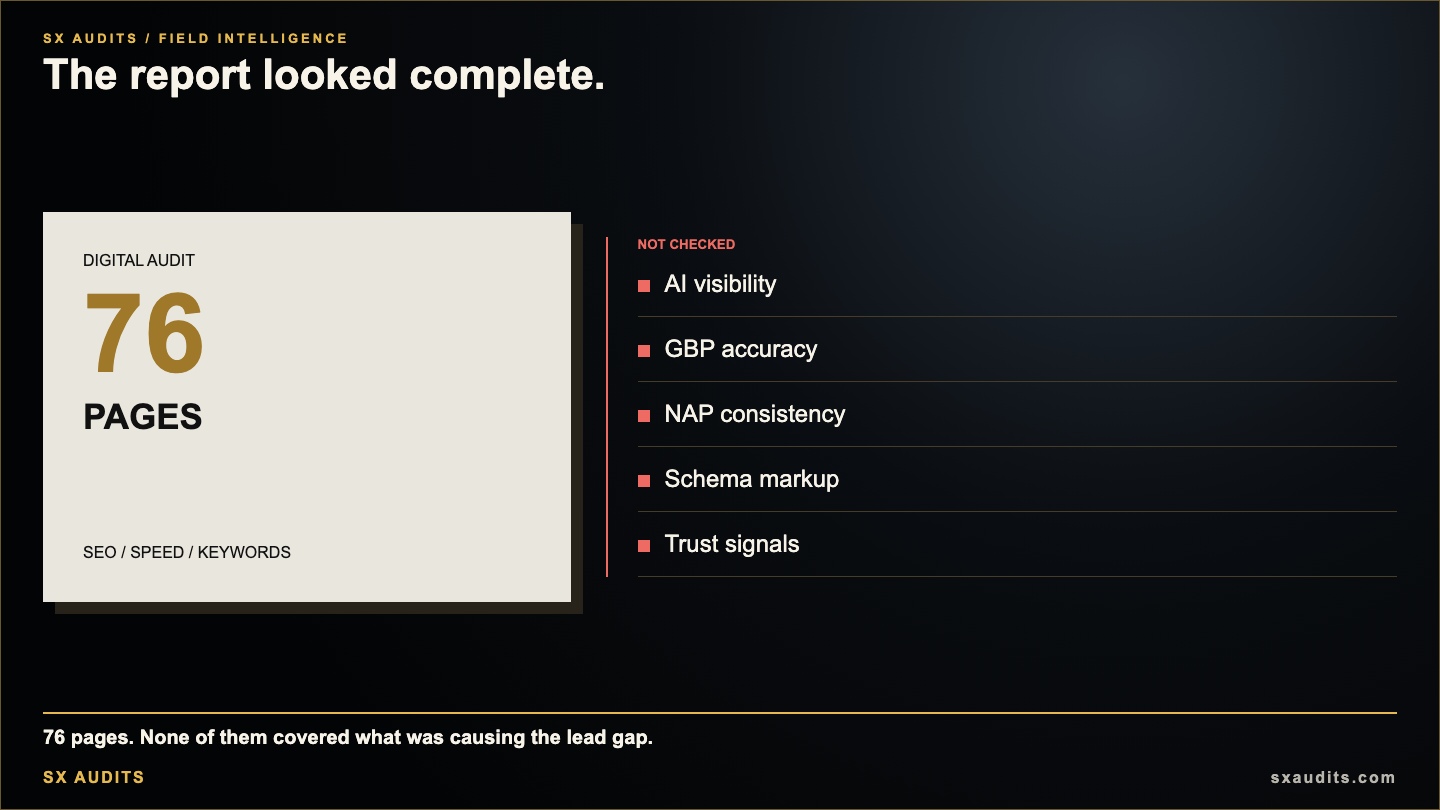
A pain management specialist in Houston received a comprehensive digital audit in January. The report was 76 pages. It covered technical SEO, content gaps, page speed, backlink opportunities, and social media presence. The practice implemented most of the technical recommendations. Their Google organic ranking improved modestly.
New patient inquiries did not respond in proportion to the work. In a follow-up conversation, the specialist asked: "What did the audit miss?"
The answer was everything that was actually causing the lead gap:
Her GBP was showing a specialty category from a previous employment — pain medicine rather than interventional pain management — causing her to appear in wrong-category recommendations. She had zero AI platform citations for any relevant query in her metro area. Her NAP was inconsistent across nine directories, with three variants of her practice name from a name change two years prior. Her website had no schema markup. Three years of review responses had been left unanswered.
None of these findings were in the 76-page audit. None of them were in any scope that a standard SEO audit is designed to cover. And each of them was more consequential for new patient acquisition than any of the findings that had consumed 76 pages.
The Five Dimensions Standard Audits Miss
1. AI Platform Visibility
Standard digital audits evaluate Google organic search performance. They were designed before ChatGPT processed 900 million queries per week and before AI platforms became a primary channel for high-intent professional service recommendations. An audit that does not test how a business appears in ChatGPT, Perplexity, and Google AI Overviews is not auditing the discovery channels that increasingly determine whether high-value new clients even encounter the business. This is the largest gap in standard audit methodology — the channel with the highest conversion rate (4.4× organic) is not being checked.
2. GBP Completeness and Category Accuracy
Your Google Business Profile drives 44% of clicks in local searches through the Maps pack. It is the primary trust verification source for 63.6% of consumers who check reviews before contacting a business. Standard SEO audits check website technical health. They typically do not conduct a thorough GBP audit: category accuracy, completeness of services and attributes, Q&A status, review response patterns, post activity, and the consistency between GBP information and website information. The pain management specialist's wrong specialty category had been quietly directing referral traffic to the wrong type of provider for two years.
3. NAP Consistency Across 30+ Directories
Only 30% of small businesses have consistent Name, Address, and Phone information across major directories. Data aggregators routinely re-introduce old variants when business information changes — a name change, an address update, a phone number modification. A business that changed its name two years ago may still have the old name in a dozen directories, suppressing Google Maps ranking, reducing AI citation confidence, and creating trust gaps for prospective clients who encounter conflicting information. Standard SEO audits flag NAP as a concept. A comprehensive audit actually checks 30+ directories and data aggregators.
4. Schema Markup for AI Entity Recognition
Schema markup is the structured data that allows AI systems to understand what a business is, what it does, where it does it, and why it should be cited in recommendations. Without schema markup, AI systems must infer entity information from unstructured text — and inference produces lower citation confidence and lower citation frequency than direct structured data. Standard technical SEO audits may check whether schema markup validates correctly. They do not assess whether the schema markup present is configured for AI entity recognition: LocalBusiness or Person schema with correct entity declarations, service schema with specialty information, FAQ schema with direct-answer content.
5. Trust Signal Infrastructure
97% of consumers research a business online before contacting it. What they find during that research — the review profile, the response pattern, the completeness of business information across platforms, the consistency of brand signals — determines whether they contact the business. Three years of unanswered reviews is not a minor cosmetic issue. It is a pattern that tells every prospective client who researches the practice that the practice does not engage with its clients. Unanswered reviews, incomplete review profiles, and inconsistent brand signals across directories are trust signal gaps that standard SEO audits rarely surface as priority findings.
Most Standard Audits Were Built For A 2018 Discovery Environment
The standard digital audit framework — technical SEO, on-page optimization, backlink profile, content gaps — was designed to evaluate performance in Google's traditional blue-link organic search results. This was an appropriate scope in 2018. In 2026, traditional organic search is one of four active discovery channels alongside AI platform recommendations, AI Overviews within Google results, and local Maps pack results. An audit that only checks the traditional organic channel is checking 25% of the discovery environment that prospective clients are actually using. The missed 75% is where the high-value lead suppression is occurring.
The Gaps Are More Consequential For Professional Services Than For E-commerce
E-commerce businesses primarily compete for search volume — organic rankings and paid traffic determine which seller gets the click. Professional service businesses compete for recommendation and referral — who does ChatGPT name when someone asks for an accountant in their city, who appears in the Maps pack when someone searches for a lawyer after an accident, whose review profile convinces a prospective patient to call rather than continuing to the next result. The AI visibility, GBP, NAP, and trust signal dimensions that standard audits miss are particularly consequential for professional services because they are the primary signals in recommendation and referral-based discovery.
The Cost Of The Missed Dimensions Is Compounding
A missed AI citation opportunity is not a one-time loss. Every month that AI platform absence continues is a month of high-value leads going to whatever competitor is appearing instead. A GBP with the wrong category is not a static issue — it is an active misdirection of every local search in the wrong category for the entire period it remains incorrect. NAP inconsistency is not just a single misranking — it is a signal to Google's algorithm that the business's identity is uncertain, suppressing Maps rankings for the entire period the inconsistency persists. The cost of missed dimensions compounds monthly. The audit that finds them produces recoveries that also compound.
A Complete Audit Produces A Different Priority Order Than A Standard Audit
The pain management specialist's 76-page audit prioritized a content gap in long-tail keyword coverage and recommended six new service pages to improve organic ranking. The complete audit prioritized fixing the GBP category mismatch, implementing schema markup, achieving NAP consistency, and establishing AI platform visibility — because these were the changes most likely to produce measurable improvement in new patient inquiry volume, and the standard audit findings were substantially lower priority relative to these. A complete audit changes the priority order because it is evaluating the full set of factors determining lead acquisition, not just the subset covered by standard methodology.
The Complete Audit Scope Is Not Larger Because It Is More Thorough; It Is Different
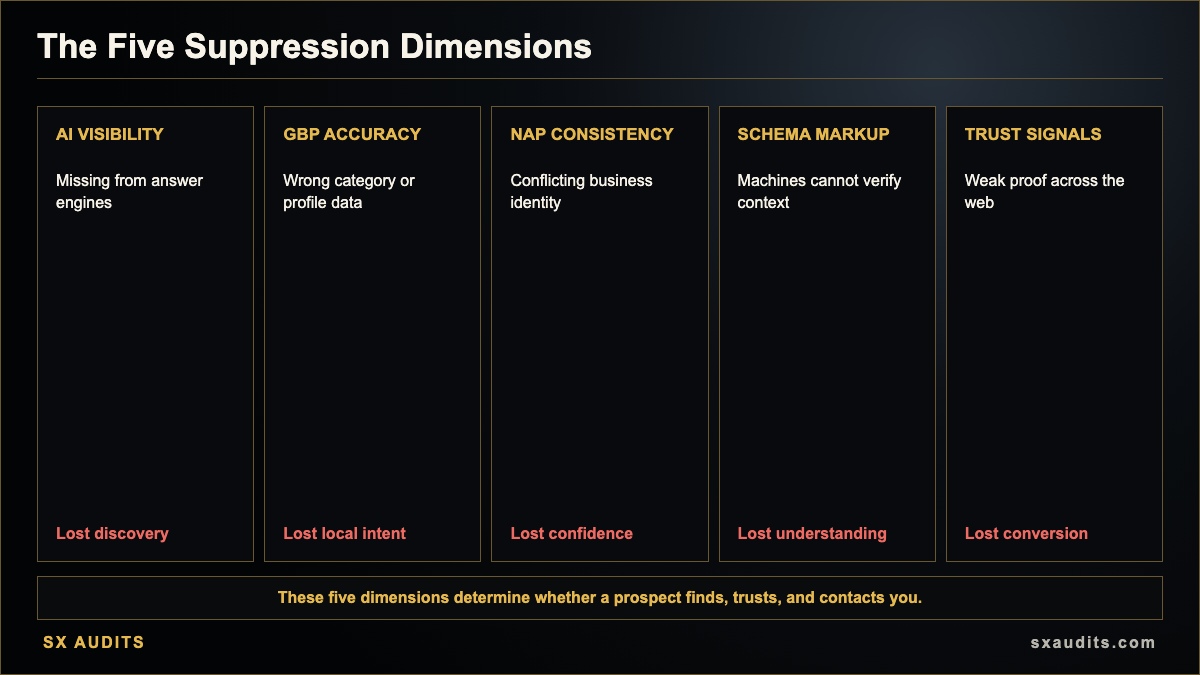
This is not an argument that comprehensive audits should be longer or more expensive than standard audits. It is an argument that the scope of a digital audit should be determined by what actually drives lead acquisition in the current discovery environment — not by what audit methodologies were designed to check in a previous era. An audit that is exceptionally thorough within a narrow scope is not a complete audit. A complete audit covers the full discovery environment: website technical health, AI platform visibility, GBP completeness and accuracy, NAP consistency across 30+ directories, schema markup for AI entity recognition, and trust signal infrastructure. These five dimensions are what determine whether a prospective client finds, trusts, and contacts a business in 2026.
What a Complete Audit Covers
| Dimension | Standard Audit | SX Audit | |---|---|---| | Website technical SEO | ✓ | ✓ | | Organic keyword rankings | ✓ | ✓ | | Backlink profile | ✓ | Partial | | AI platform visibility | ✗ | ✓ | | Schema markup (AI entity config) | Partial | ✓ Full | | GBP completeness and category | ✗ | ✓ | | NAP consistency (30+ directories) | ✗ | ✓ | | Trust signal audit | ✗ | ✓ | | Prioritized lead-impact sequence | ✗ | ✓ |
Want to know exactly where your business stands with AI search?
We run the full diagnostic and deliver a findings report in 72 hours. No discovery call. No commitment.
Book the Audit →Related intelligence · selected for this topic
Framework developer and systems thinker specializing in AI implementation and decision architecture. Creator of the AI Council methodology — a structured multi-model framework used to surface deeper insights in complex decisions. The audit intelligence at Sovereign X Audits is built on these same principles.
aicouncilconductor.com →Find out exactly where your business stands.
We audit your digital infrastructure, AI visibility, and brand presence — and show you exactly what it's costing you.