NAP Consistency: The Audit Every Business Should Run Quarterly
A home services business in the Bronx changed its phone number in 2022. The owner updated the website, updated the GBP, updated the major directories she knew about. She thought she was done.
Three years later, a Sovereign X audit found six platforms still listing the old number — including two with strong domain authority that had been feeding inconsistent signals to Google and AI systems for 36 months. The business had been paying for local SEO during that period. The inconsistency had been quietly working against everything the SEO agency built.
NAP inconsistency is one of the most common and most underestimated visibility problems for small businesses. It is also one of the easiest to fix.
What NAP Consistency Is and Why It Matters
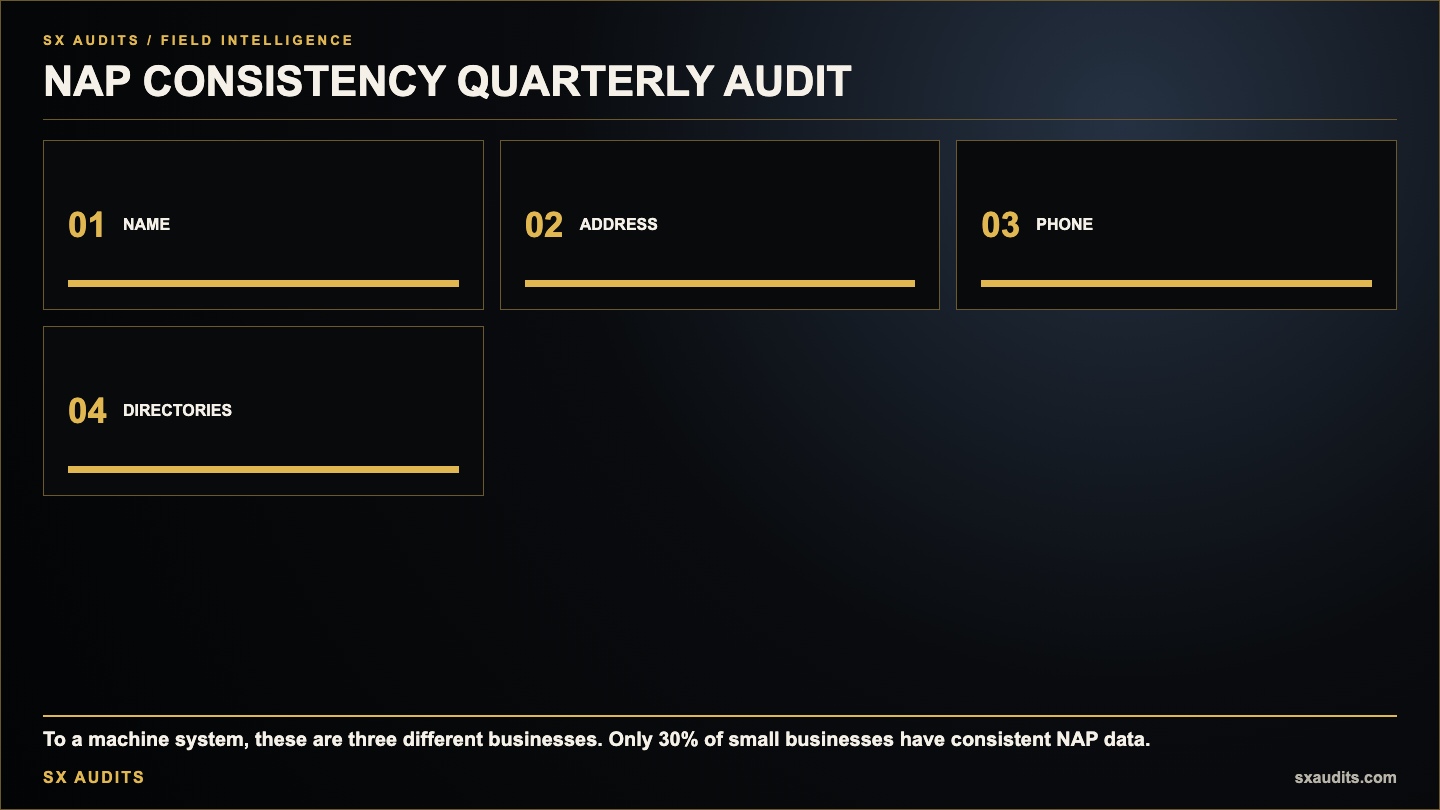
NAP stands for Name, Address, and Phone number. In local SEO and AI visibility, NAP consistency means your business information appears identically — character for character — across every platform where your business exists.
Not approximately the same. Not close. Identical.
"Smith Plumbing" and "Smith Plumbing LLC" are not the same entity to a search engine or AI system. "Suite 4B" and "Ste. 4B" are not the same. A phone number formatted as (718) 555-1234 and 718-555-1234 creates an ambiguity signal for machine systems that are cross-referencing your entity across the web.
Only 30% of small businesses have fully consistent NAP data across major directories.
NAP Inconsistency Suppresses Local Search Rankings
Citation signals — including NAP consistency — contribute approximately 11% of local ranking factors. Businesses with consistent NAP data receive 23% more website clicks from Google than those with inconsistencies. The inverse is also documented: businesses with significant NAP inconsistency can lose up to 68% of potential customer traffic due to the trust ambiguity the inconsistency creates in search systems.
AI Systems Use NAP Cross-referencing As An Entity Verification Step
Before an AI system recommends a business, it cross-references business information across multiple platforms to build confidence in the entity. NAP inconsistency registers as ambiguity. Ambiguity is the primary reason AI systems skip businesses when forming recommendations. A business with a strong website, a complete GBP, and three different phone numbers across five directories is presenting a conflicted entity signal that AI cannot confidently recommend.
Inconsistencies Accumulate Invisibly Over Time
NAP inconsistencies rarely happen all at once. They accumulate: a business moves and updates most but not all listings; a phone number changes and two directories miss the update; a business name is listed differently on different platforms because different employees submitted them at different times. By the time the problem is significant, it has usually been building for years without anyone noticing. This is why quarterly audits are necessary — not because the problem is urgent each quarter, but because unchecked accumulation becomes expensive.
The Most Commonly Missed Platforms
The platforms businesses most frequently forget to update: Apple Maps, Bing Places, Foursquare, data aggregators (Neustar Localeze, Infogroup, Acxiom), and industry-specific directories. Apple Maps is particularly important because iPhone users rely on it by default for navigation. Data aggregators are important because they feed dozens of secondary directories simultaneously — incorrect data at the aggregator level propagates broadly.
The Quarterly Audit Takes Under An Hour
A thorough NAP audit — checking your business information across the 15 to 20 most important platforms — takes under an hour if you know where to look. Many local SEO tools (Moz Local, BrightLocal, Yext) offer NAP audit features that scan hundreds of directories automatically. The manual method works for most small businesses: a spreadsheet, your canonical NAP, and a systematic check of each platform.
The Quarterly NAP Audit Process
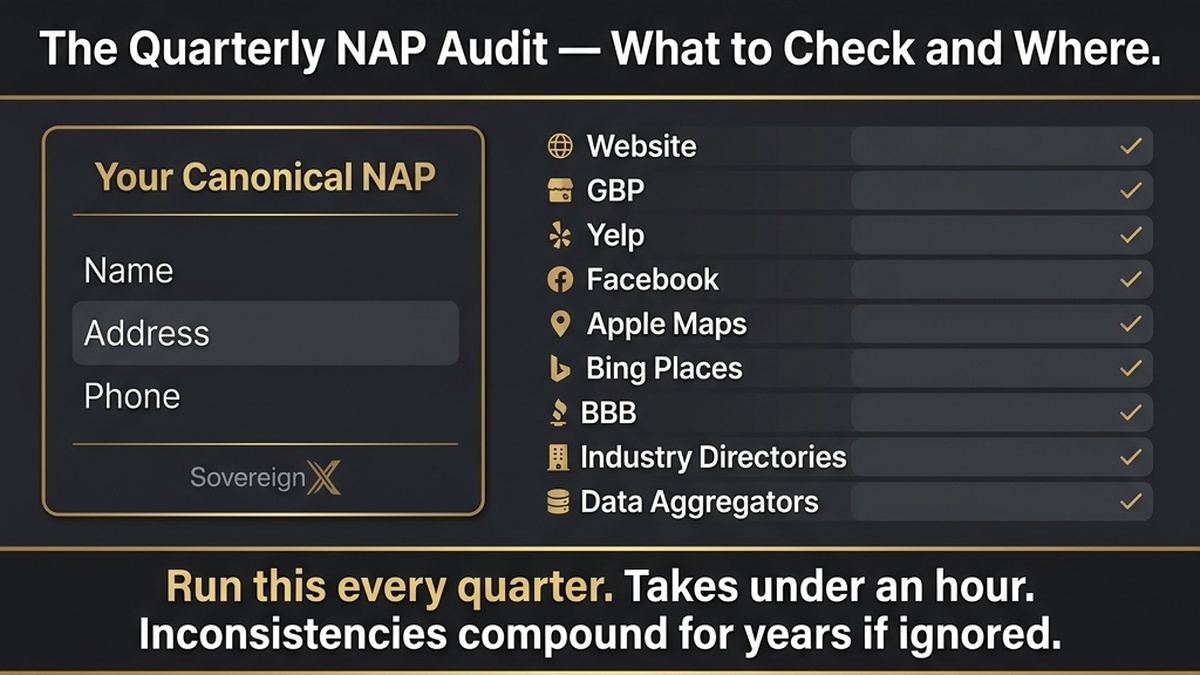
Step 1: Write down your canonical NAP — the exact, official version of your business name, address (including suite number format), and phone number (including formatting). This is the standard every platform must match.
Step 2: Check the following platforms in this order: website (header, footer, contact page), Google Business Profile, Yelp, Facebook Business Page, Apple Maps (via mapsconnect.apple.com), Bing Places, Better Business Bureau, and your top two industry-specific directories.
Step 3: For any inconsistency found, note the platform and the incorrect data. Then update it immediately.
Step 4: Document the audit date, what was found, and what was corrected. This record is useful for tracking patterns and for demonstrating due diligence if a GBP suspension appeal is ever needed.
Repeat every quarter — or immediately after any business change (address, phone, business name, hours).
Want to know exactly where your business stands with AI search?
We run the full diagnostic and deliver a findings report in 72 hours. No discovery call. No commitment.
Book the Audit →Related intelligence · selected for this topic
Framework developer and systems thinker specializing in AI implementation and decision architecture. Creator of the AI Council methodology — a structured multi-model framework used to surface deeper insights in complex decisions. The audit intelligence at Sovereign X Audits is built on these same principles.
aicouncilconductor.com →Find out exactly where your business stands.
We audit your digital infrastructure, AI visibility, and brand presence — and show you exactly what it's costing you.