What Is a Living Blog Audit
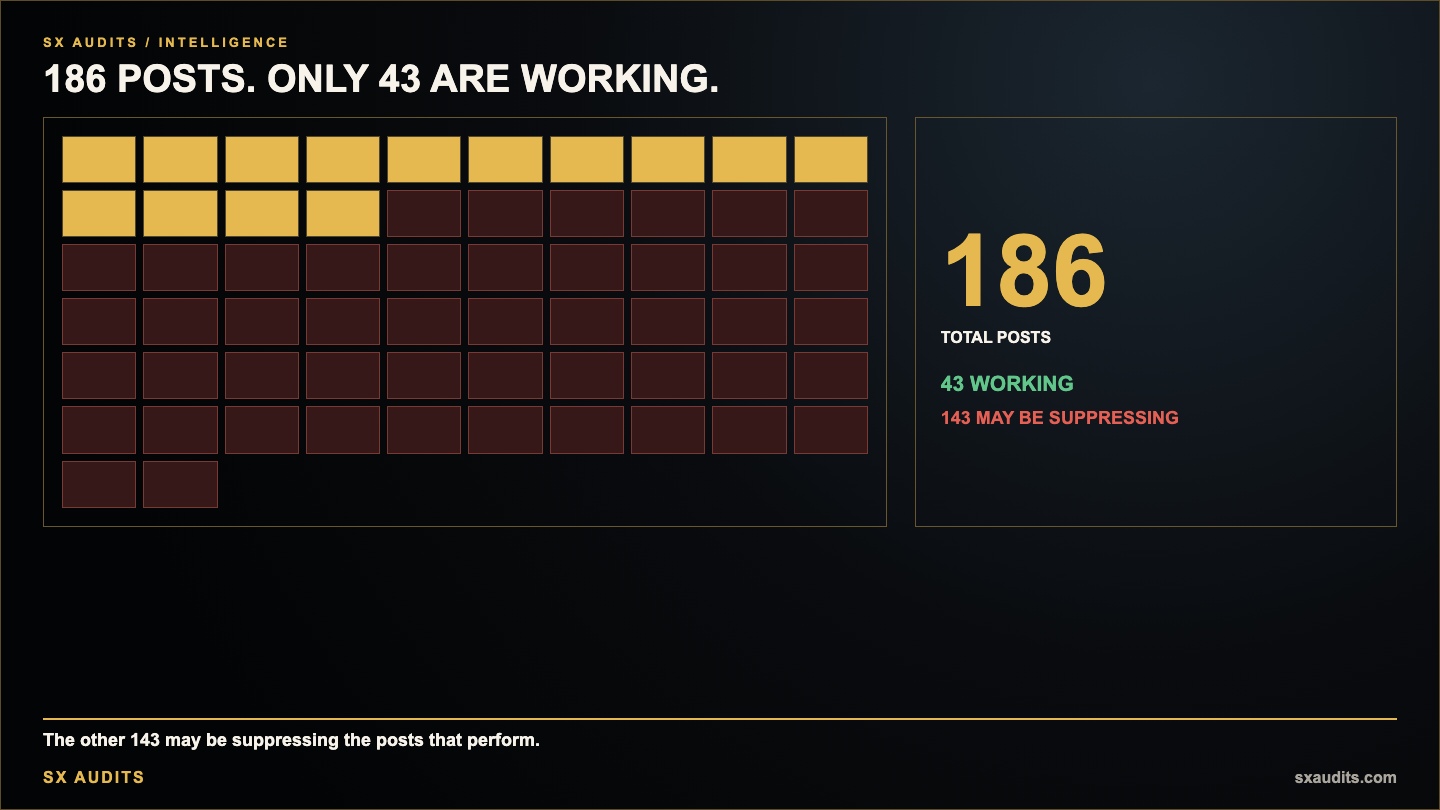
A financial planning firm in Seattle had been publishing blog content for four years. 186 posts across financial planning topics, retirement advice, market commentary, and client educational content. The firm's marketing director considered the blog a strong asset — 186 pieces of intellectual capital.
When a living blog audit was conducted, the finding was different: 43 posts were performing — earning organic clicks, appearing in AI citations, or generating direct contact. 31 posts were performing marginally and could be improved. 112 posts were actively diluting the site's topical authority: thin content, outdated information, topics so broad that no post ranked meaningfully, pages that Google had de-indexed as low quality.
The 112 underperforming posts were not neutral. They were compressing the performance of the 43 that were working — by diluting the domain's topical authority signal and consuming crawl budget that could have been spent on the high-performing pages.
The living blog audit identified not just which posts to update, but which to consolidate and which to remove — and produced a content structure that would earn significantly more AI citations and organic traffic from 80 pages than the current 186 had been producing.
What Makes a Blog Audit "Living"
A standard blog audit is a point-in-time assessment: how is the current content performing? A living blog audit adds a forward-looking layer: how should this content evolve as AI citation signals, organic search patterns, and content freshness requirements change?
AI platforms increasingly weight content freshness in citation eligibility. Pages not updated quarterly are 3× more likely to lose AI citation rates than recently updated pages. A blog that was audited once and never revisited is not a living document — it is a decaying one. The living audit framework creates a content maintenance cadence, not a one-time correction.
The "living" distinction also refers to the relationship between the audit and the content's AI citation performance: the audit identifies which posts have the structure and authority to earn citations, which posts need structural updates to become citation-eligible, and which posts are suppressing the entire domain's citation authority by signaling low topical focus to AI systems.
Most Blogs Have A 20–25% Performance Concentration
Most business blogs follow an 80/20 pattern: a small subset of posts generates the majority of traffic and leads, while the majority of posts generate minimal measurable value. The exact ratio varies, but the pattern is consistent. The problem is not the 20% that is working — it is the 80% that is not, and the compounding effect that low-quality, off-topic, or outdated content has on the performing posts. Search engines and AI systems use domain-level topical authority signals — a site with 186 posts on 150 different topics has weaker topical authority for any single topic than a site with 80 posts that consistently reinforce the same expertise area.
AI Citation Eligibility Is Content-structure-dependent, Not Volume-dependent
The content characteristics that earn AI citations are specific and structural: organized headings that allow AI to extract information hierarchically, quotable direct-answer language that AI can lift as a citation, specific and accurate data points, and authoritative third-party links that validate the content's expertise claims. A post that covers a topic broadly without meeting these structural criteria does not become citation-eligible by adding more words. The living blog audit assesses each post against the citation-eligibility criteria and identifies which structural changes would move a marginal post into citation eligibility — and which posts do not have the structure to be optimized into eligibility and should be removed.
Content Removal Is As Valuable As Content Creation
This is the counter-intuitive finding that most blog owners do not expect: removing low-quality content often improves the performance of remaining content more than adding new content does. When Google de-indexes or penalizes a domain for thin content, the penalty affects the entire domain's authority — including the pages that were performing well. Removing the thin content restores the authority budget that the performing pages can draw from. The living blog audit identifies the removal candidates: posts with no organic impressions in the last 12 months, no AI citation history, no internal link value, and no prospect of improvement without full rewrite.
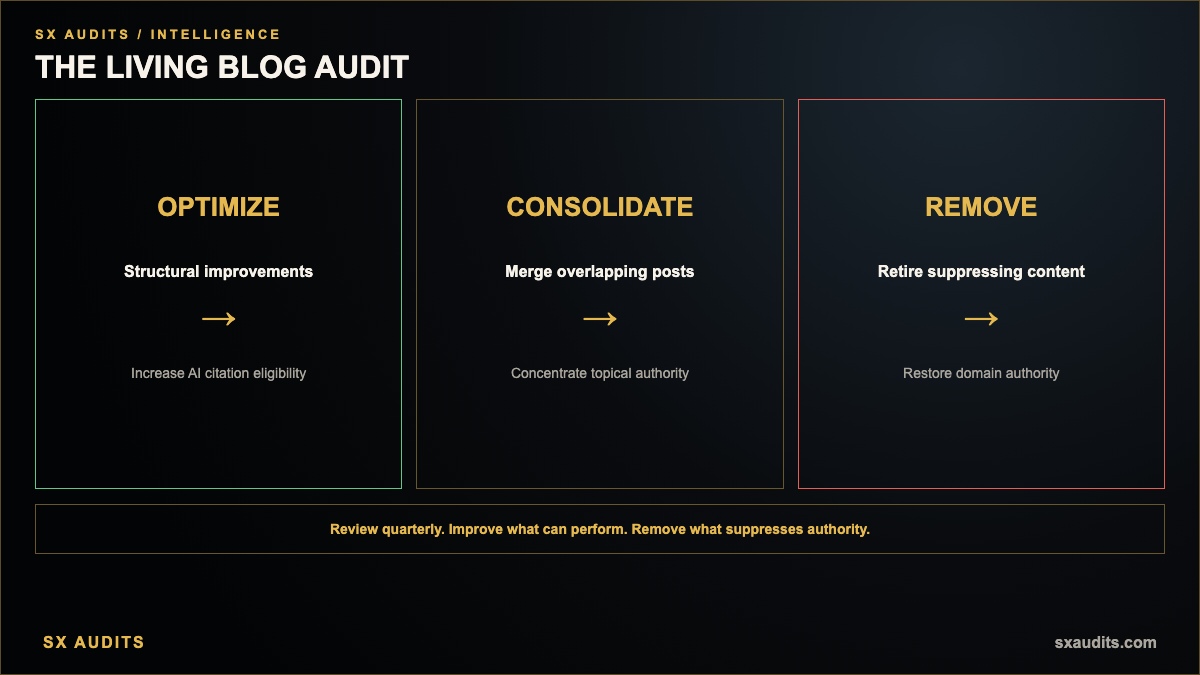
The Audit Identifies Three Categories: Optimize, Consolidate, Remove
Every post in the living blog audit falls into one of three categories. Optimize: the post is performing or has clear potential — specific structural improvements will increase AI citation rate and organic performance. Consolidate: multiple posts on similar topics should be merged into a single comprehensive piece, with appropriate redirects, to concentrate topical authority rather than diluting it across thin variations. Remove: the post has no performance history, no improvement potential without a full rewrite, and is actively diluting the domain's authority — remove with appropriate redirect handling. Most blogs have posts in all three categories. The audit identifies which category each post belongs to and produces a prioritized action plan.
Content Freshness Is A Continuous Requirement, Not A One-time Fix
The living blog audit is not a cleanup project. It is the establishment of a content freshness discipline. AI citation eligibility for existing posts requires quarterly review at minimum — updating data points, adding fresh examples, verifying that external links are still live and authoritative. A blog that was comprehensively audited and optimized in January and then left static will be in citation decline by Q3. The audit establishes the baseline. The living process maintains it. For professional service businesses where each client is worth thousands to tens of thousands of dollars, the time investment in quarterly content review is justified by the citation and discovery value it maintains.
What a Living Blog Audit Produces
Content inventory and categorization: Every post assessed and assigned to Optimize, Consolidate, or Remove.
Citation eligibility scoring: Which posts have the structure to earn AI citations? Which need specific structural changes to become eligible?
Organic performance baseline: Current impressions, clicks, and ranking positions from Search Console — the data that reveals which posts are actually driving traffic.
Priority content work sequence: Which three to five posts, if updated according to the specific recommendations, would produce the largest improvement in AI citation rate and organic traffic?
Content freshness schedule: A recommended review cadence for the highest-performing posts to maintain citation eligibility.
Want to know exactly where your business stands with AI search?
We run the full diagnostic and deliver a findings report in 72 hours. No discovery call. No commitment.
Book the Audit →Related intelligence · selected for this topic
Framework developer and systems thinker specializing in AI implementation and decision architecture. Creator of the AI Council methodology — a structured multi-model framework used to surface deeper insights in complex decisions. The audit intelligence at Sovereign X Audits is built on these same principles.
aicouncilconductor.com →Find out exactly where your business stands.
We audit your digital infrastructure, AI visibility, and brand presence — and show you exactly what it's costing you.