What Is an AI Readiness Score and How Is Yours Calculated?
Most metrics a business owner tracks — website visitors, follower count, ad impressions — measure what has already happened. They look backward.
An AI readiness score measures something different: how prepared your digital infrastructure is to capture the searches that are happening right now on platforms your current analytics probably don't track at all.
If your business can't be found on ChatGPT, Perplexity, and Google AI Overview, you don't have a traffic problem. You have a readiness problem. And unlike most marketing metrics, this one is diagnostic — it tells you exactly what to fix.
What an AI Readiness Score Measures
An AI readiness score is a structured assessment of how well your business's digital infrastructure supports discovery, verification, and recommendation by AI search platforms.
It is not a single metric. It is a composite score built from five or six weighted dimensions, each testing a different layer of your digital presence. A business can score high on traditional SEO and near zero on AI readiness — these are different evaluations of different systems.
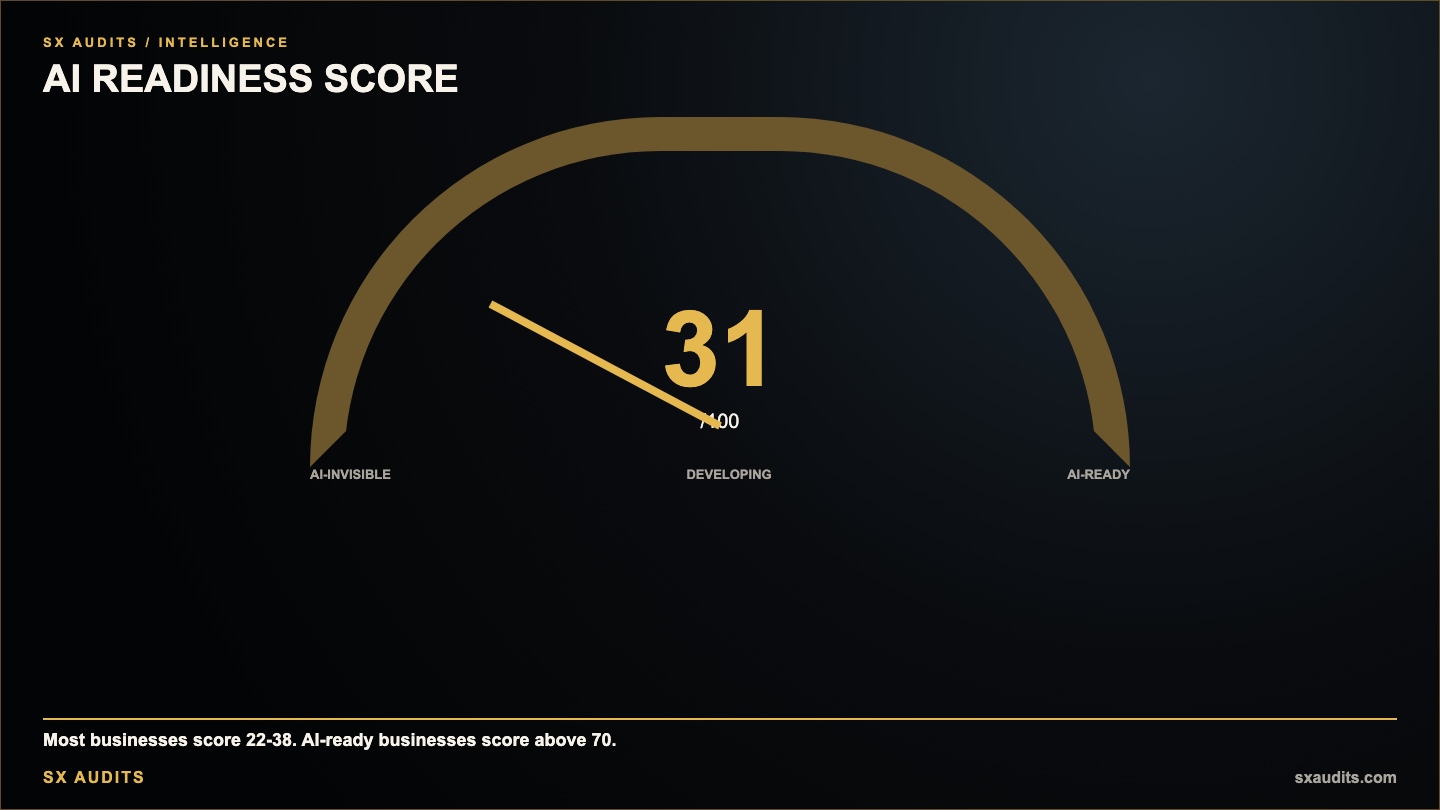
Most mid-market businesses score between 22 and 38 out of 100 on AI readiness frameworks in 2026. AI-ready businesses typically score above 70.
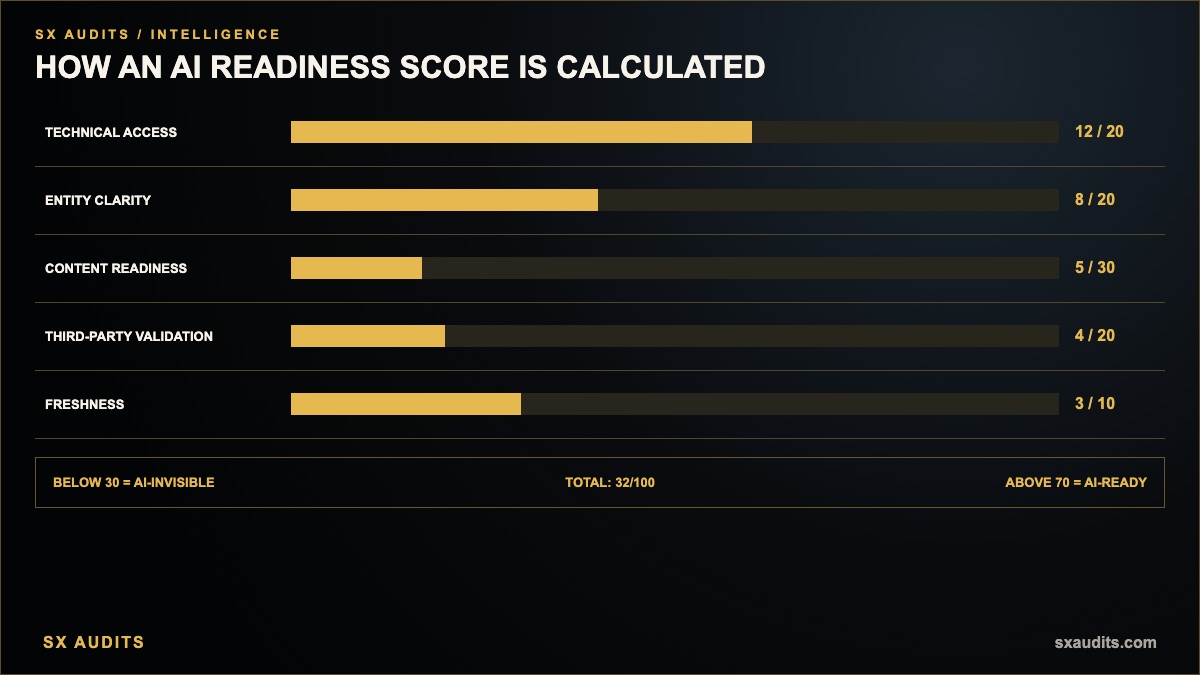
Technical Access And Crawlability (20 Points)
AI systems need to be able to reach and extract your content before they can cite you. This dimension scores whether your robots.txt file is blocking AI crawlers, whether your site loads fast enough for crawlers to complete indexing, and whether your XML sitemap is current and submitted. A functioning llms.txt file — a curated guide for AI systems navigating your content — earns additional points, though only 3.2% of websites currently have one.
Entity Clarity And Consistency (20 Points)
This dimension scores how clearly and consistently your business is identified as a single, coherent entity across all platforms. Business name, address, and phone number must be identical everywhere they appear. AI systems cross-reference this data to build confidence in the entity. Only 30% of small businesses score full marks here. The most common failure: the business name appears in three different formats across four different platforms.
Content Citation Readiness (30 Points)
This is the highest-weighted dimension and the most commonly underdeveloped. It scores whether your website has original, structured content that AI systems can quote in a response. This includes FAQ pages with direct answers to customer questions, service descriptions that are specific and informative rather than generic, and blog content that addresses real queries with data and expertise. Pages with well-organized headings are 2.8× more likely to earn AI citations. Most small business websites score near zero on this dimension.
Trust Signals And Third-party Validation (20 Points)
This dimension scores your off-site credibility: industry directory listings, press mentions, professional association profiles, and references from authoritative sources. Approximately 85% of AI citation signals come from third-party pages rather than owned domains. A business with a strong website but no off-site validation scores low here regardless of content quality. The minimum threshold for this dimension is three authoritative third-party mentions that are current and consistent with owned content.
Content Freshness And Maintenance (10 Points)
AI systems prefer current information. Pages not updated quarterly are 3× more likely to lose AI citations. This dimension scores whether your content is being actively maintained — whether blog posts are updated, whether service descriptions reflect current offerings, and whether GBP information is consistent and recent. Many businesses publish once and abandon — this dimension catches the cost of that pattern.
What Your Score Means
Below 30: Your business is effectively invisible to AI recommendations for competitive queries. Basic infrastructure work — schema markup, NAP consistency, GBP claim and verification — will produce significant improvement quickly.
30–50: Partial AI visibility. You may appear for some queries but not competitive ones. Content citability and third-party validation are the most common gaps at this range.
50–70: Moderate AI visibility. You appear in some AI recommendations but inconsistently. Freshness and content depth are typically the limiting factors.
Above 70: Strong AI readiness. You are appearing in AI recommendations and capturing high-intent traffic. The focus shifts to maintaining performance and monitoring competitor improvements.
Want to know exactly where your business stands with AI search?
We run the full diagnostic and deliver a findings report in 72 hours. No discovery call. No commitment.
Book the Audit →Related intelligence · selected for this topic
Framework developer and systems thinker specializing in AI implementation and decision architecture. Creator of the AI Council methodology — a structured multi-model framework used to surface deeper insights in complex decisions. The audit intelligence at Sovereign X Audits is built on these same principles.
aicouncilconductor.com →Find out exactly where your business stands.
We audit your digital infrastructure, AI visibility, and brand presence — and show you exactly what it's costing you.