What's Actually Included in an AI Readiness Audit
A marketing director at a mid-sized law firm in Houston assumed their AI visibility was fine. They had a strong website. Good SEO rankings. They ranked in the Google Maps pack for most of their primary search terms.
She had never run a single test of how the firm appeared across AI platforms. She had never checked whether their schema markup was configured correctly. She had never searched their firm name in ChatGPT, Perplexity, or Google AI Overviews.
When the audit came back, the findings were specific: the firm appeared in ChatGPT with a description that mixed their specialties with a competitor in the same building. Their schema was present but producing structured data errors that prevented rich results. Their NAP was inconsistent across seven directories. They did not appear in a single AI category recommendation despite being the highest-reviewed firm in their primary practice area on Google.
The problem wasn't visibility. It was AI readiness — a distinct layer that their existing SEO work had never addressed.
What AI Readiness Actually Evaluates
AI readiness is a different measurement from SEO performance or website quality. Traditional SEO evaluates how well a website ranks in Google's blue-link results. AI readiness evaluates how accurately and completely AI systems — ChatGPT, Perplexity, Google AI Overviews, Claude — can understand, describe, and recommend your business.
These are related but not identical. A business can rank in position 1 for its primary keywords while being almost completely invisible in AI-generated recommendations. In a 2026 study, only 12% of AI citations came from websites that ranked in Google's top 10 for the same query. The overlap between strong SEO performance and strong AI visibility has shrunk significantly.
An AI readiness audit evaluates the specific signals that determine how AI systems process your business — and identifies the precise gaps between your current infrastructure and what the systems require to recommend you confidently.
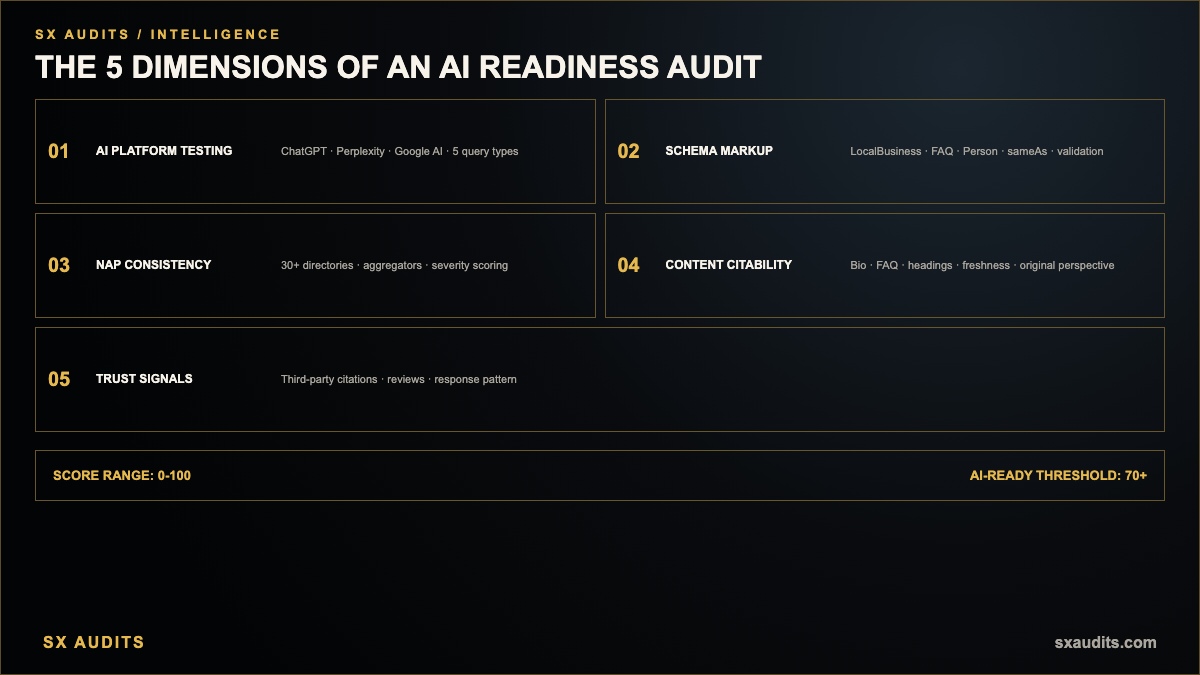
Dimension One: AI Platform Testing
The audit begins with live testing across the three major AI platforms using five query types: name queries ("tell me about [business name]"), specialty queries ("what is [business name] known for?"), category queries ("best [profession] in [city]"), methodology queries ("what is [business name]'s approach?"), and comparison queries ("who is similar to [business name]?"). Each query is run twice — once in a fresh session and once in a primed context — to assess response consistency. Findings document accuracy (what the AI gets right vs. wrong), completeness (what significant information is absent), competitive positioning (who appears in category recommendations in your place), and confidence level (whether AI systems respond with specific detail or hedge with low-certainty language).
Dimension Two: Schema Markup And Structured Data
Schema markup is the primary technical signal AI systems use to understand your business entity. The audit checks for: presence of LocalBusiness or Organization schema on the homepage; Person schema for professional services practices where the individual's expertise is the primary product; FAQ schema on pages with Q&A content; correct sameAs links connecting your schema to your LinkedIn, GBP, and other authoritative profiles; and validation against Google's Rich Results Test to identify configuration errors. Pages with schema markup earn 20–30% higher click-through rates in traditional search. More importantly, correctly configured schema is one of the most reliable signals for accurate AI citation.
Dimension Three: NAP Consistency Across Directories
AI systems — particularly for local businesses — build entity confidence from consistent signals across multiple data sources. The audit checks your name, address, and phone number across the 30+ most important directories: Google Business Profile, Bing Places, Apple Maps, Yelp, Facebook, Yellow Pages, Foursquare, industry-specific directories, and the primary data aggregators (Neustar Localeze, Infogroup, Acxiom). Inconsistencies are flagged by platform and severity — a phone number change that is inconsistent across 14 directories is a higher-priority finding than a minor suite number format variation in 3 directories.
Dimension Four: Content Citability Assessment
AI systems preferentially cite content that directly answers questions in quotable, structured language. The audit evaluates: whether your website has an About or bio page written in clear, specific language that AI can excerpt; whether you have FAQ content addressing your most common prospect questions; whether your content uses organized heading structure (pages with organized headings are 2.8× more likely to earn AI citations); whether content has been updated within the last 90 days (pages not updated quarterly are 3× more likely to lose AI citations); and whether you have at least two pieces of original perspective content — articles, guides, or frameworks — that AI systems can use as citable evidence of your expertise.
Dimension Five: Trust Signals And Third-party Validation
Eighty-five percent of AI citations come from third-party pages rather than the business's own website. The audit evaluates the quantity and quality of external references to your business: press mentions, published bylines, podcast appearances, professional association listings, industry directory profiles, and curated business listings. It also assesses your review profile — volume, recency, and average rating across Google, Yelp, and industry-specific platforms — and your response pattern, since unanswered reviews create a one-sided account that AI systems process as part of your reputation signal.
What the Report Includes
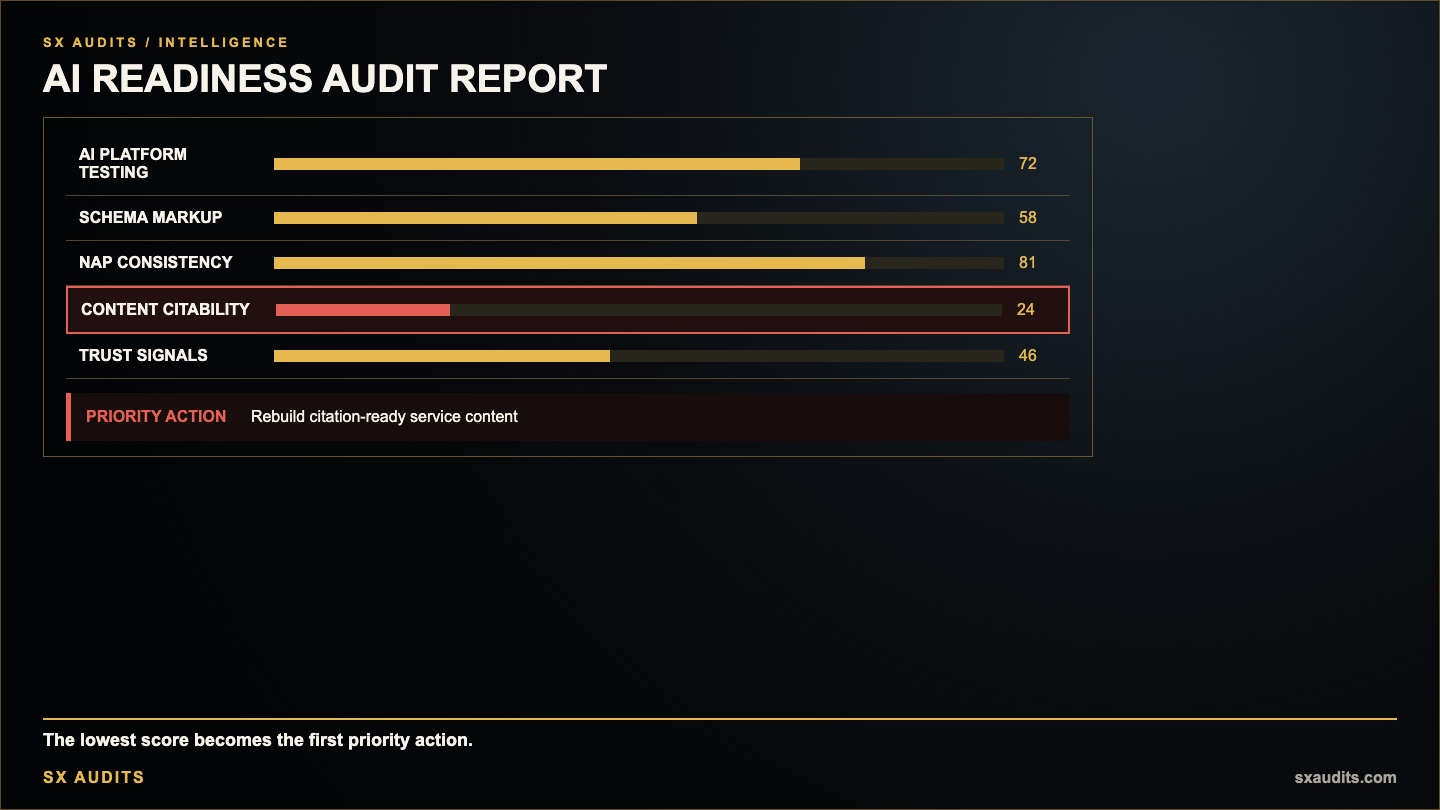
AI Visibility Score (0–100): A composite score across all five dimensions — technical access (20 points), entity clarity (20 points), content citability (30 points), third-party validation (10 points), and freshness (20 points). Most businesses score between 22 and 38 on their first audit. AI-ready businesses score above 70.
Platform-Specific Findings: What ChatGPT, Perplexity, and Google AI Overviews each say about your business — with accuracy assessment and a specific description of what each platform is getting wrong or missing.
Prioritized Issue List: Every identified gap, ranked by revenue impact, with a specific recommended action for each.
Revenue Impact Estimates: For each significant finding, a specific estimate of what the gap is likely costing annually in missed recommendations, lost trust, or suppressed visibility.
Competitive Context: Who is appearing in AI category recommendations when you aren't — and what they have that you don't.
Want to know exactly where your business stands with AI search?
We run the full diagnostic and deliver a findings report in 72 hours. No discovery call. No commitment.
Book the Audit →Related intelligence · selected for this topic
Framework developer and systems thinker specializing in AI implementation and decision architecture. Creator of the AI Council methodology — a structured multi-model framework used to surface deeper insights in complex decisions. The audit intelligence at Sovereign X Audits is built on these same principles.
aicouncilconductor.com →Find out exactly where your business stands.
We audit your digital infrastructure, AI visibility, and brand presence — and show you exactly what it's costing you.