What AI Systems Actually Verify Before Recommending a Business
A med spa owner in New York assumed that because she had hundreds of positive reviews and a strong local reputation, AI platforms would naturally recommend her when someone searched for services in her area. She had never thought about it any other way — she was well-known. She was good. Why wouldn't she come up?
When she tested it, a competitor with fewer reviews and a less impressive facility appeared every time. Her business didn't appear at all.
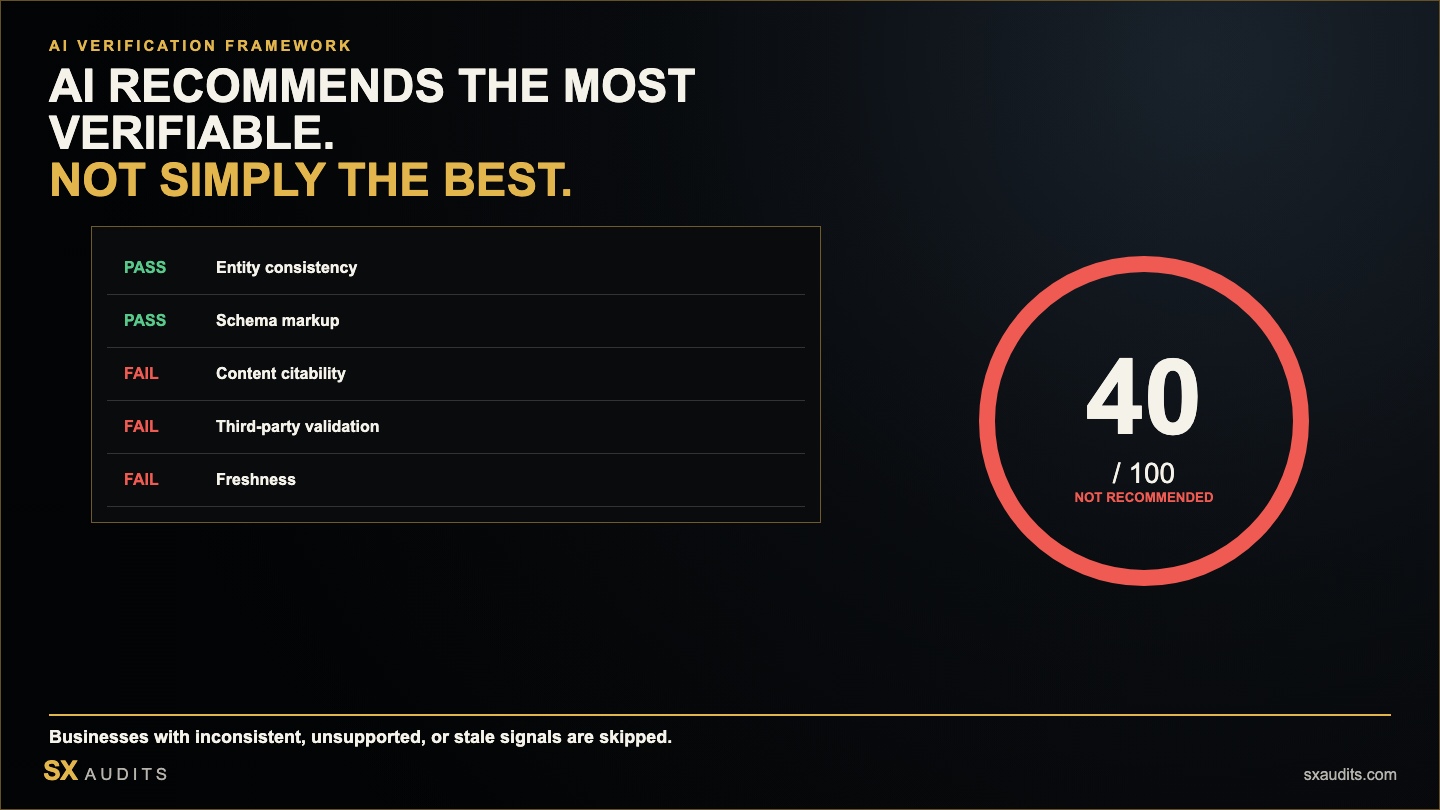
Being known is not the same as being verifiable. AI recommends what it can verify — not what actually deserves to be recommended.
How AI Systems Make Recommendations
AI recommendation systems — ChatGPT, Perplexity, Google AI Overview, Bing Copilot — don't browse the internet in real time the way a human would. They synthesize answers from signals they have already processed: structured data, indexed content, cross-platform entity records, and cached third-party citations.
Before surfacing a business name in a recommendation, an AI system runs an implicit verification process. It checks whether the business is a coherent, consistent, credible entity with enough corroborating signals to confidently recommend. Businesses that pass this check appear. Businesses that don't are skipped regardless of their actual quality.
Entity Consistency: Does This Business Have A Clear, Stable Identity?
The first check is whether the business entity is unambiguous. AI systems cross-reference business name, address, and phone number across multiple platforms simultaneously. If the same business appears as "Smith Consulting," "Smith Consulting LLC," and "Smith Business Consulting" across different platforms, the AI cannot confidently establish that these are the same entity. It defaults to businesses with clear, consistent entity signals. Only 30% of small businesses have fully consistent NAP data across major directories.
Structured Data: Does This Business Tell Machine Systems What It Is?
Schema markup is the explicit instruction set for machine readers. LocalBusiness schema tells AI platforms the business name, category, address, phone, hours, and service area in a format machines can process reliably. Without schema, AI systems must infer this information from unstructured text — which is unreliable and frequently results in misattribution. Businesses with properly implemented schema see 20–30% higher click-through rates and significantly higher AI citation rates compared to those without it.
Content Citability: Is There Something AI Can Actually Quote?
AI systems generate responses by synthesizing information from sources they can cite. They look for content that directly answers the query: FAQ pages, structured service descriptions, educational blog posts, and original perspectives on specific topics. A website whose homepage reads "We are a full-service accounting firm serving the tristate area" gives AI nothing citable. A website with a page answering "When should a small business hire a CPA?" with specific, structured answers has citation targets AI can use.
Third-party Validation: Do Authoritative Sources Confirm This Business Exists And Is Credible?
Approximately 85% of brand mentions that influence AI citations originate from third-party pages rather than owned domains. Industry directories, press mentions, professional association listings, and referenced publications all function as validation signals. A business that exists only on its own website has no external corroboration. AI treats self-reported information without third-party validation the same way a diligent researcher treats an uncited claim: with uncertainty.
Recency: Is This Information Current Enough To Be Trusted?
AI systems are designed to give current, reliable recommendations. Pages not updated quarterly are 3× more likely to lose AI citations. A business whose website content, directory listings, and GBP haven't been refreshed in over a year is generating staleness signals that reduce recommendation confidence. This is particularly impactful for businesses in competitive markets where multiple competitors are actively maintaining fresh, citable content.
The Verification Checklist AI Runs on Your Business
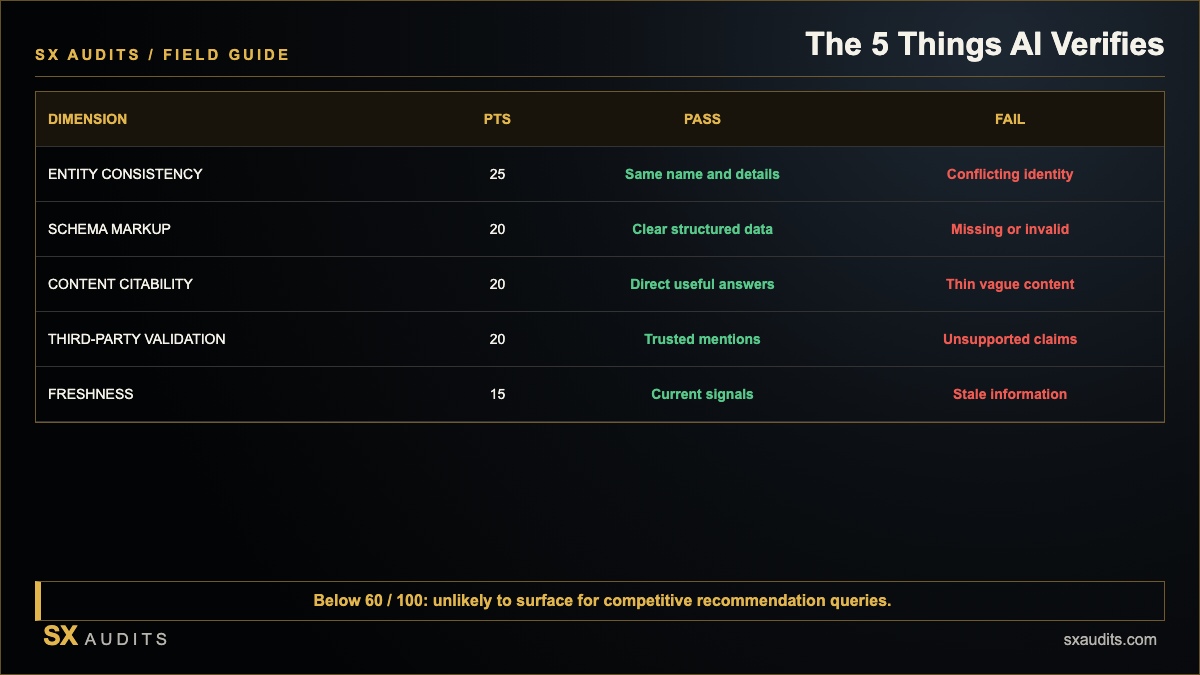
Based on current GEO audit frameworks, AI platforms effectively score businesses on five dimensions before recommending them:
- Entity consistency: Is the business clearly identified across all platforms? (20 points)
- Structured data: Is schema markup present and correct? (20 points)
- Content citability: Does the site have content AI can quote? (30 points)
- Third-party validation: Are there authoritative off-site mentions? (10 points)
- Freshness: Has the content been updated recently? (20 points)
A business scoring below 60 out of 100 on this framework is unlikely to appear in AI recommendations for competitive queries, regardless of its actual quality or reputation.
Want to know exactly where your business stands with AI search?
We run the full diagnostic and deliver a findings report in 72 hours. No discovery call. No commitment.
Book the Audit →Related intelligence · selected for this topic
Framework developer and systems thinker specializing in AI implementation and decision architecture. Creator of the AI Council methodology — a structured multi-model framework used to surface deeper insights in complex decisions. The audit intelligence at Sovereign X Audits is built on these same principles.
aicouncilconductor.com →Find out exactly where your business stands.
We audit your digital infrastructure, AI visibility, and brand presence — and show you exactly what it's costing you.