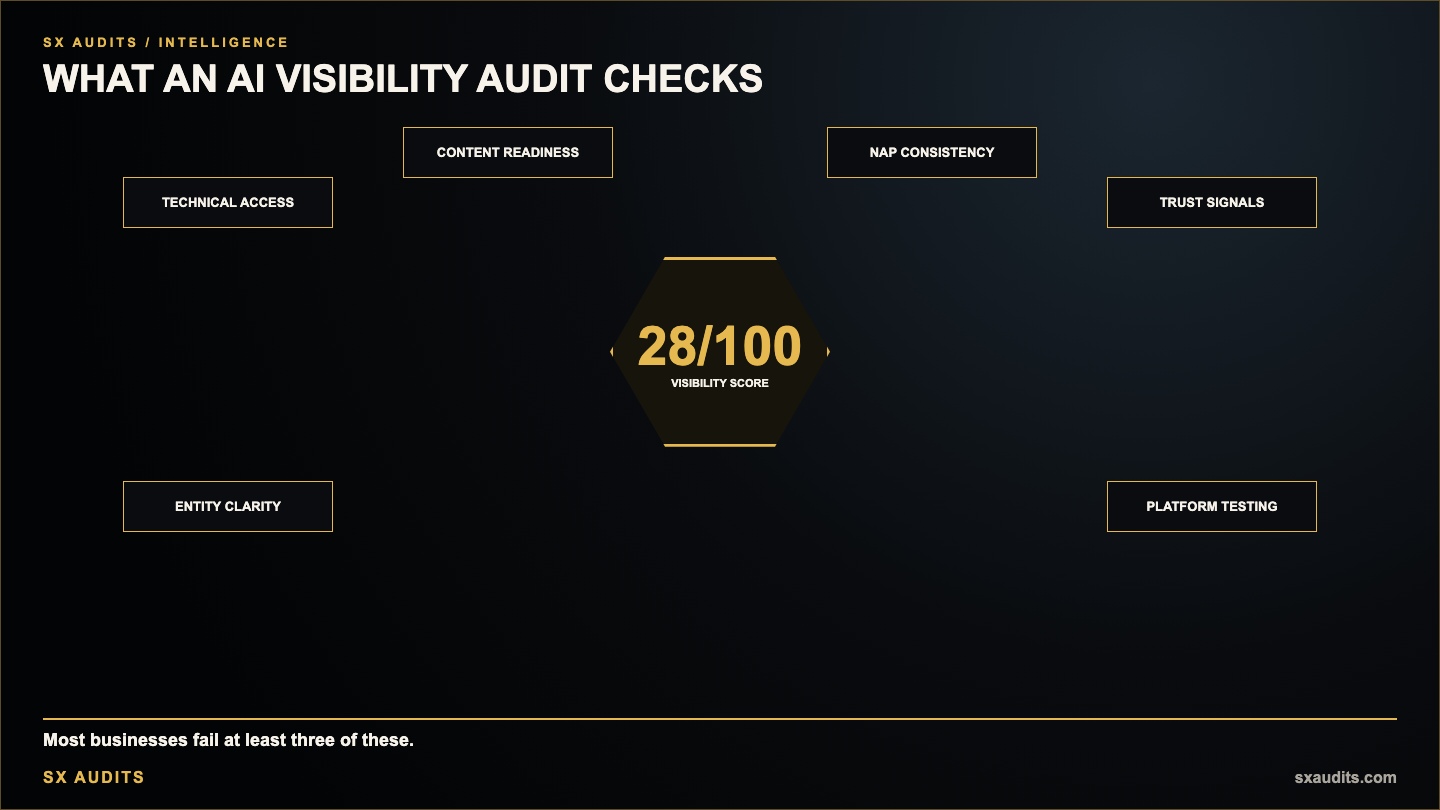
What Does an AI Visibility Audit Actually Check?
A Manhattan consulting firm recently discovered they ranked first on Google for their primary service category. Their website was professionally designed. Their SEO agency was reporting green metrics across the board.
Then their business development lead ran a simple test: she opened ChatGPT and asked the exact question their clients use when they're searching for help. Three other firms appeared. Hers did not.
An AI visibility audit would have caught this before it became a competitive disadvantage. Here is what it actually checks.
What an AI Visibility Audit Is
An AI visibility audit is a structured diagnostic that tests whether your business can be found, understood, and recommended by AI search platforms — specifically ChatGPT, Perplexity, Google AI Overview, and Bing Copilot.
It is not the same as an SEO audit. Traditional SEO tests whether Google can rank your pages. An AI visibility audit tests whether AI engines have enough structured, consistent, citable information about your business to include you in a generated recommendation.
Only 30% of brands maintain consistent presence from one AI answer to the next. Only 20% remain present across five consecutive runs of the same query. This is not a small problem.
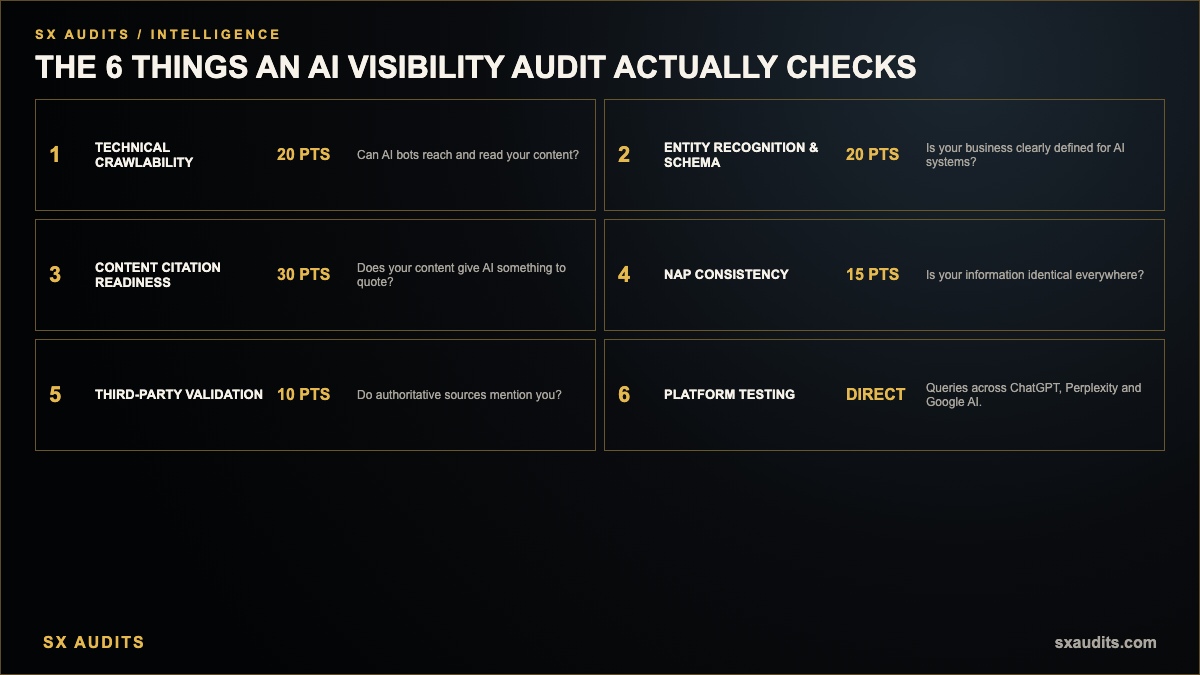
Technical Crawlability And AI Access
The audit begins by confirming that AI crawlers can actually reach and extract your content. This includes robots.txt rules that may inadvertently block AI bots, page load performance that causes crawlers to time out, and whether your site has a functional XML sitemap and — increasingly relevant — an llms.txt file. Only 3.2% of websites currently have an llms.txt file, which serves as a curated guide for AI systems navigating your content.
Entity Recognition And Schema Markup
AI engines build confidence about a business through entity recognition — understanding who you are, what you do, where you operate, and whether that information is consistent everywhere it appears. The audit checks whether your website has LocalBusiness schema markup (name, address, phone, hours, service area, business type), whether your business is consistently described across directories and social profiles, and whether schema is implemented without errors Google flags as deceptive. Businesses with properly implemented schema see 20–30% higher click-through rates and significantly higher AI citation rates.
Content Citation Readiness
AI systems preferentially cite content that directly answers the question being asked. The audit evaluates whether your site has original, structured content — FAQ pages, clearly formatted service descriptions, blog posts that answer specific client questions — that gives AI something to quote. A scoring framework used in 2026 GEO audits allocates 30 out of 100 points to content citation readiness alone, making it the single heaviest-weighted factor. A business whose website reads like a brochure scores near zero on this dimension.
NAP Consistency And Cross-platform Entity Clarity
AI engines verify businesses by cross-referencing their information across multiple platforms. If your business name, address, or phone number appears differently on your website, Google Business Profile, Yelp, and industry directories, AI systems interpret that as ambiguity and default to businesses with a cleaner signal. The audit maps every platform where your business appears and identifies every inconsistency. NAP inconsistency is one of the most common — and most easily fixed — causes of AI invisibility.
Trust Signals And Third-party Validation
AI systems build confidence through off-site validation: press mentions, industry directory listings, third-party review platforms, and whether authoritative sources cite your business by name. About 85% of brand mentions that influence AI citations originate from third-party pages rather than owned domains. The audit identifies your third-party citation footprint and benchmarks it against competitors who are currently appearing in AI recommendations you're missing.
Manual Platform Testing
The final component of the audit is direct testing: querying ChatGPT, Perplexity, Google AI Overview, and Bing Copilot with the actual phrases your customers use, then documenting citation frequency, positioning, accuracy, and sentiment. This produces the most direct evidence of your current AI visibility — and the clearest picture of who is winning the recommendations you're not getting.
What the Audit Produces
A completed AI visibility audit gives you a scored assessment across all six dimensions, a clear identification of which gaps are causing AI invisibility, a priority sequence for fixing them in order of impact, and a benchmark against competitors currently being recommended in your market.
Visitors referred by AI platforms convert at 3.6% versus 1.23% from traditional Google search. Every month without an AI visibility audit is a month competitors consolidate an advantage that compounds over time.
Want to know exactly where your business stands with AI search?
We run the full diagnostic and deliver a findings report in 72 hours. No discovery call. No commitment.
Book the Audit →Related intelligence · selected for this topic
Framework developer and systems thinker specializing in AI implementation and decision architecture. Creator of the AI Council methodology — a structured multi-model framework used to surface deeper insights in complex decisions. The audit intelligence at Sovereign X Audits is built on these same principles.
aicouncilconductor.com →Find out exactly where your business stands.
We audit your digital infrastructure, AI visibility, and brand presence — and show you exactly what it's costing you.