What Is AI Readiness and How Do You Measure It for a Small Business?
When enterprise companies talk about AI readiness, they mean internal adoption: do their teams use AI tools, do their data systems support AI integration, are their operations structured for automation?
That definition has a different application for small businesses. For a local service business in 2026, AI readiness means something more immediate and more directly tied to revenue: can AI search platforms find you, trust you, and recommend you to the customers who are asking about your category right now?
These are different questions. They require different answers.
AI Readiness for Small Businesses — The Practical Definition
A small business is AI-ready when its digital infrastructure gives AI search platforms enough consistent, structured, citable, and third-party-validated information to confidently recommend it in a generated response.
This is not about internal AI adoption. It is about external AI visibility. It answers the question: when a potential customer asks ChatGPT, Perplexity, or Google AI Overview for a recommendation in your category and location, what does AI know about your business — and is it enough to include you?
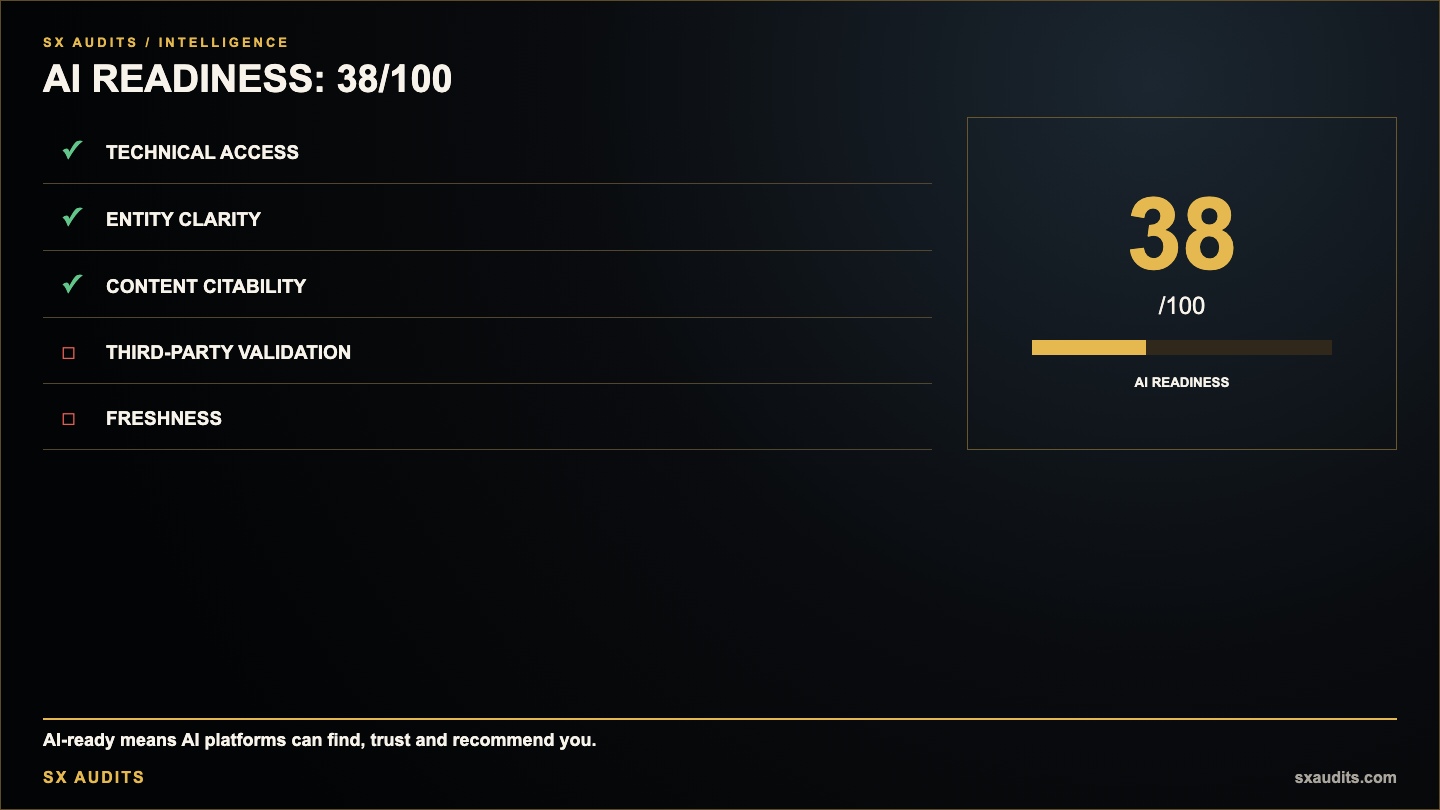
Most businesses score between 22 and 38 out of 100 on AI readiness frameworks in 2026. AI-ready businesses typically score above 70.
AI Readiness Starts With Digital Infrastructure, Not Technology Adoption
The businesses that score highest on AI readiness are not necessarily the ones that use the most AI tools internally. They are the businesses with the most consistent, structured, and citable digital footprints. A bakery with a clean GBP, consistent NAP across 15 directories, LocalBusiness schema, and two well-structured FAQ pages is more AI-ready than a tech company with an AI strategy document but no schema markup on its website.
The Five Readiness Dimensions For Small Businesses
Based on 2026 GEO audit frameworks, small business AI readiness is measured across five dimensions: (1) Technical access — can AI crawlers reach and read your content?; (2) Entity clarity — is your business consistently identified across all platforms?; (3) Content citability — does your website have structured content AI can quote?; (4) Third-party validation — do authoritative sources mention your business?; (5) Freshness — has your content been updated in the past 90 days? Most small businesses have gaps in at least three of these.
The Self-assessment Takes 20 Minutes
A basic AI readiness self-assessment requires: opening ChatGPT and Perplexity and searching five queries your customers use (checking appearance rate); running Google's Rich Results Test on your website (checking schema markup); verifying NAP consistency across website, GBP, and top two directories; checking whether your website has at least one FAQ or structured answer page; and confirming your GBP is claimed and verified. A business that passes four of five of these checks has a strong foundation. Three or more failures indicates significant AI readiness gaps.
AI Readiness Compounds As Competitors Build It
AI readiness is not a static advantage — it is an infrastructure race. Businesses building consistent entity signals, fresh citable content, and expanding third-party validation footprints are continuously improving their AI recommendation rates. Businesses that aren't investing in these foundations are not standing still while competitors pass them — they are actively falling behind because competitor AI citations generate trust signals that further reinforce their recommendation rates.
Ai-ready Businesses Capture More Valuable Traffic
Visitors arriving from AI platform recommendations convert at 3.6% compared to 1.23% for traditional organic search. They spend 68% more time on websites. They are further along in their decision process — they have already received a recommendation and arrived pre-sold. The revenue difference between a business that captures this traffic and one that doesn't compounds every month the gap persists.
The Practical Readiness Checklist for Small Businesses
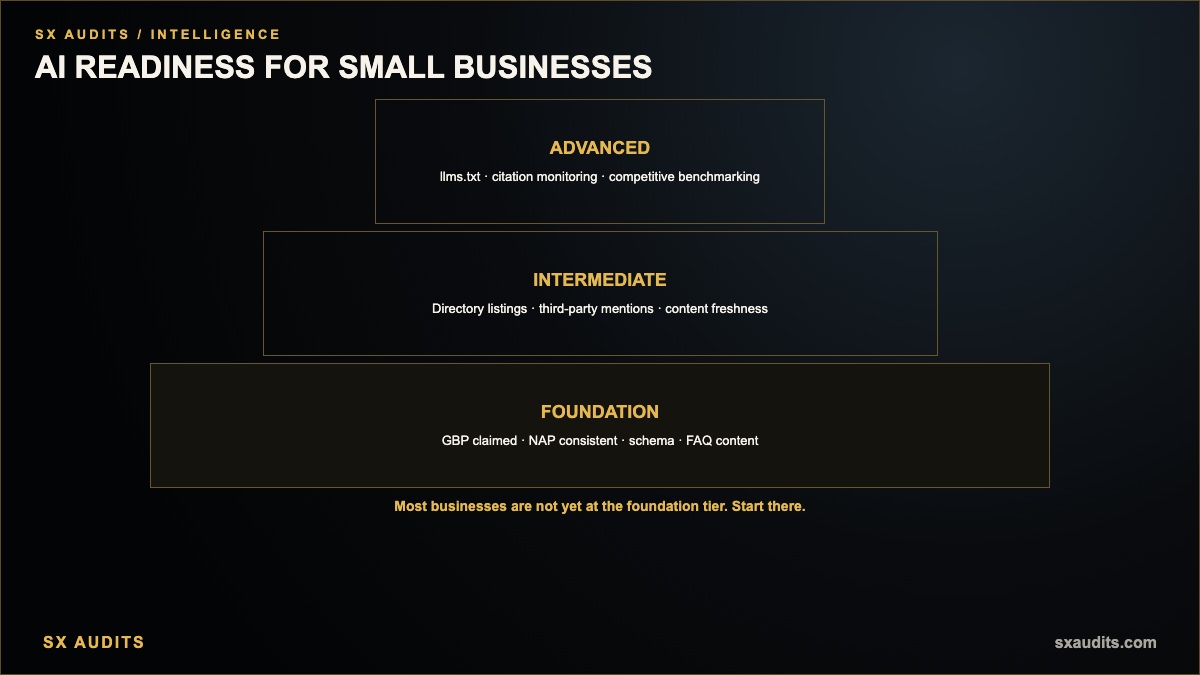
Foundation (must have):
- Google Business Profile claimed, verified, and current
- NAP identical across website, GBP, and top three directories
- LocalBusiness schema markup implemented on website
- At least one FAQ page with direct, structured answers to customer questions
Intermediate (significant impact):
- Schema implemented across all key service pages
- Business listed on top five authoritative industry directories
- Three or more recent press mentions or third-party references
- Content updated within the past 60 days
Advanced (maximizing AI citation rate):
- llms.txt file implemented
- Regular content publishing schedule (minimum monthly)
- Monitoring system for AI citation tracking
- Competitive AI visibility benchmarking
Want to know exactly where your business stands with AI search?
We run the full diagnostic and deliver a findings report in 72 hours. No discovery call. No commitment.
Book the Audit →Related intelligence · selected for this topic
Framework developer and systems thinker specializing in AI implementation and decision architecture. Creator of the AI Council methodology — a structured multi-model framework used to surface deeper insights in complex decisions. The audit intelligence at Sovereign X Audits is built on these same principles.
aicouncilconductor.com →Find out exactly where your business stands.
We audit your digital infrastructure, AI visibility, and brand presence — and show you exactly what it's costing you.