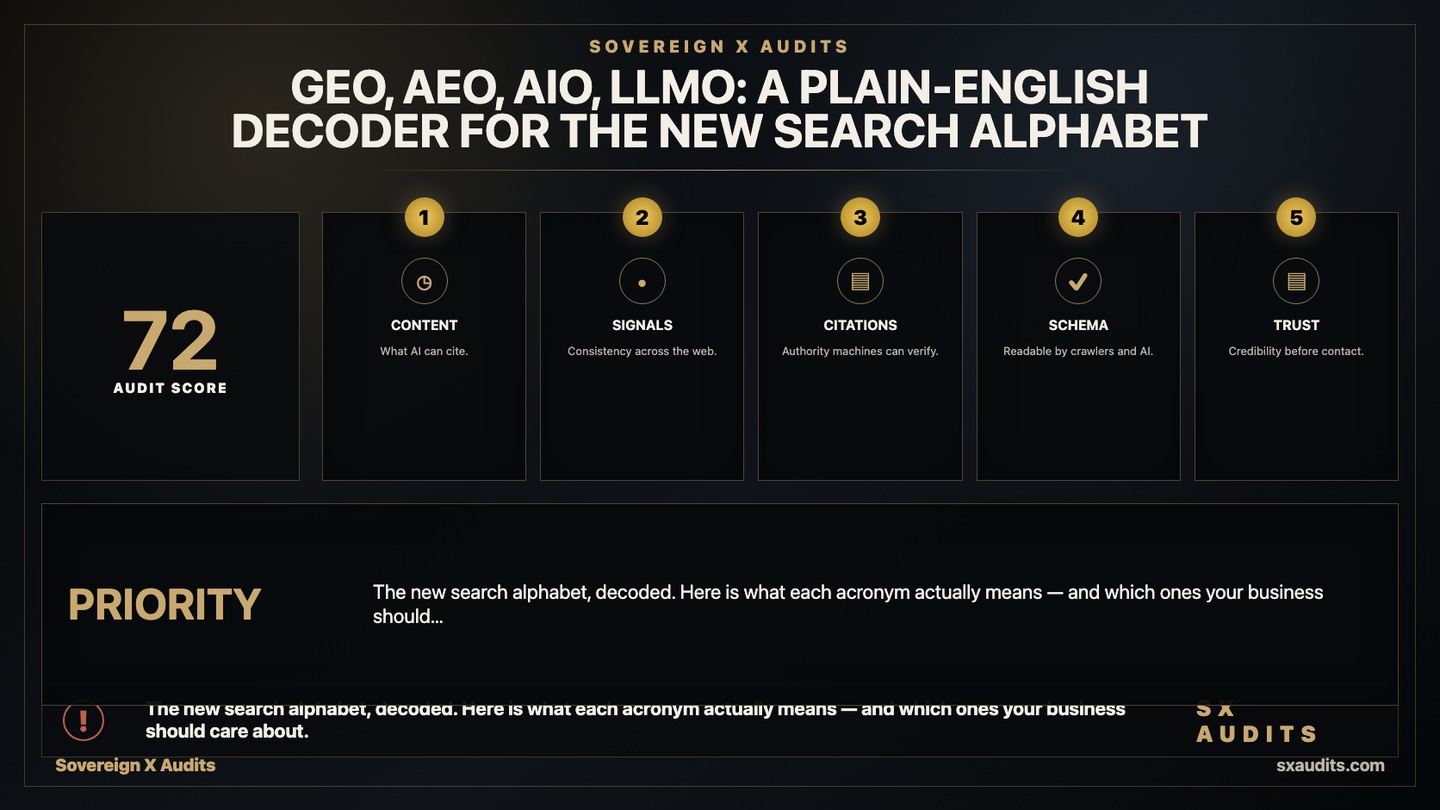
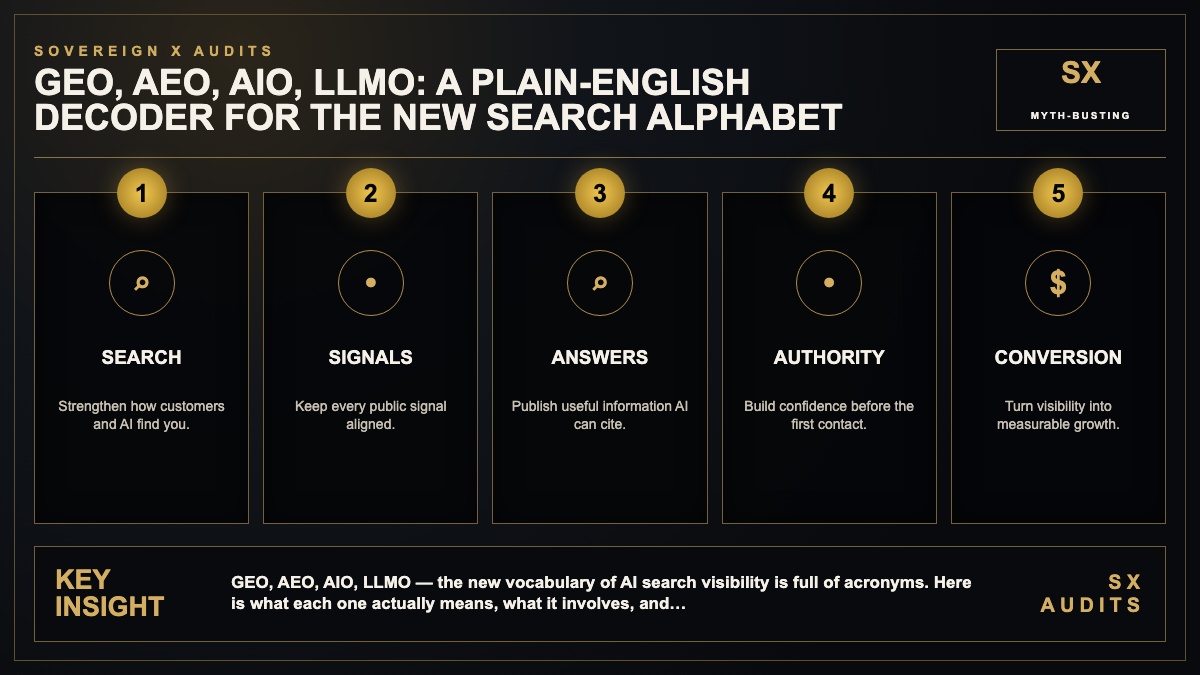
GEO, AEO, AIO, LLMO: A Plain-English Decoder for the New Search Alphabet
A marketing director at a specialty retail chain encountered four different acronyms from four different vendors in a single week. One was pitching GEO services. Another was talking about AEO. A third mentioned AIO optimization. A fourth — a newer entrant — was offering LLMO. All four were presenting different things, using different metrics, and quoting different price points.
She couldn't tell if they were describing the same thing with different names, four genuinely distinct services, or four variations of vendor noise around the same fundamental concept.
They were a mixture of all three.
The acronym proliferation in AI search visibility is real, it is partly meaningful and partly marketing, and it deserves a clear translation.
The Core Problem the Acronyms Are Trying to Describe
Traditional search — Google's blue-link results — had one optimization discipline: SEO. The advent of AI-generated answers has created a new optimization challenge: ensuring your business appears in, is cited by, and is recommended through AI-generated responses, not just ranked links. That single challenge has generated at least four distinct acronyms, each capturing a slightly different emphasis on the same underlying problem.
The underlying problem is this: AI systems don't rank pages the way Google does. They synthesize information and generate answers. Being included in those answers requires different signals than ranking in Google's results — and the industry is still developing consistent vocabulary for what that work involves.
SEO (search Engine Optimization): The Baseline
SEO is the oldest of the disciplines and refers to optimizing your website and digital presence to rank in traditional search engine results — primarily Google's blue-link results and Maps pack. SEO focuses on keyword relevance, content quality, technical performance, and link authority. It is still relevant and essential — Google still processes over 8 billion searches per day. But traditional SEO does not address AI-generated answers, which operate on a different citation logic. Only 12% of AI citations come from Google's top-10 ranking pages. Strong SEO does not guarantee AI visibility, and businesses optimizing only for SEO are leaving a growing share of the discovery landscape unaddressed.
AEO (answer Engine Optimization): Optimizing For Featured Snippets And Direct Answers
AEO focuses on optimizing content to appear in Google's featured snippets — the boxed answers at the top of search results — and in direct answer positions for question-based queries. It was developed in response to the rise of voice search and zero-click search behavior (over 60% of searches now end without a click). AEO involves: structuring content to directly answer specific questions; formatting responses in paragraph, list, or table formats that search engines extract; adding FAQ schema to signal Q&A content to Google; and writing at a reading level and length that Google's snippet extraction algorithm prefers. AEO remains highly relevant to traditional search and provides foundational work that also supports AI visibility.
GEO (generative Engine Optimization): The Discipline Most Relevant To AI Search
GEO is the newest and most comprehensive of the disciplines, focused on optimizing for AI-generated answers from systems like ChatGPT, Perplexity, and Google AI Overviews. It is the AI-era successor to both SEO and AEO, with a distinct emphasis on the signals AI systems use to generate confident recommendations: schema markup and structured data for entity recognition; content citability (quotable, structured, direct-answer content); entity consistency across platforms (NAP, naming, specialty descriptions); third-party validation (press mentions, directory listings, credential citations); and freshness (AI systems penalize content staleness, with pages not updated quarterly being 3× more likely to lose citation rates). The Princeton GEO study found that adding quotable statistics increased AI citation rates by 41%, authoritative citations by 30%, and fluency optimization by 30%.
AIO (AI Optimization): A Marketing Umbrella Term
AIO is the broadest of the acronyms and often functions as a marketing umbrella for services that combine elements of SEO, AEO, and GEO. Vendors using the AIO label are typically describing a comprehensive approach to multi-channel search visibility that spans traditional Google rankings, featured snippets, and AI platform citations. The term is not standardized — what one vendor calls AIO, another calls GEO. When evaluating an AIO service offering, the most useful question is not what acronym they use but what specific actions they take: Do they implement and test schema markup? Do they audit and correct NAP consistency? Do they test AI platform visibility across ChatGPT, Perplexity, and Google AI Overviews? The answers to those questions are more diagnostic than the label.
LLMO (large Language Model Optimization): A Technical Framing For The Same Goal
LLMO is a more technically-framed version of GEO, used primarily by vendors whose service is explicitly centered on making content more accessible and citeable by large language models — the AI systems underlying ChatGPT, Claude, Gemini, and similar platforms. LLMO focuses particularly on: content structure that makes information easy for LLMs to extract; schema and metadata that help LLMs classify and attribute content correctly; technical measures like llms.txt (a proposed file standard that guides AI crawlers to priority content); and training data access (ensuring that a business's content is included in the data sets that inform model training). LLMO is a real discipline and a meaningful framing for technical practitioners, but for most small businesses, the practical implementation overlaps significantly with GEO.
The Plain-English Summary
SEO: Getting found in Google's traditional blue-link results and Maps. Still essential. Does not address AI-generated answers.
AEO: Getting included in Google's featured snippets and direct answer boxes. Valuable for zero-click search visibility. Foundational for AI visibility.
GEO: Getting cited and recommended by AI systems — ChatGPT, Perplexity, Google AI Overviews. The primary new discipline for 2026 AI visibility. What most businesses should be focused on.
AIO: A broad umbrella term for combined search optimization across all channels. Not a distinct discipline — more of a positioning label.
LLMO: A technical framing for GEO, emphasizing the large language model layer. Most relevant for technically sophisticated content producers. For most small businesses, GEO covers the practical implementation.
The most important question: Is your business appearing accurately and prominently in AI-generated recommendations for your category and location? That is the outcome all of these disciplines are trying to address. The acronym used to describe the work matters less than whether the work is being done.
Want to know exactly where your business stands with AI search?
We run the full diagnostic and deliver a findings report in 72 hours. No discovery call. No commitment.
Book the Audit →Related intelligence · selected for this topic
Framework developer and systems thinker specializing in AI implementation and decision architecture. Creator of the AI Council methodology — a structured multi-model framework used to surface deeper insights in complex decisions. The audit intelligence at Sovereign X Audits is built on these same principles.
aicouncilconductor.com →Find out exactly where your business stands.
We audit your digital infrastructure, AI visibility, and brand presence — and show you exactly what it's costing you.