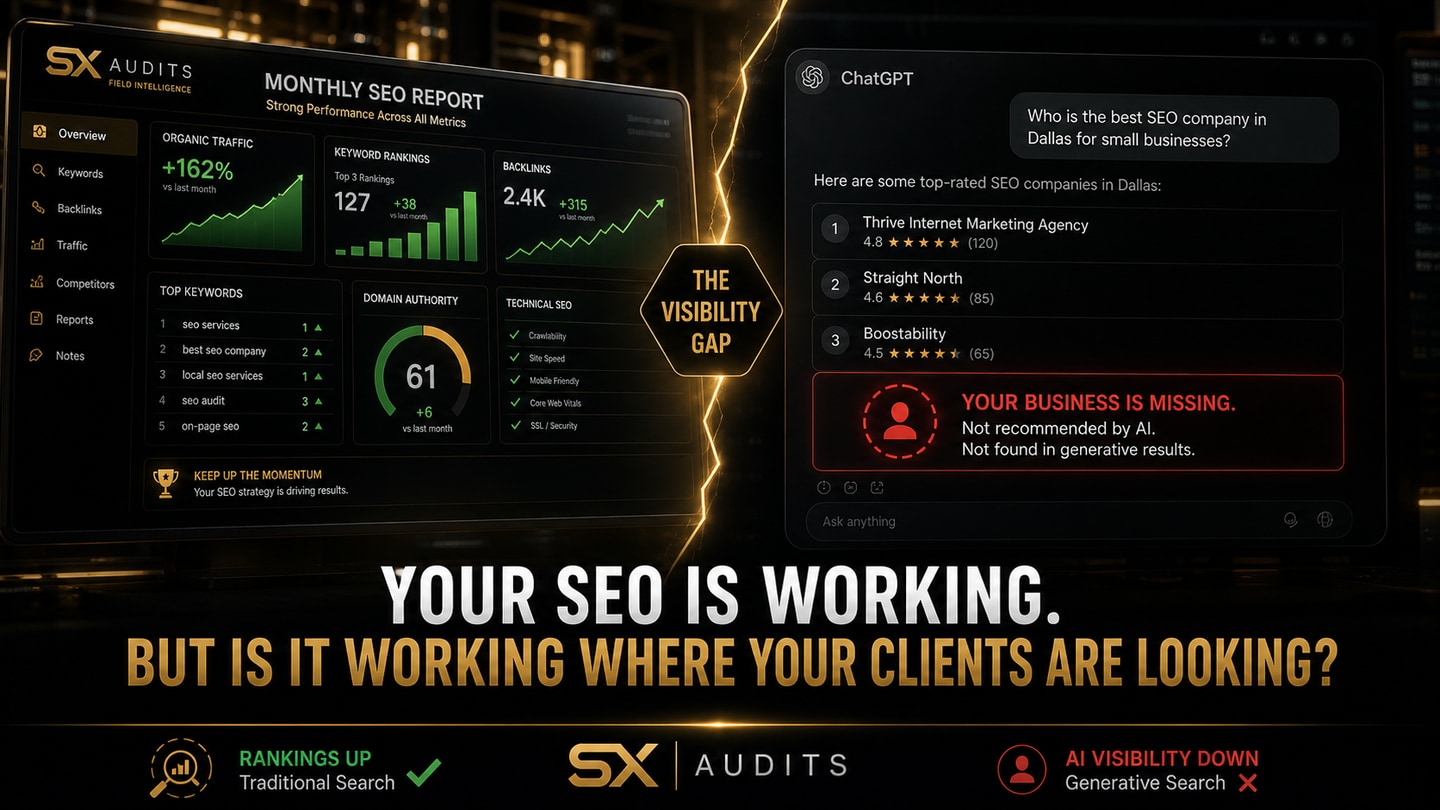
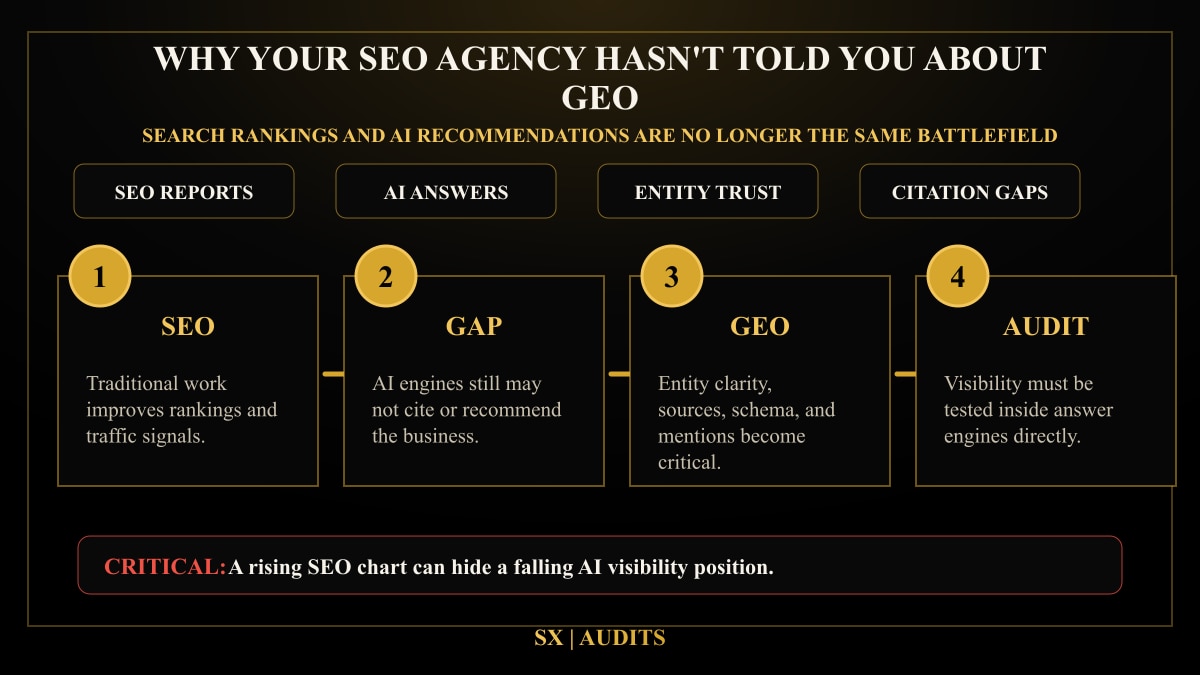
Why Your SEO Agency Hasn't Told You About GEO
A management consultant in Boston had worked with the same SEO agency for three years. He ranked in the top 3 for his primary search terms. His website traffic was steady. His agency sent monthly reports showing keyword rankings, backlink growth, and page authority scores.
In early 2026, he started noticing that prospective clients were mentioning that they had first heard about him through ChatGPT or Perplexity. He asked his SEO agency what they were doing about AI search visibility.
They told him they were "monitoring it."
He asked what that meant specifically. What queries were they running? What platforms were they checking? What changes to his website or schema were they making in response?
They didn't have specific answers. GEO wasn't part of their service scope. And they hadn't told him.
Why This Gap Exists
The SEO industry built its practices, tools, metrics, and business models around Google's traditional blue-link results. The entire measurement infrastructure — keyword rankings, domain authority, backlink profiles — is built to track performance in that specific environment.
Generative Engine Optimization requires a different set of signals, a different measurement framework, and a different technical implementation. Schema markup and structured data, which most SEO agencies treat as a minor technical item, are foundational to GEO. Content citability — whether AI systems can excerpt your content in direct response to a question — is a different quality criteria than keyword density or search intent alignment. Entity consistency across platforms is a GEO priority that many SEO agencies address partially but rarely comprehensively.
Most SEO agencies haven't told their clients about GEO because they haven't fully developed their GEO service offering. It's a newer discipline, and the honest answer at many agencies is that they are still figuring it out themselves.
Fewer Than 12% Of Marketing Teams Have A Documented GEO Strategy
Only 12% of marketing teams have a documented strategy for appearing in AI-generated answers. Among SEO agencies serving small and mid-sized businesses, that percentage is significantly lower. This is not a criticism — GEO is genuinely newer and the measurement tools are still being developed. But it means that the default assumption — that your SEO agency is managing your AI visibility because they manage your SEO — is almost certainly wrong.
SEO Performance And GEO Performance Have Diverged Significantly
In a landmark finding, only 12% of AI citations come from websites that ranked in Google's top 10 for the same query. The overlap between strong SEO performance and strong AI visibility has shrunk dramatically as AI platforms have developed their own citation logic, which weighs schema markup, entity consistency, content structure, and third-party validation differently than Google's ranking algorithm. A business that ranks well in Google is not automatically visible in AI — and vice versa. These are increasingly distinct channels that require distinct strategies.
The Signals That Drive GEO Are Different From The Signals SEO Agencies Optimize
Traditional SEO optimizes primarily for: keyword relevance, content depth, backlink authority, and technical crawlability. GEO optimizes primarily for: schema markup and structured entity data, content citability (quotable, structured, directly answering questions), entity consistency across all platforms (NAP, name formatting, specialty description), and third-party validation from authoritative external sources. The tools SEO agencies use to measure keyword rankings don't measure AI citation frequency. The link-building they do to increase domain authority doesn't create the structured entity signals AI systems use to identify and recommend businesses.
The Agencies That Are Telling Their Clients About GEO Are The Ones That Have Developed The Capability
The agencies that have proactively informed their clients about GEO and AI visibility — and updated their service scope accordingly — are those that have invested in developing the capability. They are testing AI platform visibility, implementing schema as a priority service, and building new measurement frameworks that track AI citation frequency alongside traditional keyword rankings. These agencies are in the minority. The presence or absence of a proactive conversation about GEO from your agency is a reasonable signal about whether they have developed GEO capability or are still optimizing in the traditional SEO paradigm.
What GEO Work Actually Looks Like
GEO implementation for a typical small business professional services client includes: complete LocalBusiness or Person schema implementation with sameAs links to all authoritative profiles; FAQ schema on key service pages; structured content rewrites that make About pages and service descriptions quotable by AI systems; NAP consistency audit and correction across the 30+ most important directories; AI platform testing across ChatGPT, Perplexity, and Google AI Overviews with specific query types; and a regular freshness cadence to prevent content staleness from suppressing AI citation rates. None of this is inherently incompatible with traditional SEO work — but it is a distinct set of actions that requires a distinct set of skills.
Questions to Ask Your SEO Agency
To assess whether they have a GEO service offering:
- What do you do specifically to improve our visibility in ChatGPT, Perplexity, and Google AI Overviews?
- How do you measure whether we're appearing in AI-generated recommendations for our category and location?
- What schema types do you implement for our site, and have you tested them through Google's Rich Results Test recently?
- Is our NAP consistent across the 30+ major directories, including the primary data aggregators?
What answers should concern you:
- "We're monitoring it" (no specific actions being taken)
- "AI search is still too new to optimize for" (the platforms are not new; the optimization discipline is)
- "Our SEO work covers AI visibility" (if they can't explain specifically how, it probably doesn't)
Want to know exactly where your business stands with AI search?
We run the full diagnostic and deliver a findings report in 72 hours. No discovery call. No commitment.
Book the Audit →Related intelligence · selected for this topic
Framework developer and systems thinker specializing in AI implementation and decision architecture. Creator of the AI Council methodology — a structured multi-model framework used to surface deeper insights in complex decisions. The audit intelligence at Sovereign X Audits is built on these same principles.
aicouncilconductor.com →Find out exactly where your business stands.
We audit your digital infrastructure, AI visibility, and brand presence — and show you exactly what it's costing you.