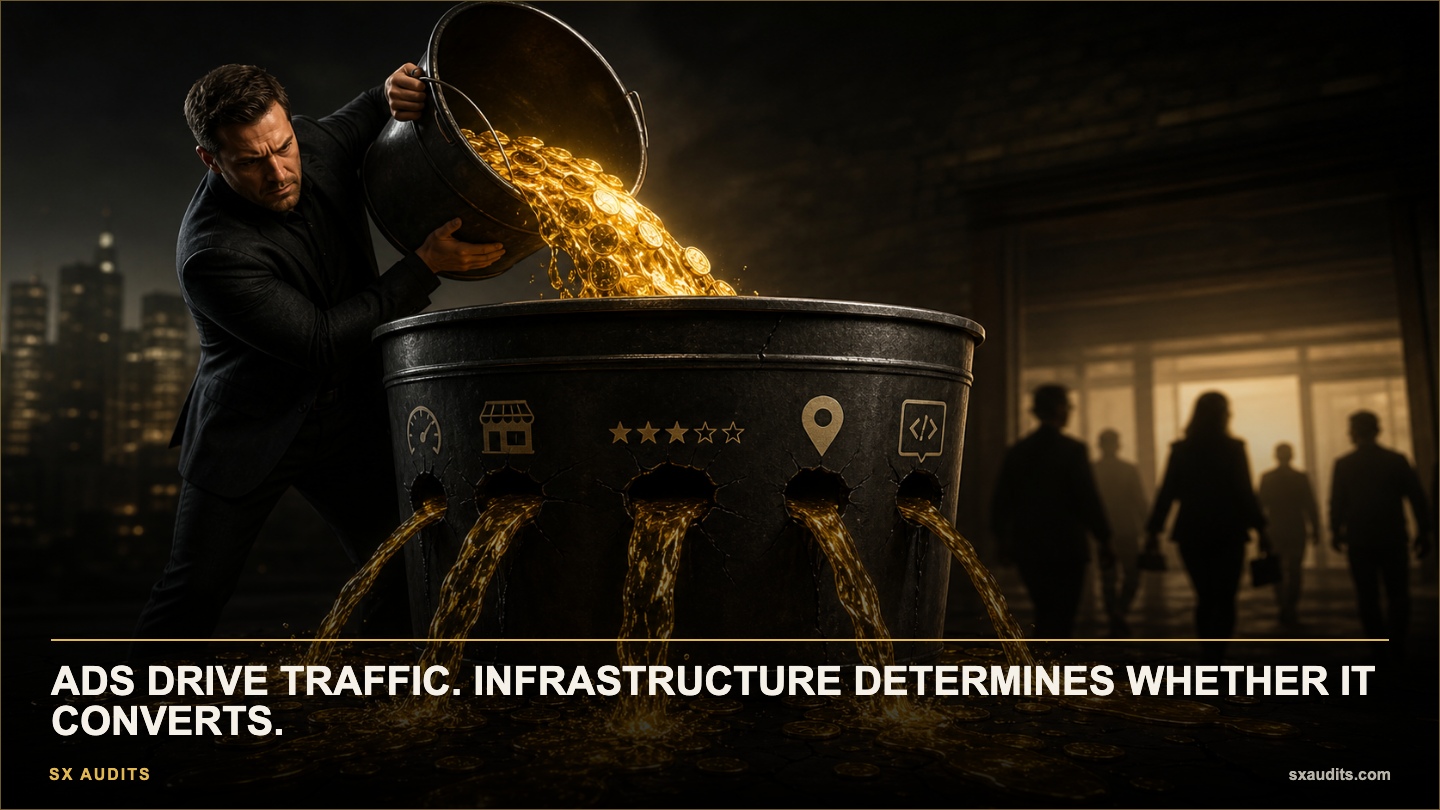
Why You Need to Fix Your Visibility Before Running Ads
A physical therapist in Chicago spent $2,400 per month on Google Ads. Her campaigns were professionally managed. Her click-through rates were above benchmark. Plenty of people were clicking.
But her GBP had no services listed and hadn't been updated in two years. Her website took 6.1 seconds to load on mobile. Her NAP was inconsistent across three major directories. She had no FAQ content and no schema markup.
When people clicked her ad and arrived at her website, they found an outdated page that raised more questions than it answered. When they searched for her name to do a second check before booking, what they found didn't reassure them. Most left without contacting her.
She was spending $2,400 per month to drive traffic to a bucket with a hole in it.
Why Ad Spend Without Visibility Infrastructure Doesn't Work
Running ads creates a traffic event. Visibility infrastructure determines what happens when that traffic arrives and what they find when they search for you before or after clicking.
Most small businesses underestimate how much pre-conversion research their potential customers do. Ninety-seven percent of consumers search a business online prior to any purchase decision. A prospective client who clicks your Google Ad does not immediately book — they verify. They look you up. They check your reviews. They visit your website to see if it looks legitimate. They may ask ChatGPT what they should know about you or your category. They look at how recently your GBP has been updated. They read your reviews — in 2026, 41% of consumers always read reviews before engaging a business, up from 29% the year prior.
If what they find during that verification process doesn't match the promise of the ad, they don't convert. Your ad spend drove a qualified lead that your infrastructure failed to close.
Ad Spend Waste Is Structural, Not Just Targeting
Studies show 30–50% of ad budgets are wasted annually across industries. The popular explanation is poor targeting — the wrong keywords, the wrong audience, the wrong timing. But the more persistent cause is structural: ads drive traffic to websites and business presences that cannot convert it. Of every dollar entering a demand-side platform, only $0.36 reaches actual consumers in ways that drive meaningful engagement. The remainder is lost through technical inefficiencies, misaligned landing experiences, and the fundamental disconnect between what the ad promises and what the destination delivers. Fixing targeting without fixing the destination is rearranging deck chairs.
Conversion Rate Is The Multiplier On All Ad Spend
The median website conversion rate across industries is approximately 2.35%. The top 10% of websites convert at 11.45% or higher. Mobile converts at 1.82% compared to desktop's 3.14%. A business spending $2,000/month on ads with a 1.2% conversion rate is generating 12 conversions. The same $2,000 with a 3.5% conversion rate generates 35 conversions — at zero additional ad cost. Every percentage point of conversion rate improvement multiplies the return on existing ad spend. But improving conversion rate requires fixing the infrastructure the ad traffic lands on: page speed, mobile performance, content clarity, trust signals, and consistent reviews.
Trust Signals Are The Most Commonly Missing Conversion Element
Seventy-four percent of consumers trust businesses more when they have positive Google reviews. Eighty-three to 84% of consumers trust Google reviews almost as much as personal recommendations. In 2026, 31% of consumers will only use a business with 4.5 stars or more, up from 17% the prior year. A business running ads but with a GBP showing fewer than 10 reviews, an incomplete profile, or a 3.2-star average is driving paid traffic to a trust gap. The ad gets the click; the GBP loses the conversion.
AI Visibility Is Now Part Of The Pre-conversion Verification Loop
In 2026, a growing share of potential customers perform pre-conversion research not only on Google but on AI platforms. Forty-five percent of U.S. consumers use AI tools for local business recommendations, up from 6% in early 2025. When a prospective customer asks ChatGPT "what should I know about [business name] before booking?" — and the AI returns an inaccurate, incomplete, or missing response — that's a trust failure in the verification loop. Running ads without schema markup and AI-readable content means ads are driving traffic to a business that AI can't confidently describe.
The Correct Order Is Infrastructure, Then Amplification
The businesses that run the most efficient ad campaigns in 2026 build their infrastructure first. Their website loads in under 2.5 seconds. Their GBP is complete, verified, and updated regularly. Their NAP is consistent across directories. They have schema markup. They have enough reviews and a high enough average that trust signals support the conversion. They have FAQ content that answers the questions potential customers are Googling during their verification process. Only then do they run ads — to amplify a system that can convert the traffic they're paying for.
The Visibility Infrastructure Checklist — Before Running Ads
Foundation (must be in place):
- Website loads in under 3 seconds on mobile
- GBP is claimed, verified, and complete — services, description, photos, hours
- NAP is consistent across website, GBP, and major directories
- You have at least 10 recent reviews with an average of 4.0 or higher
Trust infrastructure (should be in place):
- Website has a clear service description, methodology, and contact mechanism
- GBP has photos updated within the last 3 months
- You have responded to recent reviews — both positive and negative
- Schema markup is live on your website
AI visibility layer (increasingly essential):
- Your website has FAQ content addressing your most common new client questions
- You appear accurately when searched in ChatGPT or Perplexity
- Your About page is written in clear, quotable language AI systems can cite
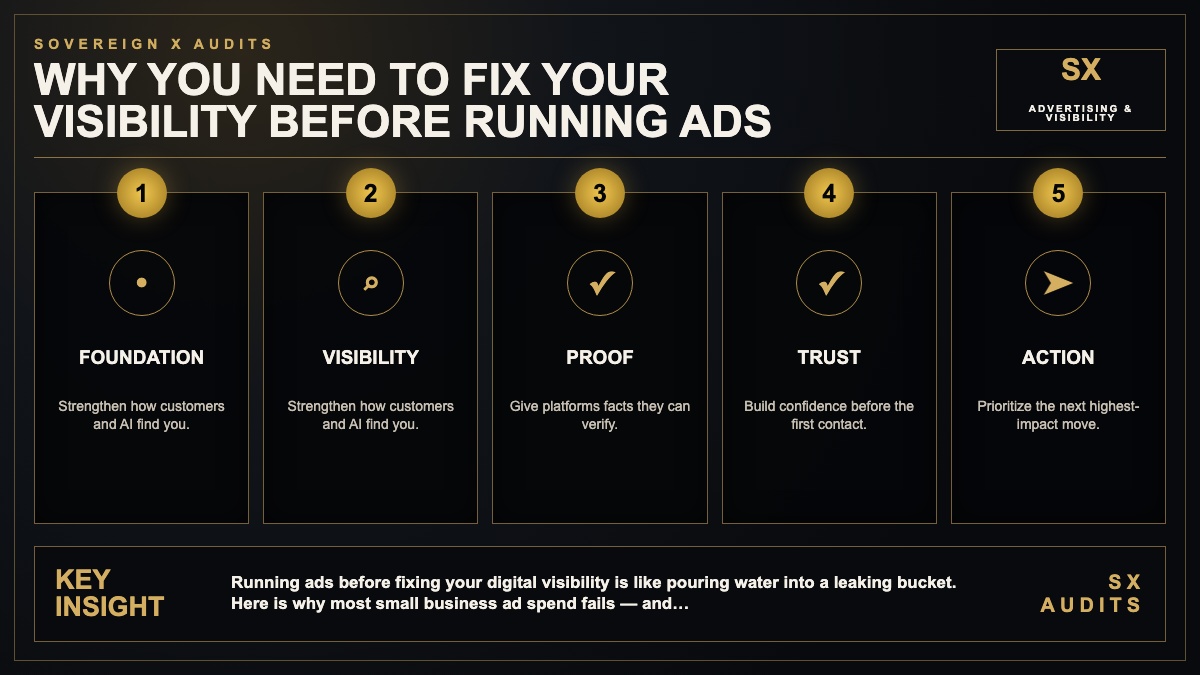
Want to know exactly where your business stands with AI search?
We run the full diagnostic and deliver a findings report in 72 hours. No discovery call. No commitment.
Book the Audit →Related intelligence · selected for this topic
Framework developer and systems thinker specializing in AI implementation and decision architecture. Creator of the AI Council methodology — a structured multi-model framework used to surface deeper insights in complex decisions. The audit intelligence at Sovereign X Audits is built on these same principles.
aicouncilconductor.com →Find out exactly where your business stands.
We audit your digital infrastructure, AI visibility, and brand presence — and show you exactly what it's costing you.