Why People Google Your Business Before They Call
A family law attorney in Charlotte had a strong referral network. He was well-regarded in his field, had 19 years of experience, and came recommended by name from other professionals regularly.
He began noticing that referrals were converting to consultations at a lower rate than they used to. Someone would mention his name, the prospective client would say they'd reach out — and then not call.
He asked a trusted colleague what they thought was happening. She suggested he search his own name the way a prospective client would. He did.
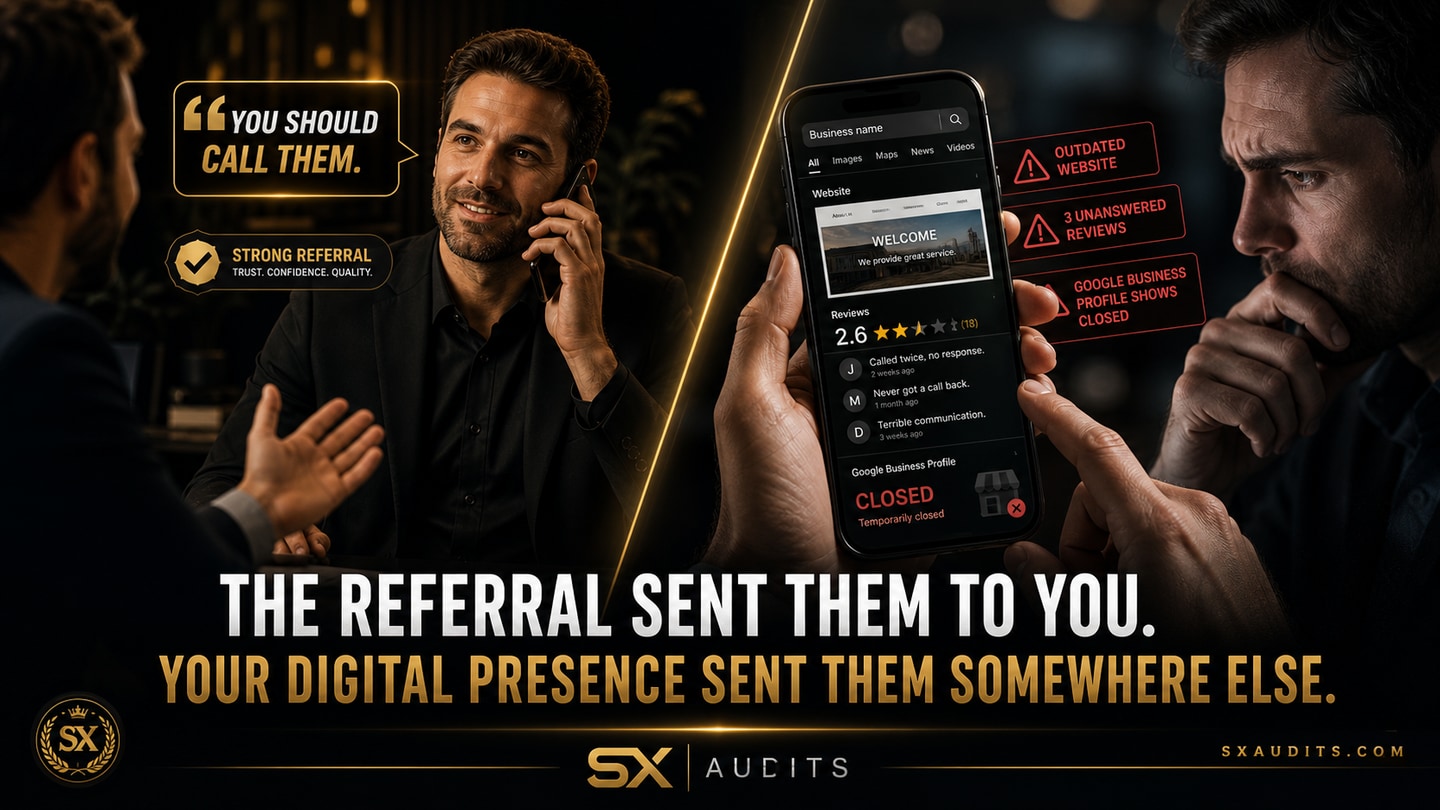
What he found: a Google Business Profile showing "Closed" during hours he was open, because he had never updated the hours after a schedule change two years ago. Three unanswered one-star reviews from the same difficult client situation in 2022. A website last updated in 2020 with a photo of himself that he no longer recognized as current. LinkedIn showing a former firm he had left.
The referral was doing its job. His digital presence was undoing it.
The Research Happens Before the Call, Not After
The assumption many established businesses operate on — particularly those built on referrals and reputation — is that the phone call comes before the research. Someone gets a recommendation, they call, they decide whether to proceed.
That is no longer the sequence. In 2026, the research happens before the call.
Ninety-seven percent of consumers read online reviews of a local business before visiting or contacting them. Eighty-one percent conduct online research before making a purchase of any kind. Eighty-three percent read Google reviews specifically before making a decision. Consumers now read an average of 10 online reviews before they will trust a business enough to make contact.
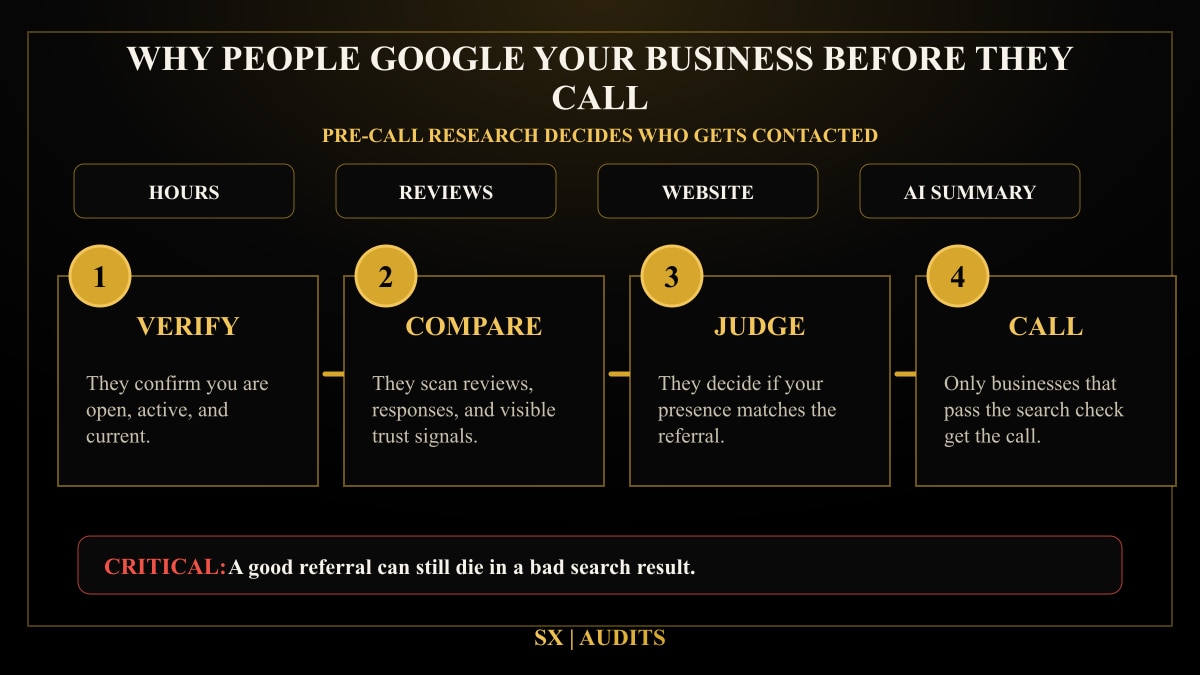
The referral, the word-of-mouth recommendation, the professional endorsement — these no longer send people directly to a phone call. They send people to Google first. What Google shows them in the next 30 seconds determines whether the call happens.
The Research Window Is Short And The Decision Is Fast
After a local business search on a mobile device, 88% of consumers will either call or visit the business within 24 hours — which means the research phase is compressed and decisive. The consumer is not conducting a multi-day investigation. They are performing a rapid trust verification: does this business look like what was described to me? Does it have enough reviews to confirm it's legitimate? Does its digital presence match the caliber of service I'm looking for? If the answer to any of those questions is no — if the hours are wrong, if the reviews are concerning, if the website looks outdated — the call goes to someone else. The verification happens fast and the decision follows immediately.
Reviews Are The Primary Trust Mechanism Of The Pre-call Research Phase
In 2026, 41% of consumers always read reviews before engaging a business — up from 29% the prior year. Forty percent check at least two review sites before choosing a local business. Thirty-one percent will only engage a business with 4.5 stars or more, compared to 17% the year before. Fifty-nine percent of consumers only trust a star rating if the business has more than 20 reviews to support it. The implication for an established business is direct: years of excellent work do not translate into trust signals unless that work has produced a visible review record. A business with 19 years of experience and 14 Google reviews is presenting a thinner trust signal than a two-year-old competitor with 85 reviews.
Unanswered Negative Reviews Are Especially Damaging In The Pre-call Window
A prospective client who finds three unanswered one-star reviews during their pre-call research is finding a one-sided account with no voice from the business to provide context or demonstrate professionalism. Businesses that respond to negative reviews — professionally, specifically, without defensiveness — consistently convert more pre-call researchers than those that don't, because a thoughtful response demonstrates accountability and care. The review itself is data. The response is character. A business with three one-star reviews and three thoughtful professional responses is presenting a more trustworthy picture than a business with three one-star reviews and silence.
AI Platforms Have Added A New Layer To The Pre-call Research Sequence
In 2026, the pre-call research sequence for a growing share of consumers is not just Google — it includes AI. Google AI Overviews appeared for 68% of local searches in Q2 2025. Forty-five percent of U.S. consumers now use AI tools for local business recommendations. A consumer who receives a referral may search the name on Google, check the GBP and reviews, and also ask ChatGPT or Perplexity "what should I know about [business name] before calling?" If the AI returns an inaccurate description, a thin response, or says it doesn't have reliable information — that is a trust gap in the research sequence that reduces conversion probability. The pre-call research now spans traditional search, review platforms, and AI platforms simultaneously.
The Information Most Commonly Checked Has A Consistent Pattern
Across industries, the pre-call research follows a consistent pattern: the consumer first verifies the business is still operational (current hours, recent activity), then checks the review profile (volume, recency, average rating, response behavior), then checks the website for credibility (does it look professional and current?), then optionally checks for professional credentials or third-party mentions (association memberships, press coverage, directory listings). A business that is strong on all four — current hours, active reviews, credible website, visible credentials — converts a far higher percentage of referrals into first calls than one with gaps in any of those areas.
What Pre-Call Researchers Are Looking For — and What Causes Them to Stop
They check first:
- Is this business still operating? (Current hours, recent GBP activity, recent review dates)
- Does it have enough reviews to feel legitimate? (Volume and recency, not just average)
- What do the reviews say, and how does the business respond?
They then check:
- Does the website look like the quality of service I was told to expect?
- Are the credentials, experience, and specialization consistent with what I was told?
- Does the business appear in AI-generated summaries as described?
Causes them to stop and call someone else:
- Hours showing "Closed" when the business is open
- Fewer than 10 reviews for a business that has been operating for years
- Unanswered negative reviews that raise specific concerns
- A website clearly not updated in several years
- Information that conflicts with the referral they received (different specialty, different address, different name)
Want to know exactly where your business stands with AI search?
We run the full diagnostic and deliver a findings report in 72 hours. No discovery call. No commitment.
Book the Audit →Related intelligence · selected for this topic
Framework developer and systems thinker specializing in AI implementation and decision architecture. Creator of the AI Council methodology — a structured multi-model framework used to surface deeper insights in complex decisions. The audit intelligence at Sovereign X Audits is built on these same principles.
aicouncilconductor.com →Find out exactly where your business stands.
We audit your digital infrastructure, AI visibility, and brand presence — and show you exactly what it's costing you.