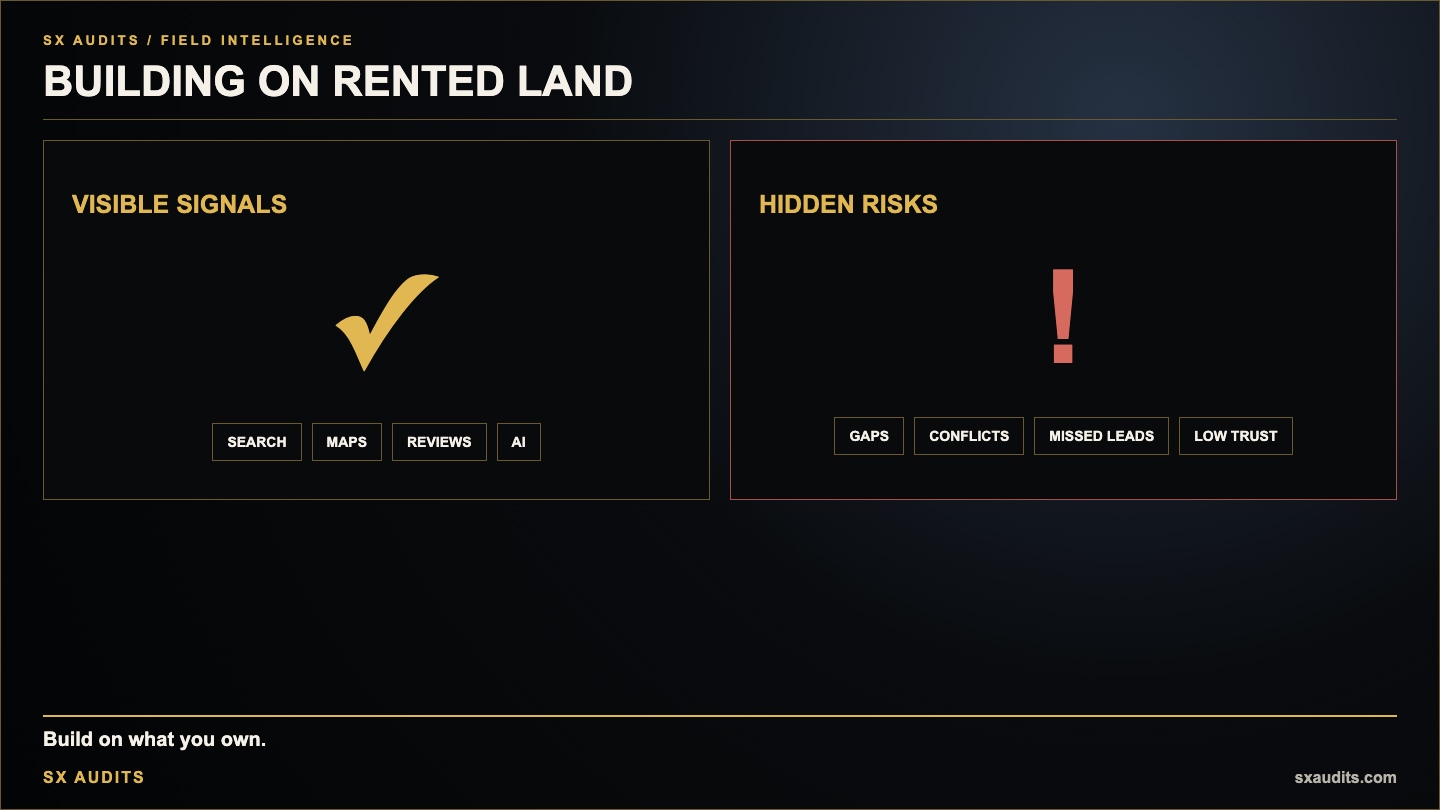
Why Most Businesses Are Building on Rented Land — and What It Costs Them
A Brooklyn fitness studio had spent three years building a Facebook audience. Consistent posting, real engagement, a community that genuinely loved the brand. By 2023, organic posts that used to reach 4,000 people were reaching 200. The algorithm had changed. The landlord had raised the rent.
The owner hadn't changed anything. The platform had. And because the business had built on rented land — no email list, no owned website with direct booking, no presence that the platform didn't control — there was no foundation to fall back on.
What "Rented Land" Means
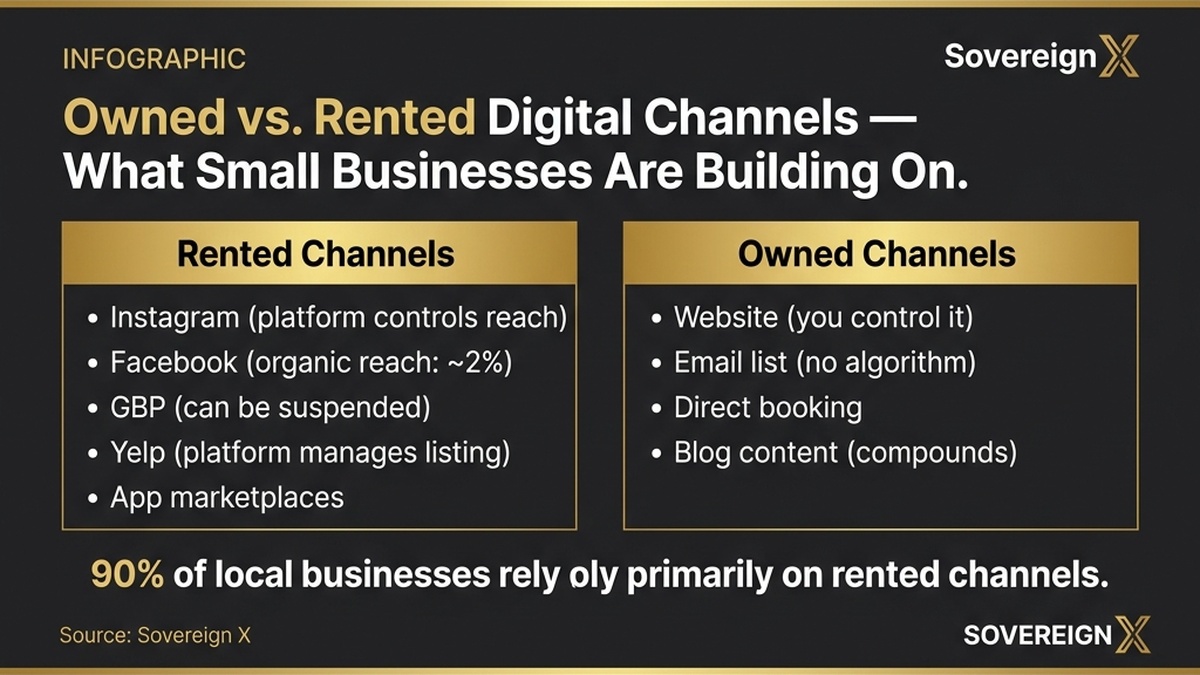
Rented land in the digital context means any platform you use to reach customers where you do not control the rules. Social media accounts, Google Business Profiles, app marketplaces, third-party review platforms — these are all rented. You can build on them. You cannot own them.
The risk is not theoretical. Algorithms bury 95% of organic business content on social platforms. Ninety percent of local businesses use social media as part of their marketing strategy, and most of them have no meaningful fallback if the platform changes terms, restricts reach, or suspends the account.
On April 27, 2026, Google's mass algorithmic sweep suspended thousands of legitimate Google Business Profiles overnight. Businesses that had no owned website or email infrastructure lost their primary discovery channel with no recourse and no timeline for restoration.
Organic Social Reach Has Effectively Collapsed
The average organic reach of a business Facebook post in 2026 is under 2% of its follower base. Instagram is comparable. A business that built its audience to 10,000 followers is reaching approximately 200 people per post — without paying for promotion. Every year this number trends downward as platforms prioritize paid visibility. A business relying on organic social as its primary channel is not marketing. It is gambling.
Platform Policy Changes Can Erase Years Of Work Instantly
Platform dependency means your business is subject to policy changes you don't control and often don't know are coming. A single rule update can result in account suspension, content removal, or algorithmic suppression. This is not a rare edge case. Between Q1 2023 and Q2 2024, global Google Business Profile suspension reports increased by over 80%. Businesses with no owned digital infrastructure beyond their GBP had no alternative discovery mechanism when their listing vanished.
Your Social Audience Doesn't Belong To You
When you build a following on Instagram or Facebook, you are building a relationship with a platform, not an audience. The platform owns the contact data. You cannot export it, email it directly, or reach it without the platform's permission. Businesses with both a website and social media presence generate 2× more revenue than those with only social media — not because websites drive more traffic, but because owned channels compound and social reach erodes.
The Opportunity Cost Accumulates Silently
Every hour spent on social content that reaches 2% of followers is an hour not spent building owned infrastructure: website content that improves search rankings, schema markup that improves AI visibility, an email list that the algorithm cannot touch. Businesses that invest in rented channels exclusively are not just exposed to platform risk — they are also falling behind competitors who are simultaneously building on land they own.
The Fix Is Structural, Not Tactical
The answer is not to stop using social media or directories. It is to stop treating rented channels as the foundation. The foundation is a properly structured website, a claimed and consistent GBP, an email capture that converts social followers into owned contacts, and content infrastructure that compounds over time. Rented channels can accelerate growth built on that foundation. They cannot replace it.
What Ownership Actually Looks Like
A business that owns its digital infrastructure has: a website it controls with schema markup and original content; an email list of actual customers and prospects it can reach without a platform's permission; a Google Business Profile that is a supplement to its website, not a substitute for it; and a strategy that treats social media as a distribution tool, not an audience-building foundation.
Owned infrastructure does not erode with algorithm changes. It compounds.
Want to know exactly where your business stands with AI search?
We run the full diagnostic and deliver a findings report in 72 hours. No discovery call. No commitment.
Book the Audit →Related intelligence · selected for this topic
Framework developer and systems thinker specializing in AI implementation and decision architecture. Creator of the AI Council methodology — a structured multi-model framework used to surface deeper insights in complex decisions. The audit intelligence at Sovereign X Audits is built on these same principles.
aicouncilconductor.com →Find out exactly where your business stands.
We audit your digital infrastructure, AI visibility, and brand presence — and show you exactly what it's costing you.