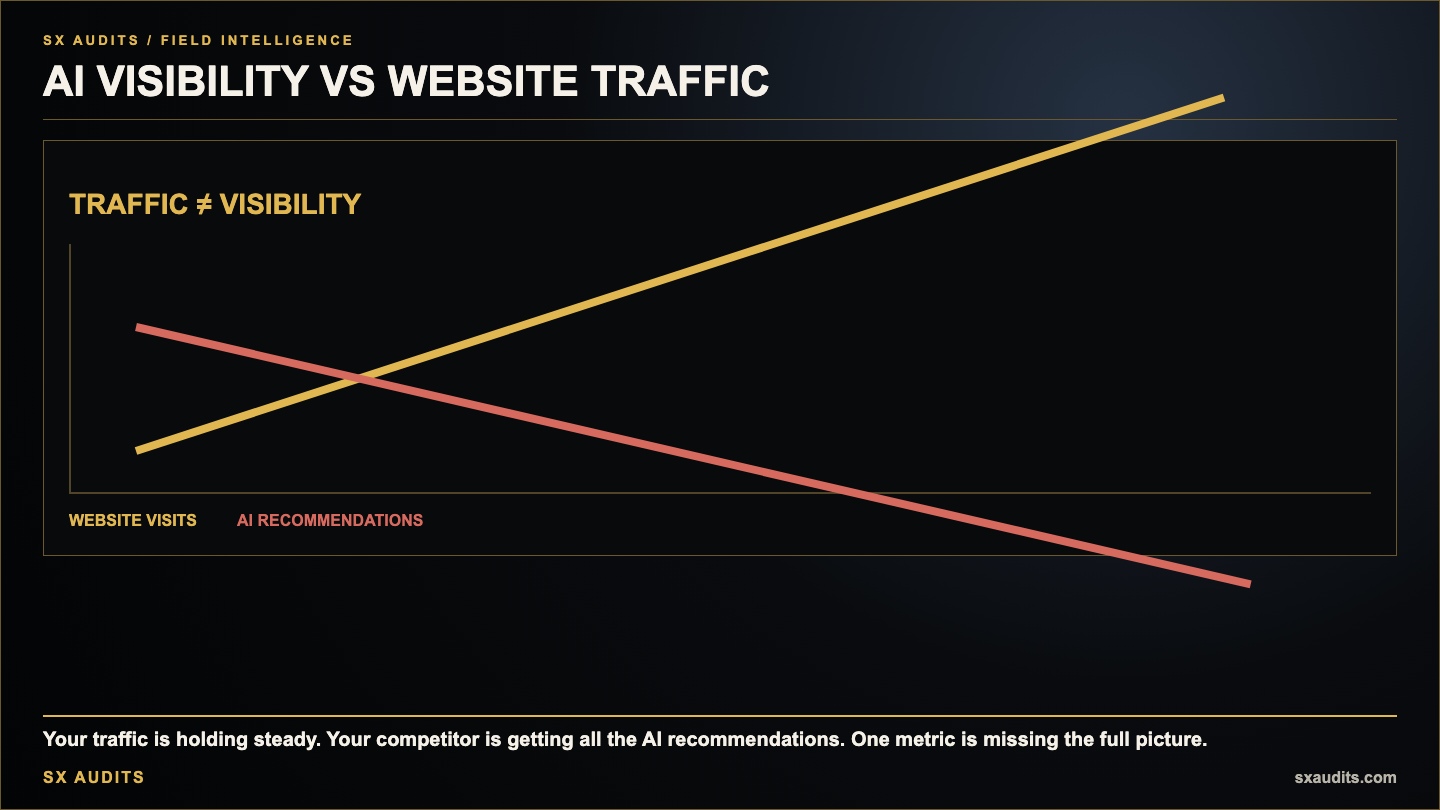
AI Visibility vs Website Traffic — Why You May Be Tracking the Wrong Number
A nutritionist in Boston had a well-maintained website with around 2,200 monthly visitors. She tracked her traffic religiously — sessions, pageviews, bounce rate, session duration. Month over month, the numbers were stable. She felt confident in her digital presence.
What her traffic dashboard could not show her: she appeared zero times in ChatGPT or Perplexity recommendations for her category. Her primary competitor — with a lower-traffic website — was being cited by AI platforms regularly because they had schema markup, an FAQ page, and a Healthgrades profile she didn't.
Her traffic was holding steady. Her share of AI-driven new client discovery was zero. Her traffic numbers had been telling her everything was fine while an entire channel of new client acquisition was functioning exclusively for her competitors.
What Traffic Measures — and What It Doesn't
Website traffic tells you how many people arrived at your website, where they came from, and what they did when they got there. It is a valuable metric. It measures the output of your current visibility — the people who found you and arrived.
It does not measure the people who didn't find you. It doesn't count the prospective client who asked ChatGPT for a nutritionist recommendation and received three names — none of which were yours. It doesn't show the searcher who typed "nutritionist Boston" into Google, received an AI Overview naming two practitioners, and booked with one of them without ever visiting your website. It doesn't capture the impact of your absence from a discovery channel.
Traffic measures presence. AI visibility measures discoverability. These are related but not equivalent — and in 2026, the gap between them is growing.
AI Search Traffic Is Under 2% Of Referrals But Converts At 4.4× The Rate
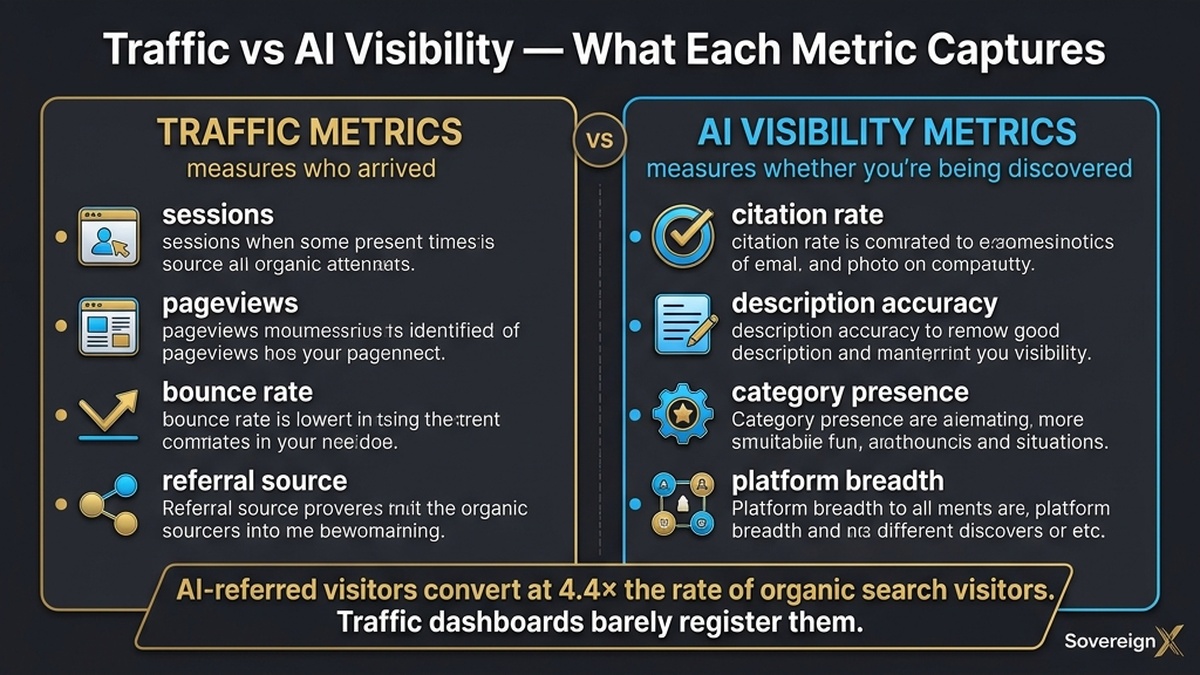
AI search currently drives under 2% of total website referral traffic across industries. Website traffic dashboards, even those showing referral source breakdowns, barely register it. But AI-referred visitors convert at 4.4 times the rate of traditional organic search visitors — because they arrive pre-qualified. An AI platform has already synthesized information, compared options, and presented curated recommendations before the user clicks a citation link. The consideration phase is substantially complete before the visit. Tracking only total traffic volume hides the disproportionate value of this small but high-quality channel.
Traditional Traffic Metrics Don't Capture Zero-click Discovery
Over 60% of Google searches now end without a click. When Google's AI Overview or featured snippet answers a question directly on the results page, the searcher never visits any website — and no traffic is recorded for any business. The businesses that appear in those zero-click results still receive brand exposure, authority signals, and influence over the buyer's next step — but none of it shows up in website traffic analytics. A business that dominates zero-click search results for its category's most common questions is generating awareness and consideration that its traffic dashboard will never capture.
AI Visibility Is Measured Differently Than Traffic
AI visibility tracks how often, how accurately, and how favorably your business appears in AI-generated responses across platforms. The relevant metrics include: citation rate (how often your business is named across a set of standardized query runs), sentiment (whether the AI description is accurate and positive), comprehension (whether AI systems correctly describe your specialty and positioning), and platform coverage (whether you appear across ChatGPT, Perplexity, and Google AI Overviews or only one). These cannot be read from Google Analytics. They require manual AI platform testing or specialized AI visibility tracking tools. A business that only measures website traffic has no visibility into these metrics — and therefore no ability to detect when AI-driven discovery is suppressed.
Declining Traffic Can Be An AI Visibility Symptom, Not Just An SEO Problem
AI Overviews reduced click-through rates for position-one Google results by up to 58% in 2025. A business that was ranking at position 2 and receiving strong organic click traffic may see their traffic decline significantly after an AI Overview begins appearing above their result — even though their ranking hasn't changed. This looks like an SEO problem in the traffic dashboard. It is actually an AI visibility opportunity: if the business appeared in the AI Overview itself, they would recapture influence over those searches even without the click. A business that responds to declining traffic by doubling down on traditional SEO may be solving the wrong problem.
The Metrics That Matter For AI Visibility Are Different From Traffic Metrics
Traffic metrics: sessions, pageviews, bounce rate, time on site, referral source. AI visibility metrics: citation frequency (appearances across standardized test runs), AI description accuracy (does the AI correctly describe what you do?), category recommendation presence (do you appear when someone asks for the best in your category?), platform breadth (how many AI platforms cite you?), and branded search lift (increases in brand-name searches that follow AI mention, often the only measurable footprint of AI influence in traditional analytics). Tracking only traffic while the AI visibility metrics are undefined is like tracking revenue while ignoring customer acquisition. One metric measures activity. The other measures the engine producing it.
A Practical Check: What Are You Currently Tracking vs. What You Should Add
You're probably tracking:
- Monthly website sessions
- Traffic by source (organic, direct, referral, social)
- Bounce rate and time on site
- Contact form submissions or bookings
You should also be tracking:
- AI citation rate: how often you appear across 15 standardized ChatGPT/Perplexity query runs
- AI description accuracy: does the AI correctly describe your specialty and positioning?
- Category recommendation presence: do you appear when AI is asked for the best in your category?
- AI referral traffic: a dedicated tracking parameter on links in any content AI systems are citing
Want to know exactly where your business stands with AI search?
We run the full diagnostic and deliver a findings report in 72 hours. No discovery call. No commitment.
Book the Audit →Related intelligence · selected for this topic
Framework developer and systems thinker specializing in AI implementation and decision architecture. Creator of the AI Council methodology — a structured multi-model framework used to surface deeper insights in complex decisions. The audit intelligence at Sovereign X Audits is built on these same principles.
aicouncilconductor.com →Find out exactly where your business stands.
We audit your digital infrastructure, AI visibility, and brand presence — and show you exactly what it's costing you.