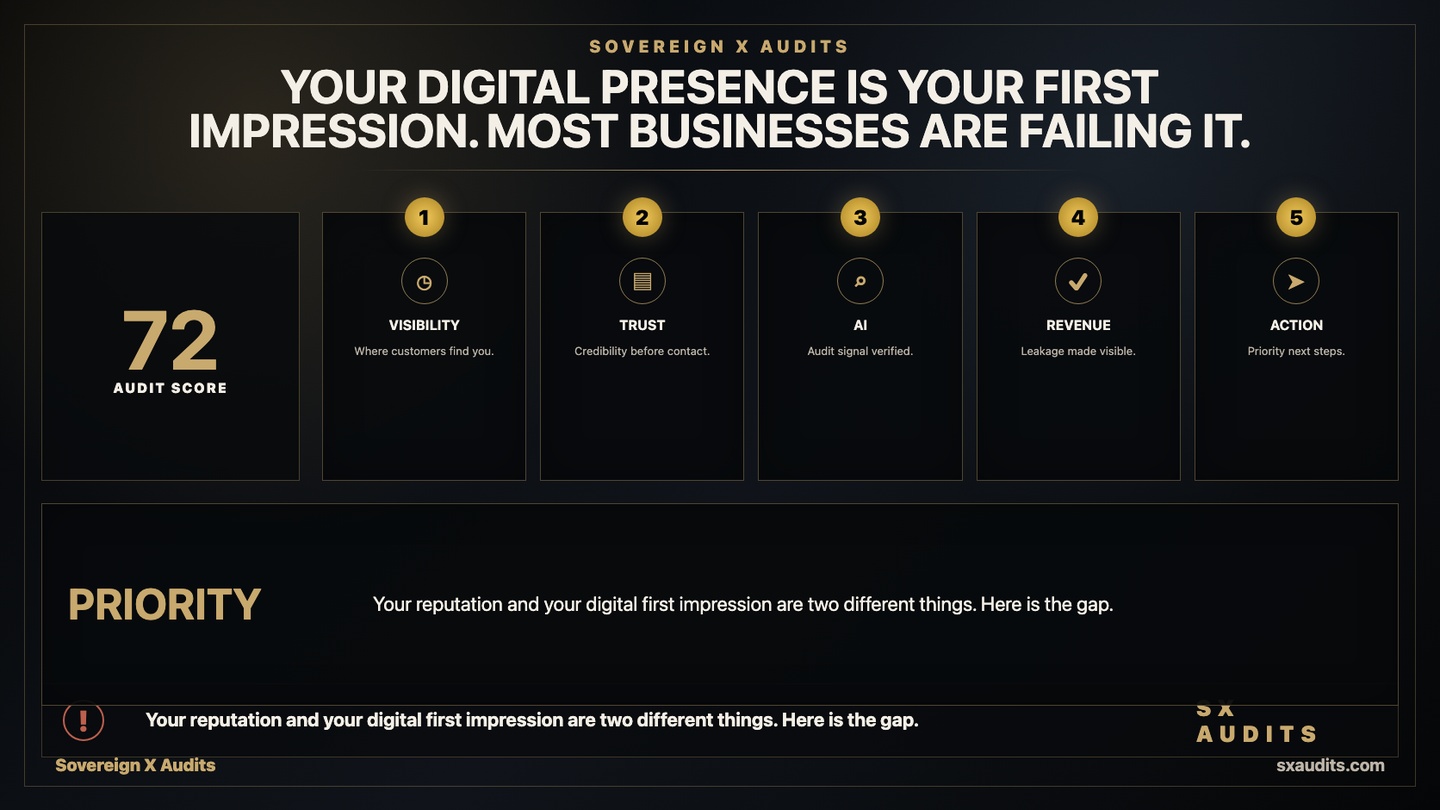
Your Digital Presence Is Your First Impression. Most Businesses Are Failing It.
A property management firm in Denver had been in business for fourteen years. Their reputation was built on referrals. Their existing clients loved them. Their retention rate was exceptional.
When a prospective client — a commercial real estate developer considering entrusting them with a portfolio of 40 units — searched their name before the first meeting, here is what she found: a website last updated in 2019 listing a service they no longer offered. A Google Business Profile with four reviews, two of which mentioned a property manager who had left the company in 2022. A LinkedIn page with eleven followers. No published articles, no case studies, no description of their methodology.
She kept the meeting. But she walked in with doubts she shouldn't have had. The fourteen-year track record should have done the talking. Instead, the digital presence told a story of a smaller, older, less credible version of the firm.
They almost lost a $180,000 contract because their digital first impression didn't match who they actually were.
The Digital First Impression Has Replaced the Handshake
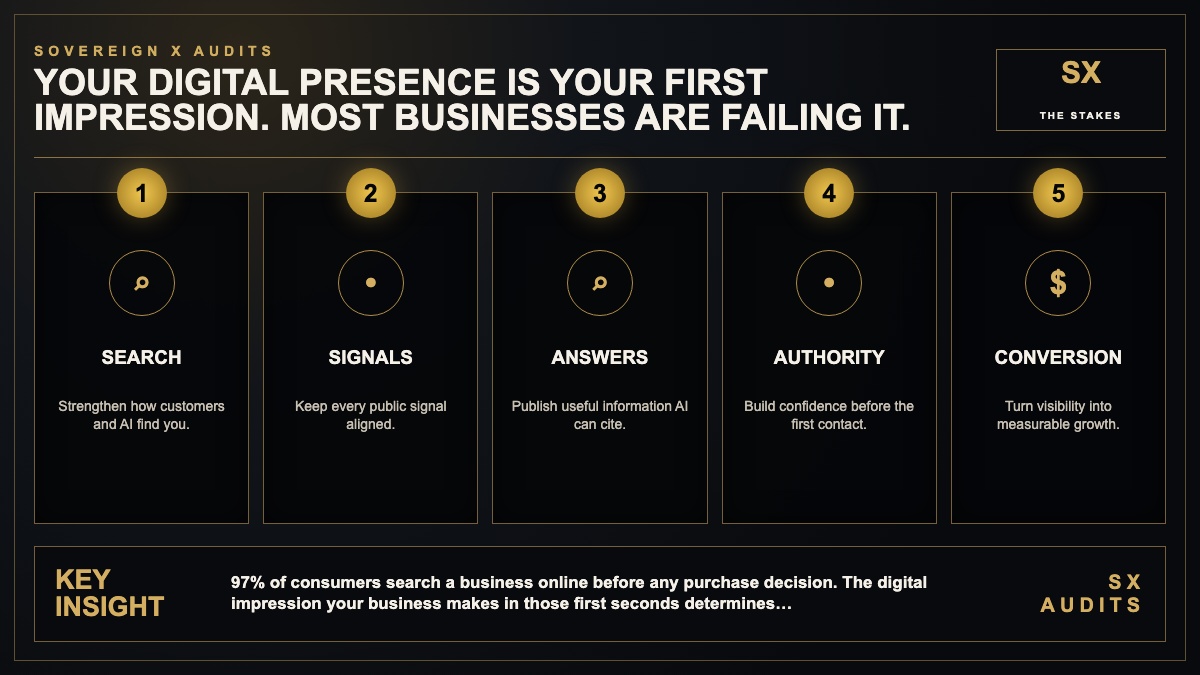
Ninety-seven percent of consumers search businesses online prior to any purchase decision. They check your site, your reviews, your social media presence, and they compare you with competitors before making contact. The digital impression your business makes is no longer background research — it is the primary first impression for the majority of people considering working with you.
And the window for that impression is brutally short. Users form an opinion about a website in approximately 50 milliseconds — before they have read a single word. It takes 7 seconds for a broader credibility judgment to form. If those 7 seconds produce doubt, 71% of buyers won't engage — and it takes an average of 8 positive interactions to overcome one negative first impression.
The question is not whether your business is making a digital first impression. It is whether the impression being made matches the business you've actually built.
The Cost Of A Mismatched Digital Impression Is Measurable
One negative search result reduces consumer trust by 22%. Three negative results — or three pieces of outdated, inconsistent, or low-quality content — reduce consumer confidence by 59%. Customers who encounter incomplete or inconsistent information about a business online are 68% less likely to contact that business. For professional service firms, the stakes are highest: executives, developers, and high-value clients are the most likely to conduct thorough pre-meeting research and the most likely to walk away from a business whose digital presence doesn't match the caliber of service being promised.
Website Design Is The Primary Credibility Signal
Seventy-five percent of consumers judge a business's credibility based on its website design. Ninety-four percent of first impressions are design-related. Nearly 40% of users abandon a site if the design is unappealing or difficult to navigate. This does not mean expensive design — it means current, professional, and consistent. A website that looks like it was built in 2015 and hasn't been updated since reads as a company that isn't active, isn't invested in its presence, and may not be the caliber of partner being sought.
Reviews Are The Trust Infrastructure Of The Digital First Impression
In 2026, 41% of consumers always read reviews before engaging a business — a significant increase from 29% the prior year. Eighty-three to 84% of consumers trust Google reviews almost as much as personal recommendations. Thirty-one percent will only engage a business with 4.5 stars or more. A business with fourteen years of exceptional service that has four Google reviews — two of which reference a departed employee — is presenting a trust signal that contradicts the reality of their operation. Reviews are the word-of-mouth of the digital era. Not having them, or having stale and unrepresentative ones, is the equivalent of showing up to a first meeting with no references.
Inconsistency Across Platforms Reads As Fragmentation
Sixty-seven percent of professionals have mismatched online and offline presence. When a prospective client's pre-meeting research produces a LinkedIn showing one set of services, a website describing a different emphasis, and a GBP listing a phone number that no longer works — the impression is not neutral. It is active doubt. AI systems processing the same inconsistent signals classify the business as ambiguous, reducing the confidence of any AI-generated summary. Human evaluators respond similarly — inconsistency reads as disorganization, inattention, or decline.
AI Summaries Are Now Part Of The First-impression Stack
In 2026, a growing share of pre-meeting research begins with an AI query — "tell me about [business name]," "what should I know about [firm] before a meeting," "what is [professional] known for?" The AI summary produced by that query is now part of the first-impression experience. If the summary is thin, inaccurate, or missing entirely because the business has no schema markup and no AI-readable content, it contributes to a first impression that raises questions rather than building confidence. A business with a strong AI summary — accurate, detailed, citing the right credentials and specialties — begins the relationship with the credibility conversation already won.
What a Strong Digital First Impression Looks Like
A prospective client who searches your business should find:
- A website that loads quickly, looks current, and clearly states who you serve and what you do
- A Google Business Profile that is complete, has recent photos, and has a volume of reviews commensurate with your years in business
- A LinkedIn presence that accurately reflects your current team, services, and expertise
- Consistent information — same name, address, phone, specialty description — across every platform
- An AI summary (from ChatGPT or Perplexity) that accurately represents your credentials and work
- No outdated content from previous phases of the business that contradicts the current reality
What they should not find:
- A website that references services you no longer offer or a team that has changed significantly
- Reviews that are disproportionately old, negative, or referencing departed staff
- Inconsistencies between your website, GBP, and professional directory listings
- No response to negative reviews
- An AI summary that gets your specialty wrong or conflates you with a competitor
Want to know exactly where your business stands with AI search?
We run the full diagnostic and deliver a findings report in 72 hours. No discovery call. No commitment.
Book the Audit →Related intelligence · selected for this topic
Framework developer and systems thinker specializing in AI implementation and decision architecture. Creator of the AI Council methodology — a structured multi-model framework used to surface deeper insights in complex decisions. The audit intelligence at Sovereign X Audits is built on these same principles.
aicouncilconductor.com →Find out exactly where your business stands.
We audit your digital infrastructure, AI visibility, and brand presence — and show you exactly what it's costing you.