What llms.txt Is, Whether You Need One, and How to Write It
If you've been following the growth of AI search optimization, you've probably seen references to llms.txt appearing in discussions about GEO and AI visibility. It sounds technical. It is not, particularly. It is a text file that takes about 30 minutes to write once and never needs to change unless your website changes significantly.
Here is an honest explanation of what it is, what it currently does, and whether your business needs to think about it.
What llms.txt Is
llms.txt is a plain-text file hosted in your website's root directory — the same level as robots.txt — written in Markdown format. It provides AI systems and large language models with a curated guide to your website's most important content: a short description of what your site is, who it's for, and a prioritized list of links to your most valuable pages.
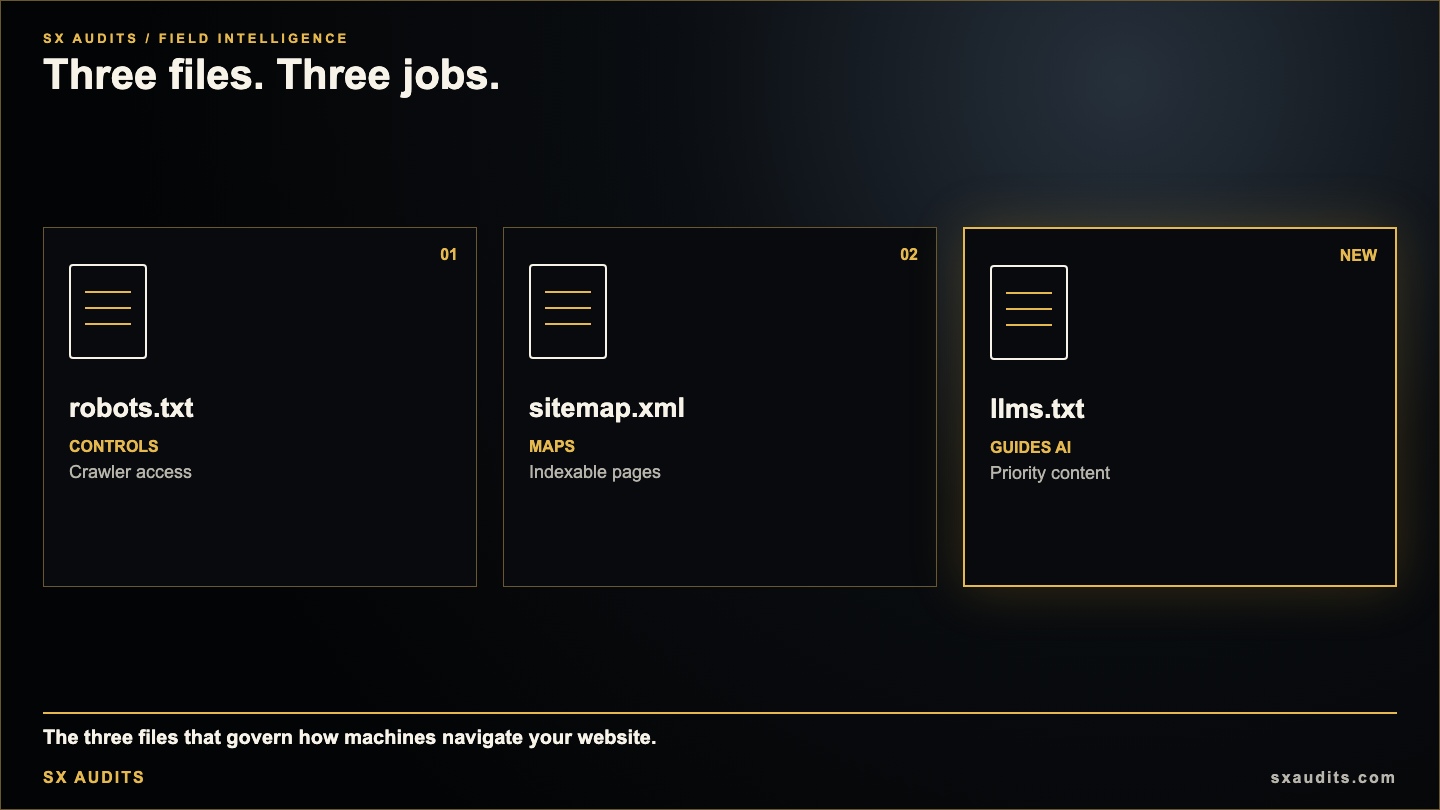
It was proposed in September 2024 by Jeremy Howard of Answer.AI, building on the established conventions of robots.txt (which controls crawler access) and sitemap.xml (which maps all indexable pages for search engines). llms.txt is different from both: it doesn't control access and it doesn't map everything. It curates a shortlist of your highest-signal pages specifically for large language models.
The analogy that works: robots.txt tells crawlers where they can't go. sitemap.xml tells search engines where everything is. llms.txt tells AI systems where the most important things are.
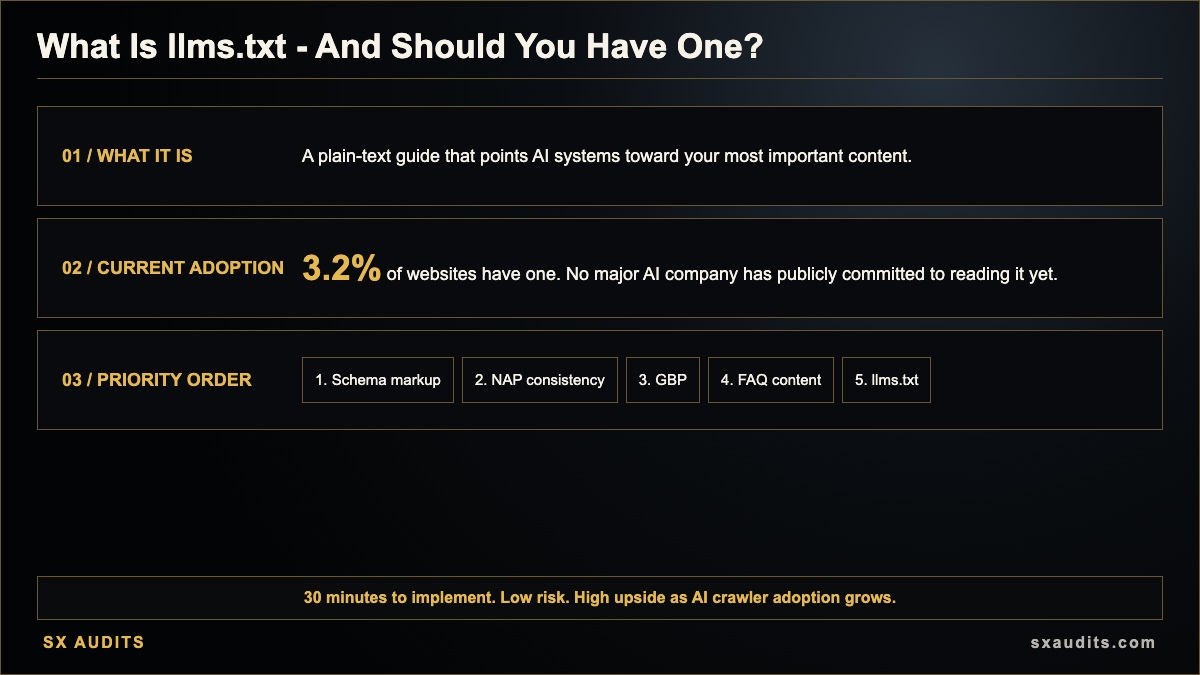
Only 3.2% Of Websites Currently Have One
As of 2026, llms.txt adoption remains extremely low despite growing attention in the GEO community. This means that implementing one is not yet a competitive standard — it is currently an early signal. Businesses that implement it now are building a technical foundation that their competitors are almost certainly not building yet.
No Major AI Company Has Publicly Committed To Reading It — Yet
As of Q1 2026, OpenAI, Google, Anthropic, Meta, and Mistral have not publicly confirmed that their production systems read or act on llms.txt files. The file is not an SEO play in the traditional sense — it does not improve Google rankings. Its current primary use case is for developers using AI-assisted tools (like GitHub Copilot or Cursor) to work with your site, and as a forward-looking investment in AI crawler infrastructure as adoption grows.
It Pairs With Schema Markup Rather Than Replacing It
llms.txt and schema markup address different layers of the same problem. Schema markup communicates your business identity in machine-readable structured data embedded in your HTML — this directly influences search engine rankings and current AI citation systems. llms.txt communicates your content hierarchy to AI systems navigating your site — this is more relevant to future AI systems as the standard matures. Both are worth implementing; schema markup is significantly higher priority for businesses focused on near-term AI visibility.
Writing One Takes Under 30 Minutes
An llms.txt file for a small business website is typically 20–40 lines. It begins with a brief Markdown description of what your website is and who it serves, followed by a prioritized list of your most important pages: homepage, core service pages, FAQ, contact, and any high-quality blog content. That's it. No coding required. A plain-text editor and 30 minutes is sufficient.
It Signals Technical Seriousness Even Before Adoption Matures
For businesses actively building AI visibility infrastructure, an llms.txt file is a low-cost signal that the website is prepared for AI-first discovery. As AI crawler adoption grows — which it will — websites with llms.txt files are positioned to benefit early. The cost of implementation is 30 minutes. The potential upside is meaningful as major AI platforms formalize their crawler behavior.
Should Your Business Create One?
Yes, if: You are actively building GEO infrastructure and want to be technically complete. You are in a competitive market where AI visibility differentiation matters. You have a developer who can implement it quickly.
Lower priority, if: You haven't yet implemented LocalBusiness schema, claimed your GBP, or standardized your NAP. Fix those foundational elements first — they have a far larger near-term impact on AI visibility.
The honest priority order for most small businesses is: schema markup first, NAP consistency second, GBP completion third, FAQ content fourth. llms.txt is a strong addition after those foundations are in place.
A Basic llms.txt Template
# [Your Business Name]

> [One sentence description of what your business does and who it serves]

[One or two sentences of additional context about your methodology, specialization, or service area]

## Core Pages

- [Homepage](https://yourdomain.com/): [One-line description]
- [Services](https://yourdomain.com/services): [One-line description]
- [FAQ](https://yourdomain.com/faq): [One-line description]
- [Contact](https://yourdomain.com/contact): [One-line description]

## Key Content

- [Blog Post 1](https://yourdomain.com/blog/post-1): [One-line description]
- [Blog Post 2](https://yourdomain.com/blog/post-2): [One-line description]
Upload this file as llms.txt to your website's root directory (the same location as robots.txt). Verify it's accessible at yourdomain.com/llms.txt.
Want to know exactly where your business stands with AI search?
We run the full diagnostic and deliver a findings report in 72 hours. No discovery call. No commitment.
Book the Audit →Related intelligence · selected for this topic
Framework developer and systems thinker specializing in AI implementation and decision architecture. Creator of the AI Council methodology — a structured multi-model framework used to surface deeper insights in complex decisions. The audit intelligence at Sovereign X Audits is built on these same principles.
aicouncilconductor.com →Find out exactly where your business stands.
We audit your digital infrastructure, AI visibility, and brand presence — and show you exactly what it's costing you.