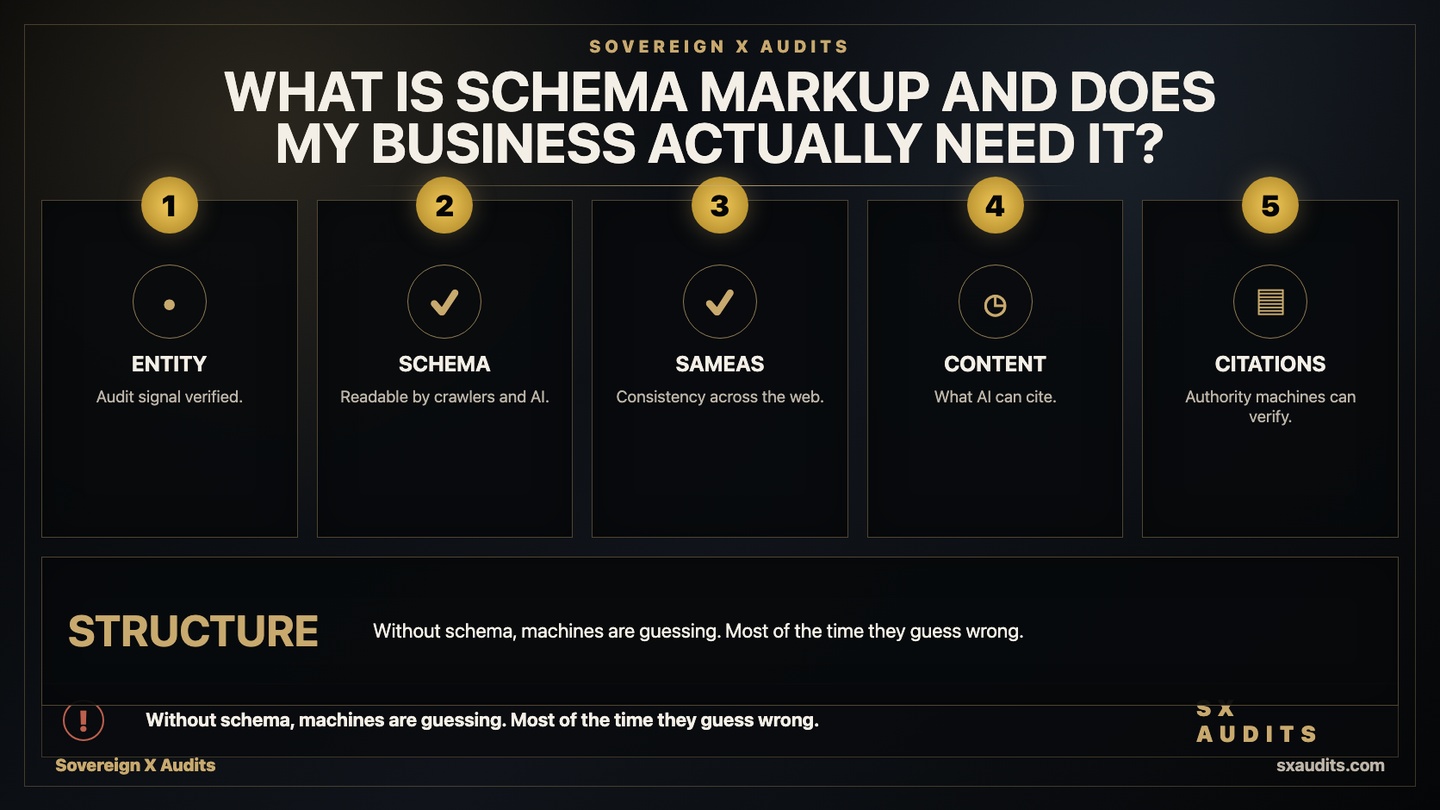
What Is Schema Markup and Does My Business Actually Need It?
A bakery owner in Park Slope asked her web developer if her website had schema markup. He said he'd look into it. Three weeks later he reported back: "I added some meta tags and cleaned up the code. You're good."
Meta tags are not schema markup. They are different things entirely. The developer either didn't know the difference or hoped she wouldn't. She still has no schema. And Google's Rich Results Test confirms it.
Schema markup is one of the most consistently underdone elements of small business websites — and one of the highest-return fixes available.
What Schema Markup Actually Is
Schema markup is structured data code — typically written in JSON-LD format and embedded in your website's HTML — that communicates explicitly to machine systems what your business is, where it is, what it does, and who it serves.
Think of it this way: when a human visits your website, they read your copy, look at your photos, and form an understanding of your business. When a machine system — Google's search algorithm, an AI recommendation engine, Bing, Perplexity's crawler — visits your website, it processes structured signals rather than human-readable prose. Schema markup is the explicit instruction set for those machine readers.
Without it, machines must infer your business identity from unstructured text. They frequently get it wrong, get it incomplete, or skip your business entirely in favor of one that provides cleaner signals.
Localbusiness Schema Is The Most Important For Small Businesses
LocalBusiness schema is a specific type of structured data from schema.org that tells machine systems your business name, address, phone number, business hours, geographic service area, business category, and website URL — all in a standardized format machines can process reliably. This schema type directly influences local search rankings, Google Maps placements, featured snippets, and AI recommendation systems. Businesses with properly implemented LocalBusiness schema see 20–30% higher click-through rates compared to those without it.
Faq Schema Creates Citation Targets For AI
FAQ schema marks up question-and-answer content on your website in a format that AI systems can extract and cite directly in generated responses. A page with FAQ schema becomes a citation target: the AI can quote your answer, attribute it to your business, and include your business name in its recommendation. Pages with well-organized headings and FAQ structure are 2.8× more likely to earn AI citations. For businesses trying to appear in ChatGPT and Perplexity responses, FAQ schema is one of the highest-leverage investments available.
Rich Results Drive Significantly Higher Click-through Rates
When schema is implemented correctly, it enables rich results — enhanced search listings that display star ratings, hours, FAQs, review counts, and other structured information directly in the search results page. Users click rich results 58% of the time compared to 41% for standard listings. Pages appearing as rich results achieve 82% higher click-through rates compared to standard listings. This is not a marginal improvement — it is a substantial conversion difference at the top of the funnel.
Most Professional Websites Are Delivered Without It
Despite its importance, schema markup is consistently absent from websites built by designers whose expertise is primarily visual. A website can look exceptional and have zero structured data. Google's "spammy structured data" filters are also sharper than ever — schema that misrepresents content (marking up a five-star rating with no visible reviews, for example) can trigger penalties. The implementation must match the visible content of the page.
Implementation Takes Under Two Hours For Most Small Business Websites
LocalBusiness schema for a typical small business website can be written in under 30 minutes and embedded in under 30 minutes more. Multiple free schema generators are available online (schema.org, Google's Structured Data Markup Helper). The resulting code is a few dozen lines of JSON added once to your website's header or homepage. For most businesses, this is a two-hour investment with compounding returns.
Does Your Business Need It?
If your business has a physical location, serves a geographic area, or provides services to customers who search locally — yes, you need LocalBusiness schema.
If your website has any FAQ content, service descriptions, or informational pages that answer questions customers ask — yes, you need FAQ schema.
If you want your business to appear in AI recommendations on ChatGPT, Perplexity, and Google AI Overview — schema markup is not optional. It is the machine-readable foundation everything else is built on.
How to Check If You Have It
Go to search.google.com/test/rich-results. Enter your website URL and run the test. If LocalBusiness schema is present and valid, it will appear in the results. If the results show no structured data or flag errors, your website does not have functioning schema markup.
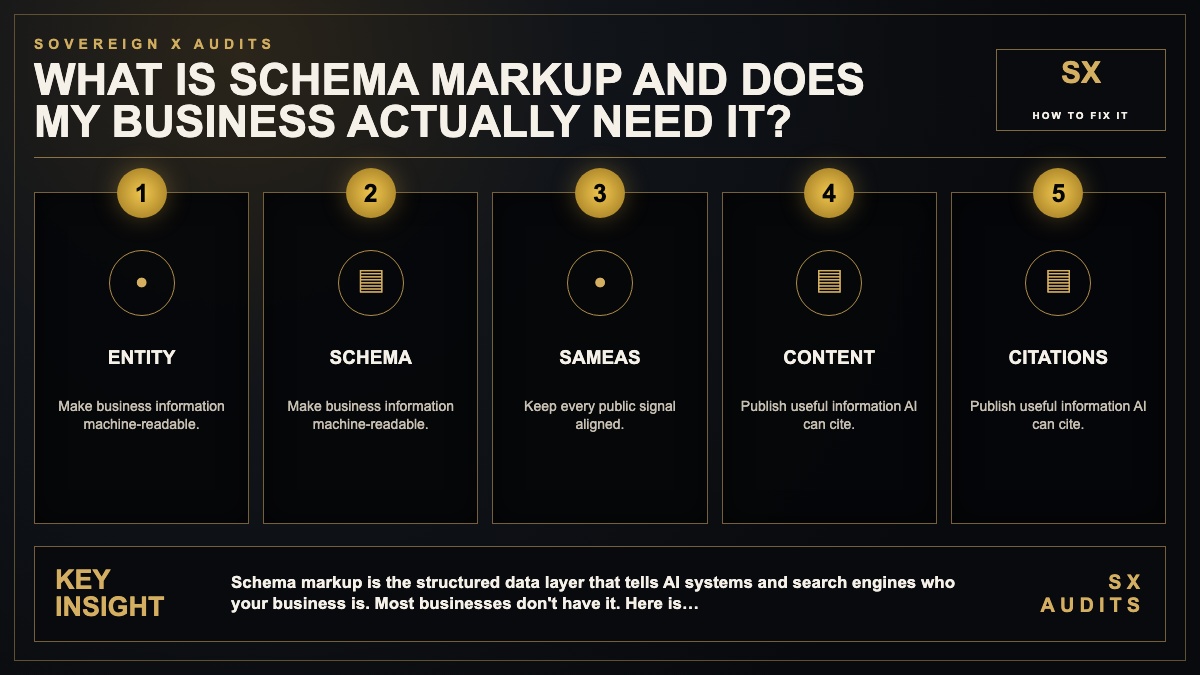
Want to know exactly where your business stands with AI search?
We run the full diagnostic and deliver a findings report in 72 hours. No discovery call. No commitment.
Book the Audit →Related intelligence · selected for this topic
Framework developer and systems thinker specializing in AI implementation and decision architecture. Creator of the AI Council methodology — a structured multi-model framework used to surface deeper insights in complex decisions. The audit intelligence at Sovereign X Audits is built on these same principles.
aicouncilconductor.com →Find out exactly where your business stands.
We audit your digital infrastructure, AI visibility, and brand presence — and show you exactly what it's costing you.