What Is an Online Presence and Why Is It Different from Having a Website?
A dentist in Queens built a website five years ago. It lists his services, his hours, his address. He pays $200 a month for someone to "maintain" it. When a new patient recently told him she almost didn't book because she couldn't find him online, he was confused. "I have a website," he said.
He does. What he doesn't have is an online presence.
The Difference
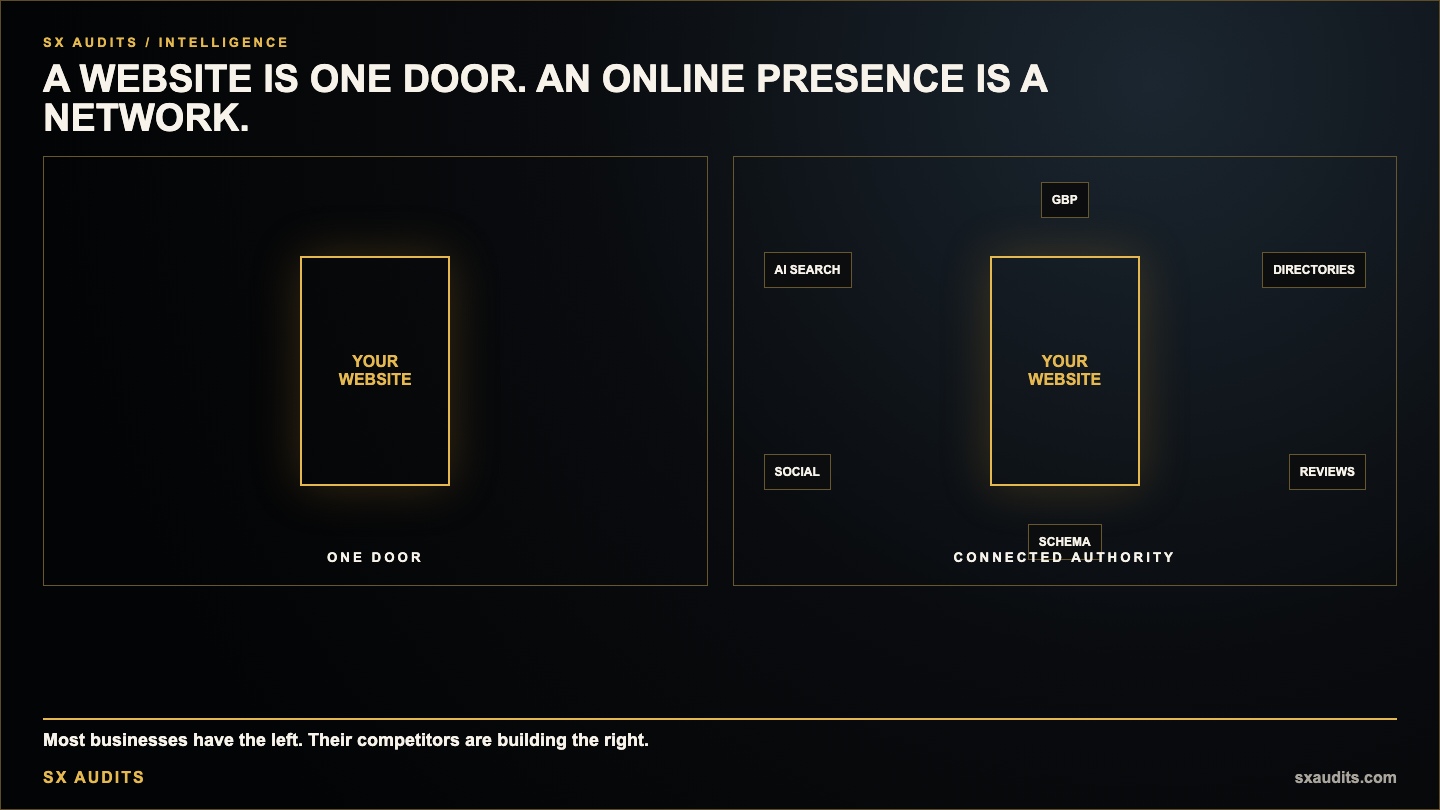
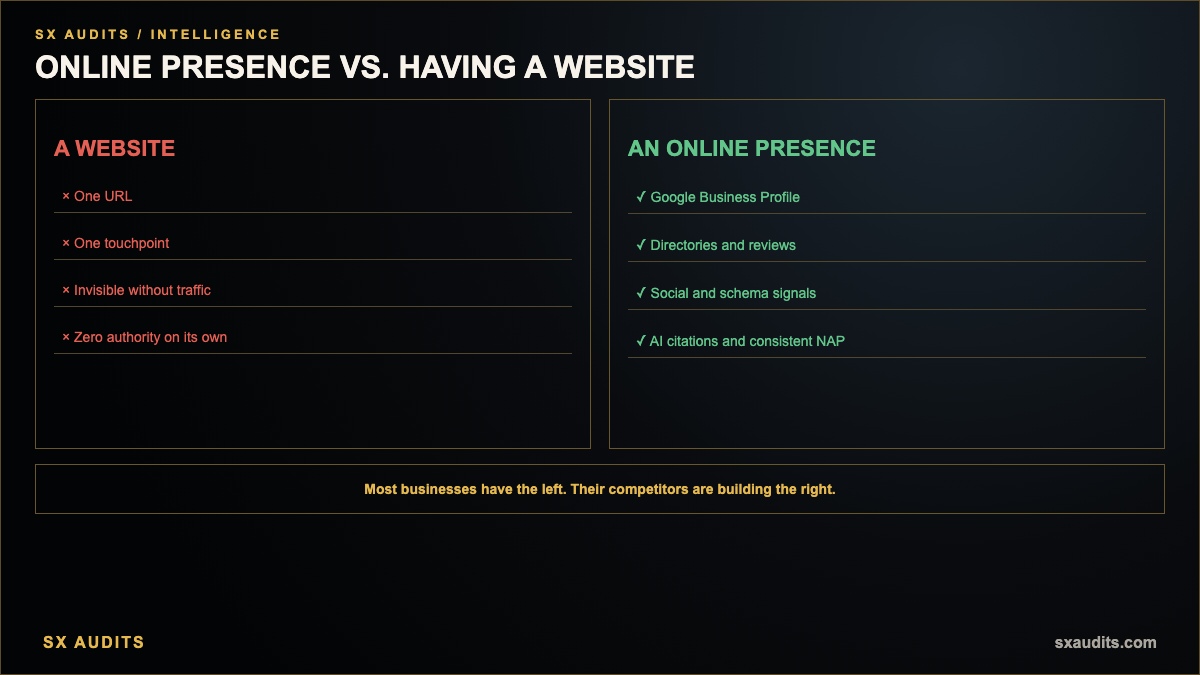
A website is one asset. An online presence is the entire ecosystem of signals, platforms, and information that exists about your business across the internet — whether you put it there or not.
Your website is your front door. Your online presence is every street sign, directory listing, review, AI recommendation, and word-of-mouth signal that determines whether anyone ever walks toward it.
Twenty-seven percent of US small businesses still have no website at all. But a far larger number have a website and nothing else — and are equally invisible to the customers actively looking for them right now.
Your Google Business Profile Is A Channel In Its Own Right
A GBP is not a supplement to your website. For local search, it is often the primary contact point — the entry that appears in Maps, in the local 3-pack, and increasingly in AI-generated recommendations. Businesses with a complete Google Business Profile are 2.7 times more likely to be considered reputable, and customers are 70% more likely to visit them. A polished website paired with an unclaimed or sparse GBP is functionally invisible to anyone searching with local intent.
Directories Are Not Optional Decoration
Depending on your industry, Yelp, Healthgrades, Avvo, Houzz, Angi, and similar platforms are where a significant share of your potential customers are actively searching. More critically, they are the sources AI systems pull from when forming recommendations. Inconsistent or missing directory listings are not just missed opportunities — they are active signals to AI engines that your business entity is ambiguous. Businesses with consistent NAP data across directories receive 23% more website clicks from Google than those with inconsistencies.
Review Presence Is Infrastructure, Not Reputation Management
Reviews are a discovery mechanism. The volume, recency, and response pattern of your reviews influences local search ranking, AI citation probability, and the immediate trust calculation every potential customer makes in the first five seconds of finding you. Consumers read an average of 10 online reviews before trusting a business and spend nearly 14 minutes reading them before deciding. A business with 12 reviews and a competitor with 200 is not competing on equal footing regardless of product quality.
Social Media Creates Signals Even When It Doesn't Drive Traffic
AI systems and search engines look at social accounts differently than follower counts suggest. They check whether your accounts exist, whether they're linked correctly to your other digital assets, and whether they establish that your business is active. Algorithms currently suppress 95% of organic business content — but the structural presence of active, properly linked accounts still contributes to entity authority. Businesses with both a website and social media presence generate 2× more revenue than those with only social media.
AI Visibility Is A Distinct Layer That Sits Above All Of This
Even if every element above is in order, your business may still be invisible on ChatGPT, Perplexity, and Google AI Overview — where 31% of the US population now begins discovery searches. AI visibility requires schema markup, original citable content, NAP consistency, and third-party validation. Only 30% of brands maintain consistent presence from one AI answer to the next. It is built on top of a functioning online presence, not a substitute for one.
What a Fragmented Presence Costs
The dentist in Queens has had the same $2,000 website for five years. In that time, a competitor three blocks away claimed his Google Business Profile, built 180 Google reviews, and began appearing in AI recommendations for dental services in the borough. The gap between their practices has widened every year — not because of clinical skill, but because of digital infrastructure.
An online presence is not expensive to build. It is expensive to ignore.
Want to know exactly where your business stands with AI search?
We run the full diagnostic and deliver a findings report in 72 hours. No discovery call. No commitment.
Book the Audit →Related intelligence · selected for this topic
Framework developer and systems thinker specializing in AI implementation and decision architecture. Creator of the AI Council methodology — a structured multi-model framework used to surface deeper insights in complex decisions. The audit intelligence at Sovereign X Audits is built on these same principles.
aicouncilconductor.com →Find out exactly where your business stands.
We audit your digital infrastructure, AI visibility, and brand presence — and show you exactly what it's costing you.