The Difference Between Being Indexed by Google and Being Trusted by AI
A personal trainer in Jersey City had a well-indexed website. Google had crawled every page. His sitemap was submitted. His domain was five years old. When his existing clients searched his name, they found him immediately.
When prospective clients asked ChatGPT for the best personal trainers in Jersey City, he didn't appear. A competitor whose website was newer, simpler, and ranked lower on Google appeared twice — in ChatGPT and in Perplexity.
He was fully indexed. He was not trusted.
Two Different Standards
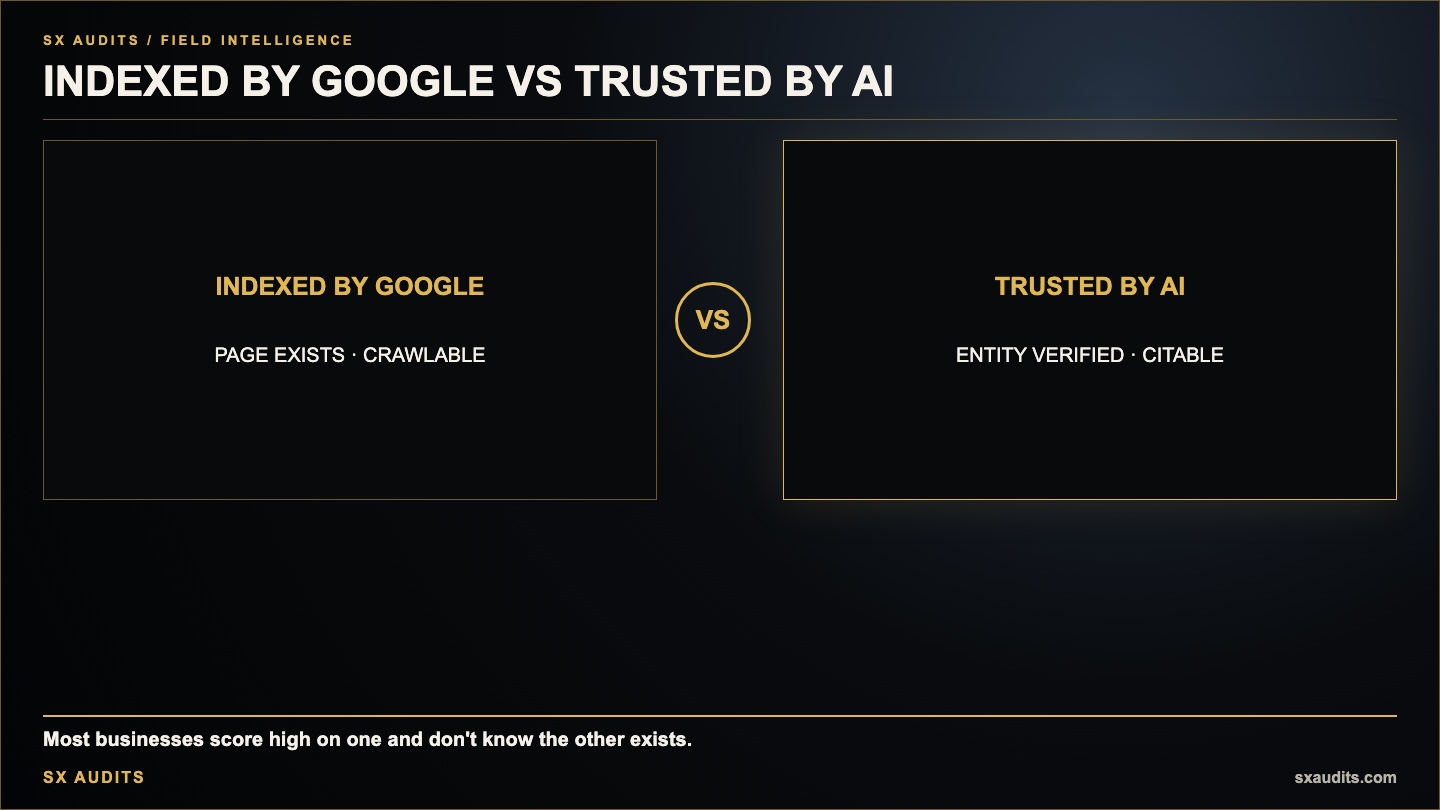
Google's indexing system and AI recommendation systems evaluate websites according to fundamentally different criteria.
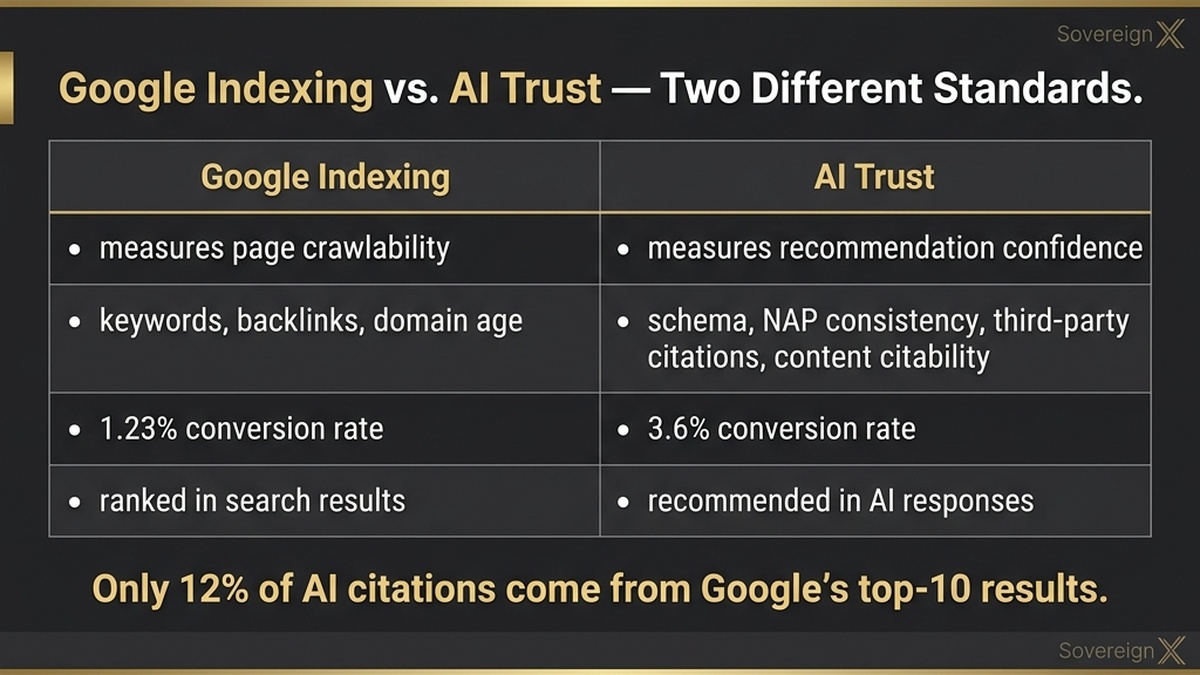
Google indexing is about discoverability: can the crawlers find your pages, read your content, and associate your site with the queries you should rank for? This is governed by crawlability, keyword relevance, backlinks, and domain authority.
AI trust is about confidence: does this business have enough consistent, structured, citable, third-party-validated information for an AI system to recommend it without introducing uncertainty? This is governed by entity clarity, schema markup, NAP consistency, content citability, and off-site validation.
A website can be perfectly indexed by Google and score near zero on AI trust. Only 12% of AI citations come from Google's top-10 results — meaning the overlap between "ranked well" and "trusted by AI" is remarkably small.
Indexing Is About Crawlability; Trust Is About Confidence
When Google indexes your site, it establishes that your content exists and can be associated with certain queries. When an AI system considers recommending your business, it asks a different question: is there enough corroborating evidence from multiple sources for this recommendation to be defensible? Google can index a page with a vague service description. AI will not cite one.
The Gap Between Google Rankings And AI Citations Is Dramatic And Growing
Research from Ahrefs analyzing 1.9 million AI citations found that only 12% of AI citations also rank in Google's top 10. The previous overlap was 75–76%; it has collapsed. AI Overviews now reach 2 billion users monthly — but only 38% of those citations come from Google's top-10 ranked pages. A business can occupy the number-one organic ranking and be completely absent from the AI recommendations that now precede it on the results page.
AI Systems Use Cross-platform Verification, Not Single-source Ranking
Google's ranking algorithm primarily evaluates pages independently, using backlinks as a proxy for authority. AI systems evaluate entities — businesses — by cross-referencing their information across multiple platforms simultaneously. If your business name, address, and phone number are consistent across your website, GBP, Yelp, industry directories, and social profiles, AI confidence increases. If even two of these are inconsistent, AI systems register ambiguity and default to businesses with cleaner signals.
Schema Markup Is The Bridge Between Indexing And AI Trust
Schema markup is the structured data layer that communicates explicitly to machine systems — both Google and AI — who you are, what you do, and why you're relevant. Businesses with properly implemented LocalBusiness schema see 20–30% higher click-through rates from traditional search, and significantly higher AI citation rates. Without schema, AI systems must infer your business identity from unstructured text — a process that is unreliable and frequently results in misattribution or omission.
The Conversion Premium Makes AI Trust Financially Significant
Being indexed earns clicks at roughly 1.23% conversion from traditional organic search. Being trusted by AI earns visitors at 3.6% conversion — nearly 3× higher — because AI-referred visitors are further along in their decision process. They have already received a recommendation. They arrive pre-sold. The revenue difference between a business that is merely indexed and one that is actively trusted by AI is compounding: the trusted business gets better leads, converts more of them, and increasingly dominates the recommendations that produce the next cycle of trust signals.
What Building AI Trust Requires
Moving from indexed to trusted involves several distinct actions:
Entity consolidation: Ensure your business name, address, and phone are identical across every platform. This is the foundation AI trust is built on.
Schema markup: Implement LocalBusiness schema on your website. Add FAQ schema to pages that answer customer questions.
Content that can be cited: Write at least four pieces of content that directly answer specific questions your customers ask. Not general descriptions — specific answers.
Third-party validation: Ensure your business is listed on at least three authoritative third-party directories relevant to your industry. Pursue press mentions or industry publication bylines where possible.
Freshness: Update at least one piece of content per quarter. Pages not refreshed quarterly are 3× more likely to lose AI citations.
Want to know exactly where your business stands with AI search?
We run the full diagnostic and deliver a findings report in 72 hours. No discovery call. No commitment.
Book the Audit →Related intelligence · selected for this topic
Framework developer and systems thinker specializing in AI implementation and decision architecture. Creator of the AI Council methodology — a structured multi-model framework used to surface deeper insights in complex decisions. The audit intelligence at Sovereign X Audits is built on these same principles.
aicouncilconductor.com →Find out exactly where your business stands.
We audit your digital infrastructure, AI visibility, and brand presence — and show you exactly what it's costing you.