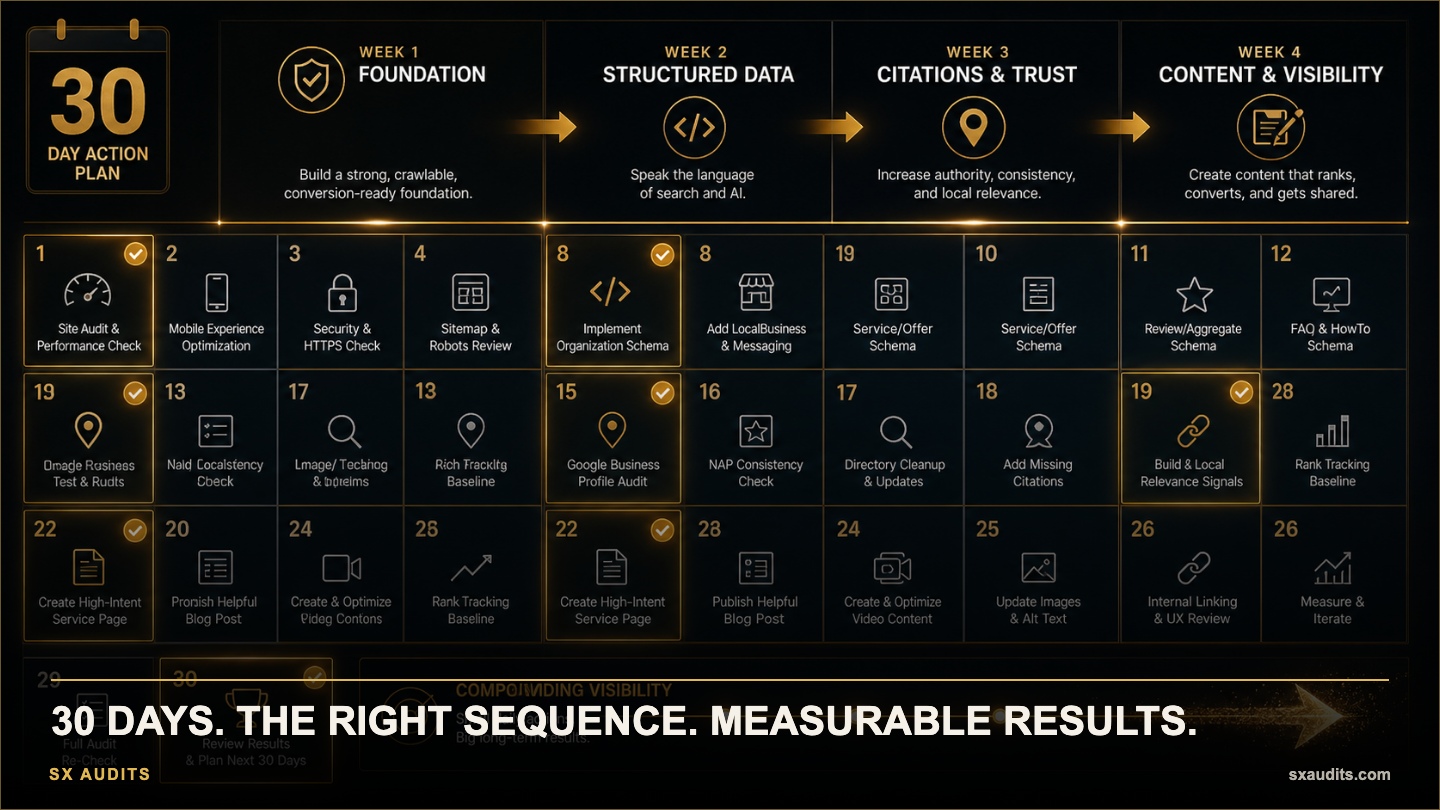
How Do I Fix My Online Presence in 30 Days?
Most online presence problems are not complex. They are accumulated. A GBP that was never claimed. A NAP inconsistency introduced when the business moved two years ago and three directories were never updated. A website with no schema because the developer who built it didn't include it. None of these require months of agency retainer to fix. They require the right sequence and two to four hours of focused work.
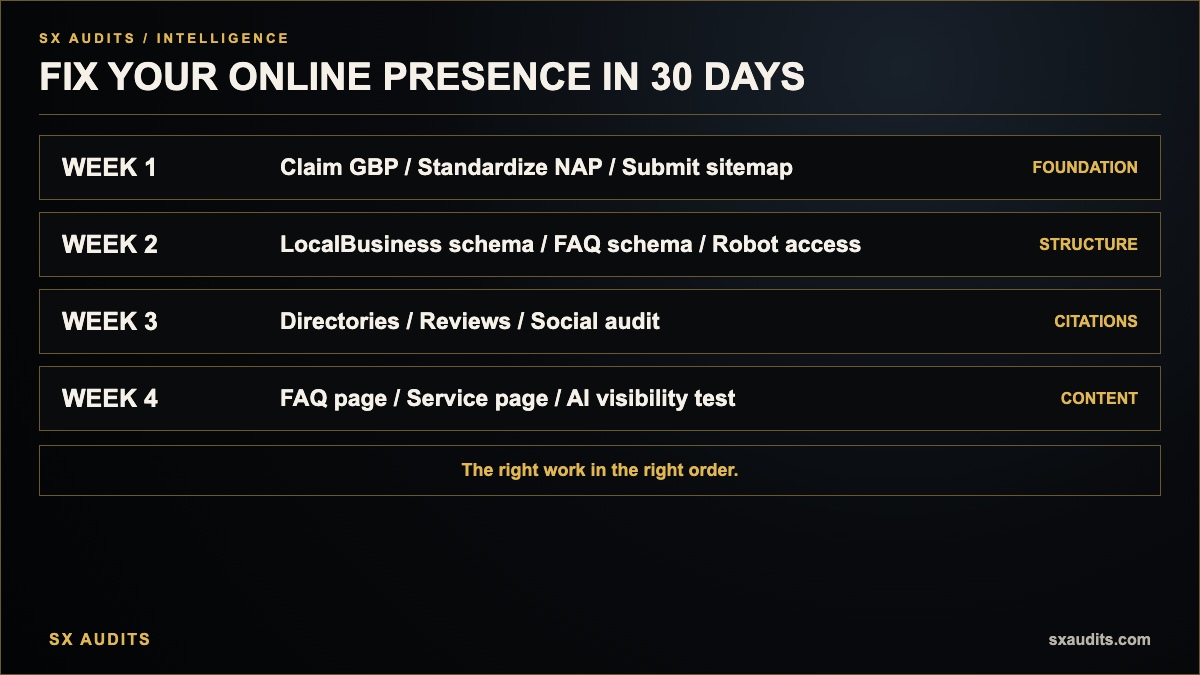
This is the 30-day fix framework. It works in order — each step builds on the previous one, and the sequence matters.
Week 1 — Claim the Foundation
Day 1–2: Claim and verify your Google Business Profile
If your GBP is unclaimed, this is the single highest-priority action. Go to business.google.com, claim your listing, and complete the verification process. Fill every available field: business category, hours, service area, description, website URL, and at least five recent photos. Businesses with complete GBPs are 2.7× more likely to be considered reputable and 70% more likely to be visited.
Day 3–4: Standardize your NAP
Decide on the canonical version of your business name, address, and phone number. Write it down exactly as it should appear everywhere. Then audit every platform where your business appears — website, GBP, Yelp, Facebook, industry directories — and update each to match the canonical version exactly. This is the foundation of local search ranking and AI visibility. NAP consistency improves local rankings by an average of 23%.
Day 5–7: Submit your website to Google Search Console
If you haven't already, verify your website in Google Search Console (search.google.com/search-console) and submit your sitemap. This accelerates Google's indexing of your content and gives you visibility into how your site is being crawled.
Week 2 — Add the Machine-Readable Layer
Day 8–10: Implement LocalBusiness schema markup
Schema markup is the structured data layer that tells AI systems and search engines who you are in a format machines can process reliably. Add LocalBusiness JSON-LD schema to your website's homepage and key service pages. Include business name, address, phone, hours, service area, and business category. Validate using Google's Rich Results Test (search.google.com/test/rich-results). Businesses with schema see 20–30% higher click-through rates and significantly higher AI citation rates.
Day 11–12: Add FAQ schema to your highest-traffic page
Identify the page on your website that gets the most traffic or that answers the most common question new customers ask. Add FAQ schema markup to it. This is the primary driver of both featured snippet placements (AEO) and AI citation probability (GEO). Pages with well-organized headings and FAQ structure are 2.8× more likely to earn AI citations.
Day 13–14: Verify AI crawler access
Check your robots.txt file (yourdomain.com/robots.txt) and confirm it is not inadvertently blocking AI crawlers. Common AI bots include GPTBot, ClaudeBot, and PerplexityBot. If any are blocked, remove those rules.
Week 3 — Build Citation Authority
Day 15–17: Claim and complete your top three directory listings
Identify the three directories most authoritative for your industry. For most local service businesses: Yelp, Better Business Bureau, and one industry-specific directory (Healthgrades for healthcare, Avvo for legal, Houzz for home services, etc.). Claim each listing, complete every available field, and ensure NAP is consistent with your canonical version.
Day 18–20: Respond to all unanswered reviews
Go through every review platform where your business is listed and respond to every unanswered review — positive and negative. Keep responses professional and specific. Google's algorithm factors review response rate into local search rankings. Seventy-three percent of consumers don't trust reviews older than a month, so recent, responded-to reviews carry disproportionate weight in first-page impressions.
Day 21: Verify your social profiles
Ensure your business Facebook page, Instagram profile, and LinkedIn (if applicable) are linked correctly to your website and list accurate NAP. Social profiles with broken links or inconsistent information create authority gaps that AI systems register.
Week 4 — Add Content AI Can Use
Day 22–25: Write one FAQ page
Write a page on your website that directly answers the five most common questions new customers ask before hiring you. Use clear question-and-answer structure with brief, direct answers. This is the most important content investment for AI visibility — and it also improves SEO and AEO simultaneously. A Princeton GEO study found that structured, citable content boosts AI visibility by up to 41%.
Day 26–28: Update your most important service page
Rewrite your primary service page so that it describes specifically what you do, who you serve, where you serve them, and what makes your approach distinct. Replace generic descriptions with specific language AI can use as citation material.
Day 29–30: Run the verification test
Open ChatGPT and Perplexity in incognito mode. Run five queries using the language your customers actually use. Compare your appearance rate now to where you started. Document the improvement. This becomes your baseline for the next 30 days.
Want to know exactly where your business stands with AI search?
We run the full diagnostic and deliver a findings report in 72 hours. No discovery call. No commitment.
Book the Audit →Related intelligence · selected for this topic
Framework developer and systems thinker specializing in AI implementation and decision architecture. Creator of the AI Council methodology — a structured multi-model framework used to surface deeper insights in complex decisions. The audit intelligence at Sovereign X Audits is built on these same principles.
aicouncilconductor.com →Find out exactly where your business stands.
We audit your digital infrastructure, AI visibility, and brand presence — and show you exactly what it's costing you.