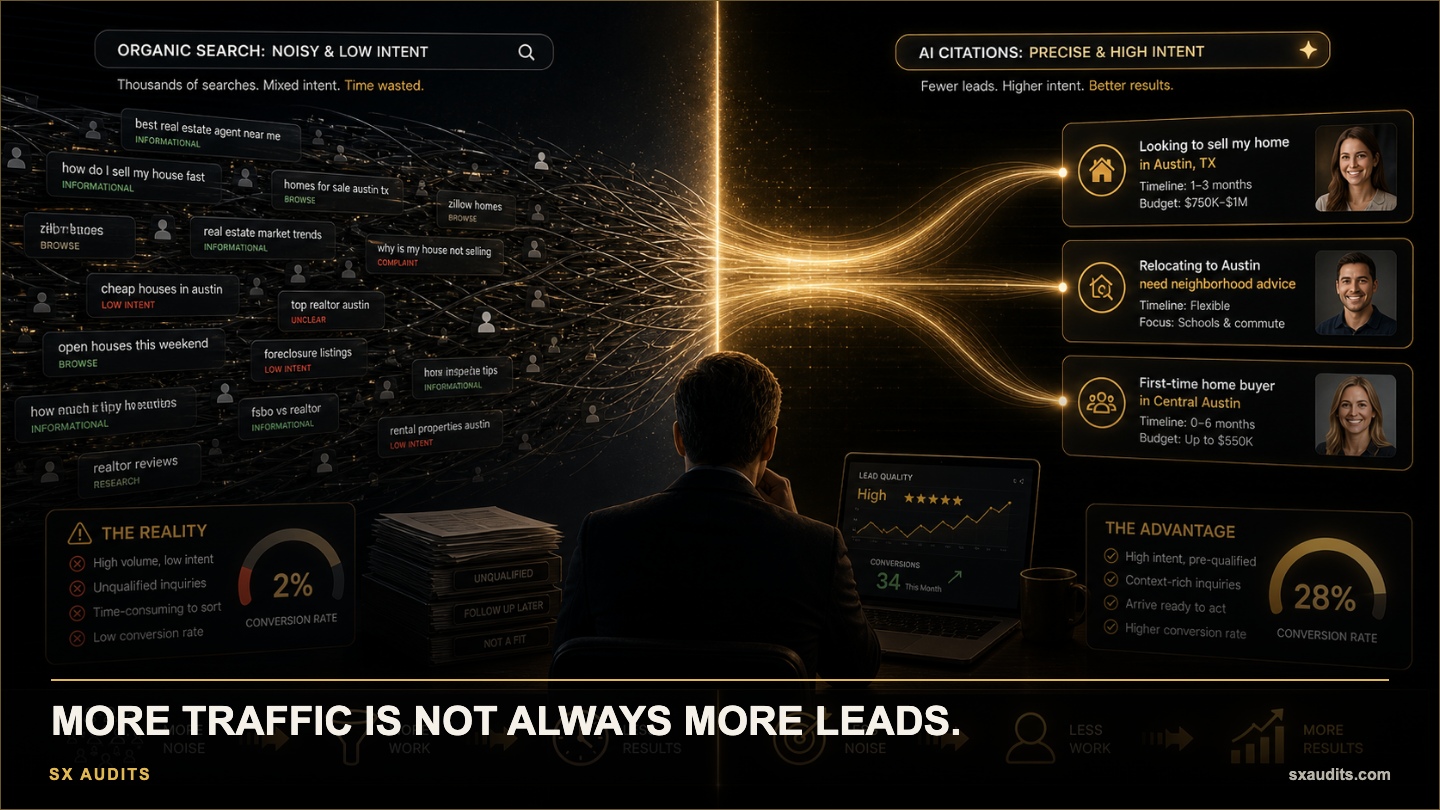
Organic Search vs AI Citations — Which Drives More Qualified Leads Now
A business litigation attorney in Chicago had strong organic search visibility. She ranked on the first page for several competitive terms, received steady website traffic from those rankings, and tracked her contact form submissions carefully.
She noticed something odd in her intake data: the leads arriving from organic search were inconsistent in quality — a mix of people who understood her practice area and people who clearly didn't, who needed to be redirected or declined. It was taking time and resources to sort them.
Then she started noticing a different pattern in leads that mentioned they had "looked her up on ChatGPT first." Those leads arrived with a clearer understanding of her practice area, fewer mismatched inquiries, and a higher rate of converting to actual engagements.
The organic leads were coming from people who had typed keywords and were still figuring out what they needed. The AI leads were coming from people who had already received a synthesized explanation and had decided they needed exactly what she offered.
What the Conversion Data Shows
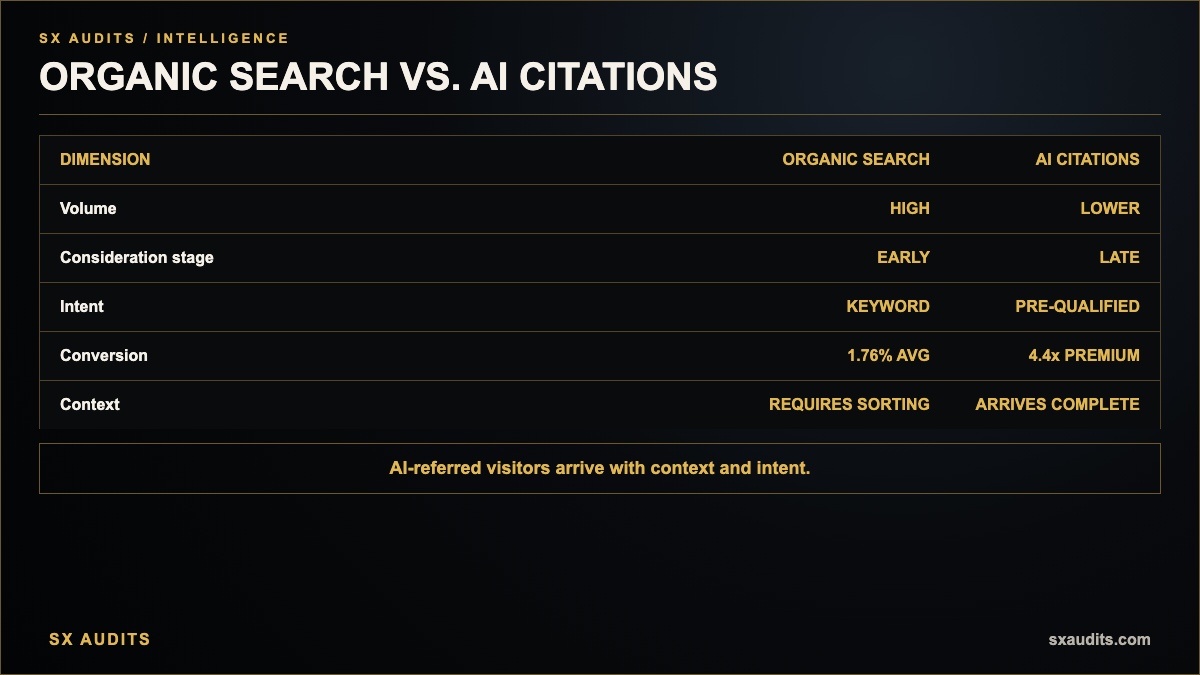
The quality gap between organic search and AI citations is real and measurable. AI search traffic converts at 4.4× the rate of traditional organic search visitors for informational and consideration-stage queries. Platform-specific rates show ChatGPT-referred visitors converting at approximately 15.9% in some categories, compared to 1.76% for Google organic. BrightEdge research found that while AI search drives under 1% of total referral traffic, qualified lead generation from AI-driven visitors increased 23% as these referrals proved more targeted and conversion-ready.
The reason is the nature of the discovery process itself. A traditional organic searcher types keywords, receives a list of options, and is in the early stages of comparison shopping. An AI-referred visitor has already received a synthesized summary, had options compared for them by the AI, and specifically chose to click through to a business the AI recommended. The consideration phase is substantially complete before the visit.
Organic Search Wins On Volume; AI Citations Win On Quality
Organic search remains the dominant source of website traffic by volume — it is not being replaced. What is changing is the distribution of high-intent, ready-to-convert traffic. AI-referred visitors arrive later in the decision journey, with more specific understanding of what they need and higher intent to act. A business that appears in both channels captures the full spectrum: the high-volume organic traffic at the early research stage and the high-intent AI referral at the consideration stage. Optimizing for only one leaves half the acquisition funnel unaddressed.
AI Citations Require A Different Profile Than Organic Rankings
The businesses that earn AI citations are not always the businesses that rank highest in organic search. Research confirms only 12% of AI citations overlap with Google's top-10 organic results for the same query. AI systems reward: schema markup and structured entity data, content with organized headings and quotable direct-answer language (2.8× more likely to earn citations), consistent NAP across authoritative directories, third-party validation from credible external sources (85% of AI citations come from third-party pages), and freshness (pages not updated quarterly are 3× more likely to lose citation rates). A business investing exclusively in organic SEO — backlinks, keyword content, domain authority — may be optimizing for the wrong signals for the AI citation channel.
The Sales Funnel Implication Differs By Channel
Organic search primarily reaches buyers in the awareness and early consideration stages: people still defining their problem, comparing options, and learning about the category. AI citations primarily reach buyers in the late consideration stage: people who have defined their problem, used the AI to synthesize their options, and are ready to evaluate a specific provider. These are different buyers at different points in the journey. Content optimized for organic search answers broad informational queries. Content optimized for AI citation positions a specific business as the credible, well-defined answer to the specific need the AI has already helped the buyer articulate.
Local Businesses Have Disproportionate Opportunity In AI Citations
For local service businesses, AI-driven local discovery is growing faster than the overall AI traffic trend. Forty-five percent of U.S. consumers now use AI tools for local business recommendations, up from 6% in early 2025. For categories like medical care, legal services, financial advising, and skilled trades — where trust and credibility are the primary conversion factors — AI recommendations carry authority similar to a personal referral. A local business that appears in ChatGPT's top-3 recommendations for its category and city is receiving the AI equivalent of a word-of-mouth endorsement. For these businesses, AI citation quality as a referral channel is particularly high.
The Infrastructure For Each Channel Overlaps But Is Not Identical
The good news is that the work required to appear in AI citations is not entirely separate from good SEO practice. A well-structured website with organized content, fast technical performance, and authoritative external links benefits both channels. The GEO-specific work — schema markup, entity consistency, FAQ content, third-party citation building — complements SEO without conflicting with it. The businesses in the most competitive position are those that have invested in both signal sets: SEO-strong enough to capture organic volume, GEO-ready enough to capture AI-driven high-intent traffic. The audit identifies which channel has the larger gap for a specific business and prioritizes accordingly.
The Practical Question for Your Business
Where do your highest-quality new client inquiries currently come from? If you track your leads by source, what is the conversion-to-engagement rate for organic search visitors versus visitors who mentioned AI, a specific referral, or who arrived having already researched your specific approach?
If you have not tracked this, the question itself is worth answering. The attorney in Chicago found that AI-referred leads converted at more than double her organic search lead rate. Knowing that changed how she prioritized her next infrastructure investment.
Want to know exactly where your business stands with AI search?
We run the full diagnostic and deliver a findings report in 72 hours. No discovery call. No commitment.
Book the Audit →Related intelligence · selected for this topic
Framework developer and systems thinker specializing in AI implementation and decision architecture. Creator of the AI Council methodology — a structured multi-model framework used to surface deeper insights in complex decisions. The audit intelligence at Sovereign X Audits is built on these same principles.
aicouncilconductor.com →Find out exactly where your business stands.
We audit your digital infrastructure, AI visibility, and brand presence — and show you exactly what it's costing you.