
Getting a Digital Audit vs Running Google Ads — Why Sequence Matters More Than Budget
A landscaping company in Nashville decided to invest in Google Ads after a slow spring. The owner set a $2,500 monthly budget, hired a freelancer to manage the campaigns, and ran ads for two months. Traffic increased significantly. Calls did not increase proportionately.
When a digital audit was commissioned at the end of the two-month test, the findings were foundational: the GBP was showing incomplete service information and the wrong service area, the website had no LocalBusiness schema, the contact page had a form that wasn't loading correctly on mobile, the NAP showed three variants across major directories, and the business was absent from AI platforms entirely. The campaigns were sending traffic to a digital presence that couldn't convert it.
The ad spend had not been wasted on bad campaigns. It had been wasted on a sound amplification of an undiagnosed problem. More traffic, converting at the same broken rate.
What Google Ads Actually Does
Google Ads drives traffic — paid, intent-matched, immediately measurable traffic to your website and GBP. At its best, it is a precision instrument: you specify who you want to reach, at what cost, in what geography, for which search terms, and you pay per click. Businesses using Google Ads see an average return of $2 in revenue for every $1 spent according to 2026 benchmarks. Some industries and well-optimized campaigns generate $6 to $8 per $1 spent.
At its worst, it is the fastest way to amplify an undiagnosed infrastructure problem. Every ad click sends a prospective client to the current state of your digital presence. If that presence has a broken mobile form, an incomplete GBP, inconsistent NAP data, and no schema markup — the ad is driving traffic to a broken destination at full cost per click.
30–50% Of Small Business Ad Spend Is Wasted Without Conversion-ready Infrastructure
Audits of underperforming Google Ads campaigns consistently find that 30 to 50 percent of ad spend is wasted — not on bad keywords or poor targeting, but on traffic arriving at infrastructure that cannot convert it. The average Google Ads conversion rate for small businesses runs around 2.35% — while the top 10% of advertisers convert at 11.45%. That gap is primarily not in the campaign — it is in what the campaign sends traffic to. A well-targeted ad campaign driving traffic to a website with no mobile optimization, a GBP with outdated hours, and a contact experience that creates friction is spending full cost per click for partial conversion. The audit identifies the conversion gap before the ad budget confirms it.
Ads Amplify Whatever Infrastructure Is Already There — Good Or Bad
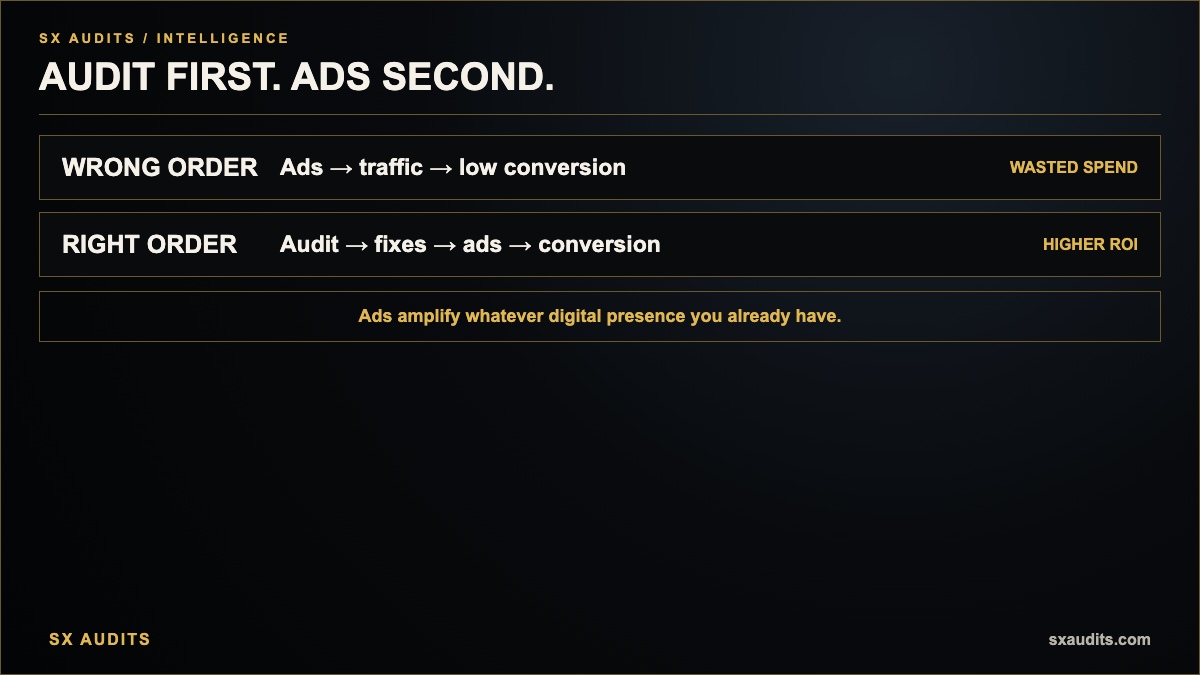
The correct mental model for Google Ads is amplification, not creation. Ads increase the volume of prospective clients encountering your digital presence. If the digital presence is strong — clear, verified, AI-visible, trust-signaled, with a friction-free contact path — ads amplify those strengths and deliver proportionate returns. If the digital presence has infrastructure problems — wrong GBP category, schema absent, broken mobile experience, NAP inconsistency — ads amplify those problems and deliver proportionate underperformance. The audit does not compete with Google Ads. It is the prerequisite that determines whether the ad budget will work. Companies that audit their digital presence before running ads report 20% higher ROI compared to those who run ads without auditing first.
The Trust Gap Kills Paid Traffic That SEO And Organic Traffic Survive
Organic traffic visitors have typically already made a basic trust judgment before clicking — they chose to click through from a search result that appeared credible. Paid traffic includes visitors who clicked on an ad without necessarily having made that pre-judgment. When a paid visitor arrives and encounters an incomplete GBP, missing reviews, or a contact experience that doesn't inspire confidence, the bounce rate is disproportionately high. The same trust gaps that suppress organic conversion suppress paid conversion at higher cost per click. The audit that identifies and corrects trust signal gaps before ads run is not just improving conversion — it is protecting the ad spend that would otherwise drive traffic to a gap.
An Audit Identifies The Specific Fixes That Move Conversion Rate
The fastest way to improve Google Ads ROI is to audit the funnel, remove friction, simplify calls-to-action, and optimize for conversions before increasing traffic. A digital audit provides exactly this: the specific, prioritized list of infrastructure issues that are suppressing the conversion of whatever traffic — organic or paid — is currently arriving. For the landscaping company in Nashville, the priority fixes were: correct the GBP service area and complete the service information, fix the mobile contact form, add LocalBusiness schema. These fixes cost a fraction of the two months of ad spend. Made before the ads ran, they would have allowed that budget to convert at a substantially higher rate.
The Correct Sequence Is Audit First, Then Ads
This is not a preference. It is arithmetic. Ad spend per month × conversion rate = leads. A conversion rate suppressed by undiagnosed infrastructure problems produces a cost per lead that makes ad spend appear ineffective. The same ad budget, after infrastructure is corrected, produces a higher conversion rate and a proportionately lower cost per lead. For any business where ad spend is more than a few hundred dollars per month, the one-time cost of a diagnostic audit applied before the campaign launch pays for itself in reduced wasted spend within the first month of correctly configured ads.
The Right Decision Framework
Invest in ads first if:
- You have completed a digital audit in the last six months
- Your infrastructure is verified: GBP complete and accurate, schema configured, NAP consistent, mobile experience clean, AI visibility established
- You know your baseline conversion rate and want to test paid traffic on a strong foundation
Commission an audit first if:
- You have not had a professional digital audit
- Your previous ads underperformed and you don't know why
- You are planning to invest $1,000 or more per month in ads
- Your organic traffic is converting at a rate you don't understand
Want to know exactly where your business stands with AI search?
We run the full diagnostic and deliver a findings report in 72 hours. No discovery call. No commitment.
Book the Audit →Related intelligence · selected for this topic
Framework developer and systems thinker specializing in AI implementation and decision architecture. Creator of the AI Council methodology — a structured multi-model framework used to surface deeper insights in complex decisions. The audit intelligence at Sovereign X Audits is built on these same principles.
aicouncilconductor.com →Find out exactly where your business stands.
We audit your digital infrastructure, AI visibility, and brand presence — and show you exactly what it's costing you.