SX Audits vs GustyAudit — Conversion Friction vs Full Digital Presence Diagnosis
An optometry practice in Sacramento had decent website traffic but a conversion rate that had been declining for six months. The owner ran a friction audit and received a clear picture: confusing appointment booking flow, unclear calls-to-action on the services page, a mobile contact button that was too small for comfortable use. The friction audit was accurate and useful. The practice fixed the issues over the next three weeks.
The conversion rate improved modestly. But the steady decline in new patient inquiries continued.
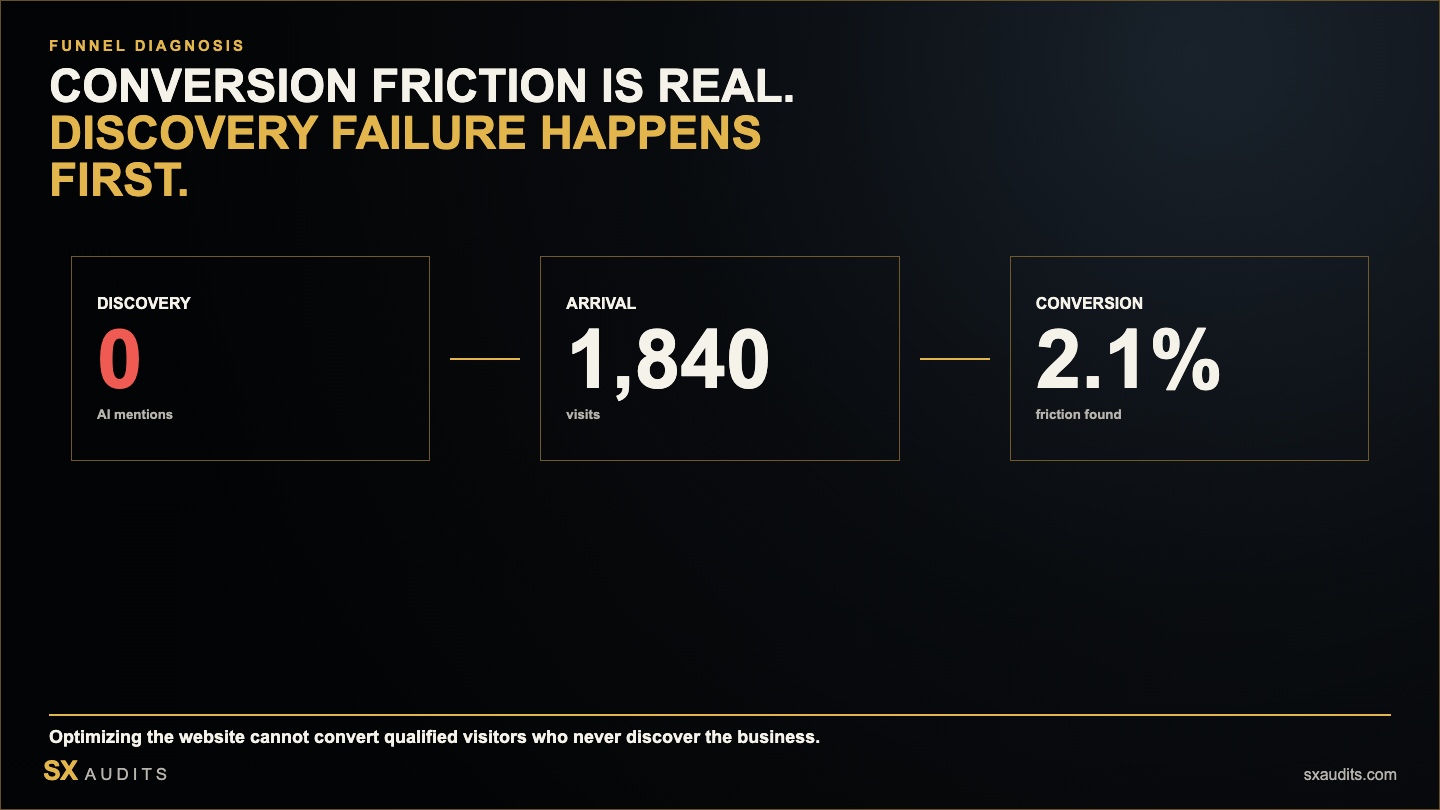
The friction audit had found real problems — problems with what happened after visitors arrived. What it couldn't see: the practice had been losing AI-driven discovery traffic for four months. A competitor with better schema markup and consistent NAP had started appearing in ChatGPT recommendations for "eye doctor Sacramento" while the practice was invisible. AI-referred visitors — who convert at 4.4× the rate of organic search visitors — were being directed to the competitor before they ever had the chance to encounter the optometry practice's booking flow.
The conversion problem was real. The discovery problem was larger, and upstream of it.
What GustyAudit Does
GustyAudit is a website friction audit tool. It scans websites for conversion-killing friction — the UX and messaging issues that prevent visitors from taking desired actions after they arrive. It identifies what to fix to improve the conversion of existing traffic into leads, appointments, or sales. It is built for businesses that have traffic and want more of that traffic to convert.
The scope of GustyAudit is the website conversion experience: clarity of messaging, ease of contact, user flow, call-to-action design, and the friction points that cause visitors to leave without converting.
What GustyAudit is not designed to evaluate: whether the business is appearing in AI-generated recommendations; whether schema markup is configured to support AI citation; whether NAP is consistent across 30+ directories; whether GBP is showing the correct category and accurate information; or whether the first-page digital presence is functioning correctly for new discovery. GustyAudit optimizes what happens after arrival. It does not assess the discovery infrastructure that determines whether traffic arrives.
Conversion Friction And Discovery Failure Are Different Problems With Different Solutions
Conversion friction suppresses the percentage of visitors who take action. Discovery failure suppresses the number of qualified visitors who arrive. A friction audit finds the first problem. A digital audit finds the second. The optometry practice's conversion problem was real and worth fixing. But a 5% improvement in conversion rate on declining traffic is a smaller impact than the traffic decline caused by AI discovery failure. The correct diagnosis requires identifying which problem is the larger constraint — and for most small service businesses in 2026, AI discovery failure is the more consequential issue.
Ai-referred Visitors Convert At 4.4× The Rate Of Organic Traffic — Conversion Friction Matters More When They Arrive
The paradox of optimizing for conversion before establishing AI discovery is that you are improving the experience for a lower-quality traffic segment while the higher-quality segment never arrives. AI-referred visitors arrive pre-qualified — they have already received a synthesized explanation, compared providers, and specifically chosen to visit. Their conversion rate is disproportionately high relative to organic search visitors. A business that has excellent conversion friction optimization but zero AI visibility is optimizing the last 10% of the funnel while leaving 90% of the highest-value acquisition pathway untouched. Establish discovery first, then optimize conversion.
Upstream Problems Mask As Conversion Problems In The Data
Declining new patient inquiries look like a conversion problem in the analytics. Contact form submissions decline. Appointment booking rates drop. The natural instinct is to examine the conversion experience — which is what GustyAudit is designed for. But if the root cause is a shift in AI discovery away from the practice and toward a competitor, the conversion rate improvement from friction optimization will be smaller than expected, and the decline will continue. The distinction between a conversion problem and a discovery problem requires looking at traffic source composition, AI platform citation rates, and competitor appearance in AI recommendations — data that no conversion audit tool provides.
Gustyaudit Solves For The Website; Sx Audits Solves For The Full Digital Presence
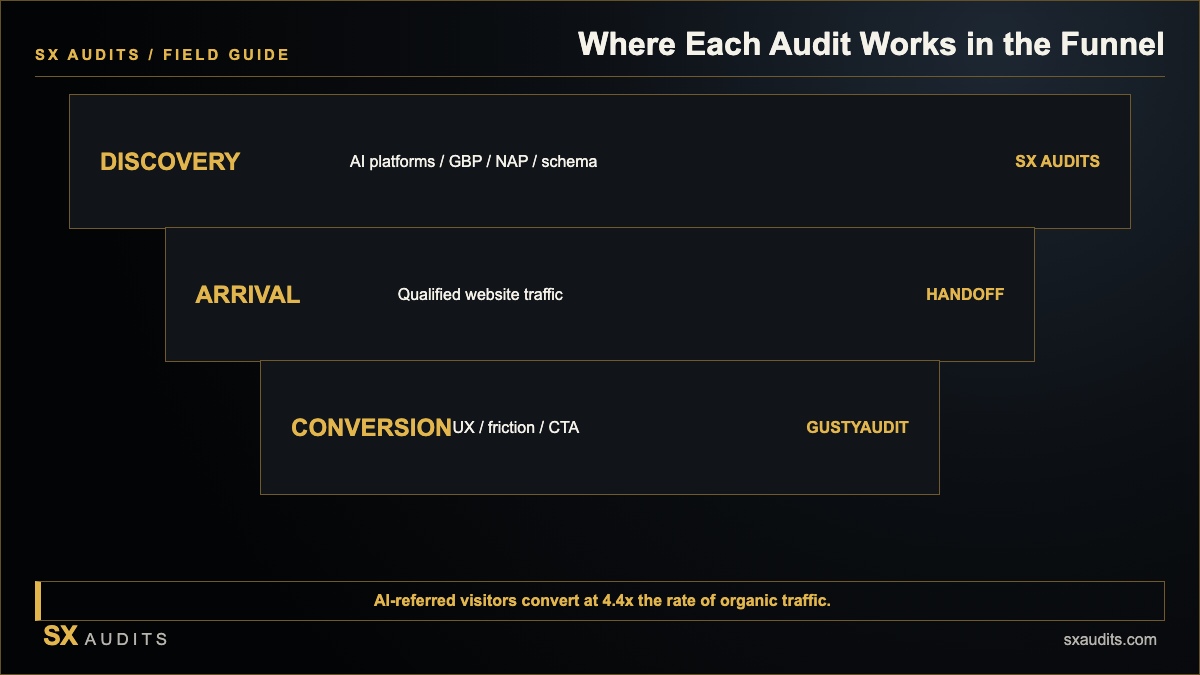
These are not competing tools aimed at the same problem. GustyAudit examines what happens on the website after a visitor arrives. SX Audits examines the full digital presence — everything that determines whether a prospective client finds the business in the first place: AI platform visibility, schema markup, GBP accuracy, NAP consistency, first-page brand search results, and trust signals. A business that uses both is in a strong position: discovery optimized, conversion optimized. A business that uses only one may be addressing the wrong constraint.
The Right Sequence Is Discovery Infrastructure First, Conversion Optimization Second
A well-configured AI readiness infrastructure drives high-quality discovery traffic to the website. That traffic — pre-qualified, intent-confirmed, AI-referred — then encounters the website conversion experience. If the conversion experience has friction, GustyAudit finds it and tells you exactly what to fix. But if the AI discovery infrastructure is broken, the high-quality traffic never arrives for the friction audit to matter. Establish the discovery infrastructure. Then optimize what happens to the traffic it delivers.
Quick Comparison
| | SX Audits | GustyAudit | |---|---|---| | Scope | Full digital presence | Website conversion friction | | AI platform visibility | ✓ | ✗ | | Schema markup diagnosis | ✓ | ✗ | | GBP audit | ✓ | ✗ | | NAP consistency (30+ directories) | ✓ | ✗ | | Website UX/conversion friction | ✗ | ✓ | | Call-to-action clarity | ✗ | ✓ | | Mobile conversion experience | Partial | ✓ | | What it optimizes | Discovery infrastructure | Conversion of existing traffic | | When to use it | Before/alongside marketing investment | After establishing solid traffic volume |
Want to know exactly where your business stands with AI search?
We run the full diagnostic and deliver a findings report in 72 hours. No discovery call. No commitment.
Book the Audit →Related intelligence · selected for this topic
Framework developer and systems thinker specializing in AI implementation and decision architecture. Creator of the AI Council methodology — a structured multi-model framework used to surface deeper insights in complex decisions. The audit intelligence at Sovereign X Audits is built on these same principles.
aicouncilconductor.com →Find out exactly where your business stands.
We audit your digital infrastructure, AI visibility, and brand presence — and show you exactly what it's costing you.