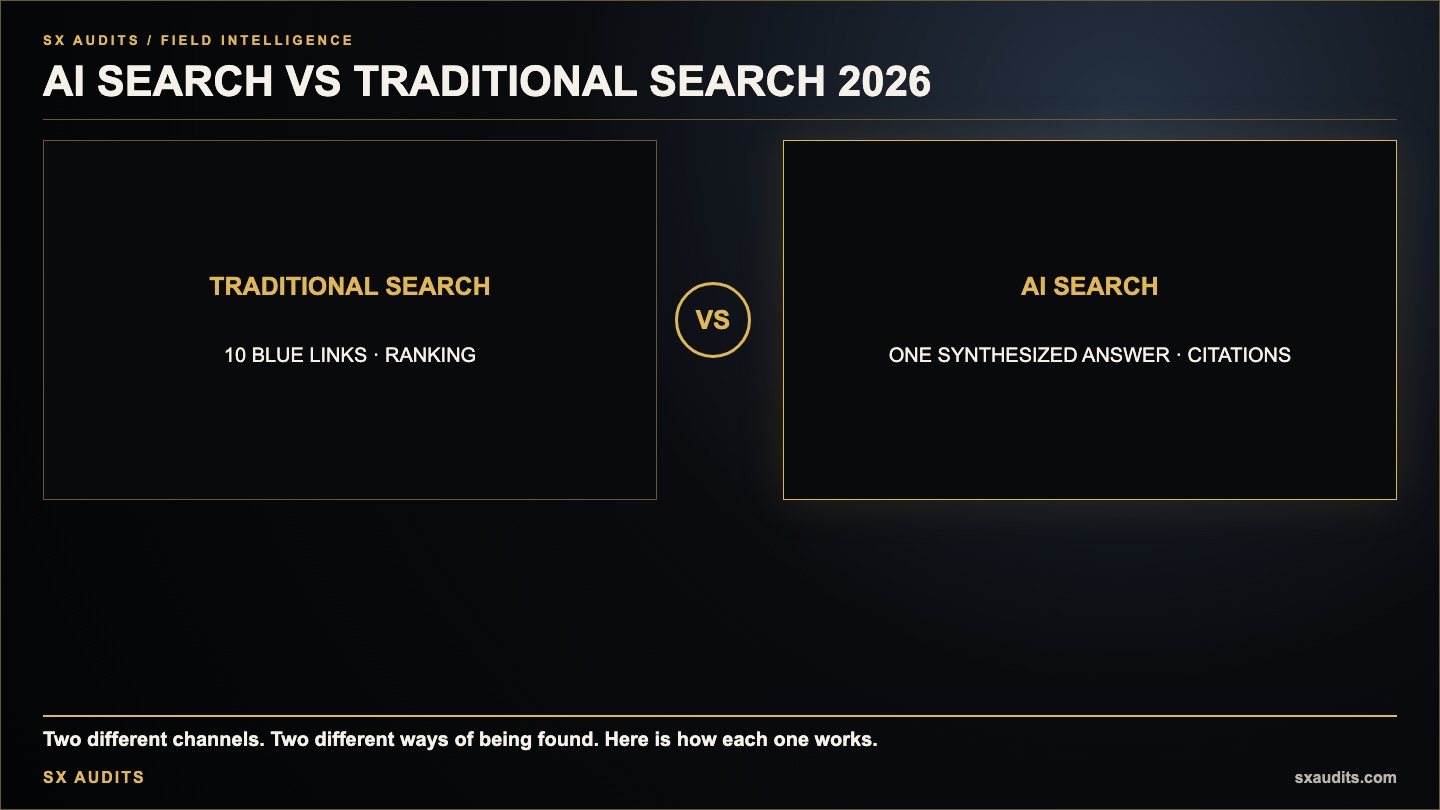
AI Search vs Traditional Search — How Discovery Actually Works in 2026
A homeowner in Atlanta needed a roofing contractor after storm damage. She opened Google and typed "roof repair Atlanta." She got a list of results, opened three tabs, read two reviews, and called the one with the best combination of reviews and a clear website.
Her neighbor next door had the same problem the same week. He opened ChatGPT and typed "what should I look for in a roofing contractor after storm damage, and can you recommend someone in Atlanta?" ChatGPT gave him a response explaining what to look for, then named three contractors in the Atlanta area that fit the profile.
Neither woman nor neighbor used the wrong tool. They used different tools that work differently — and the roofing contractor appearing in both channels captured both leads. The contractor appearing only in traditional search missed one of them.
How the Two Systems Work
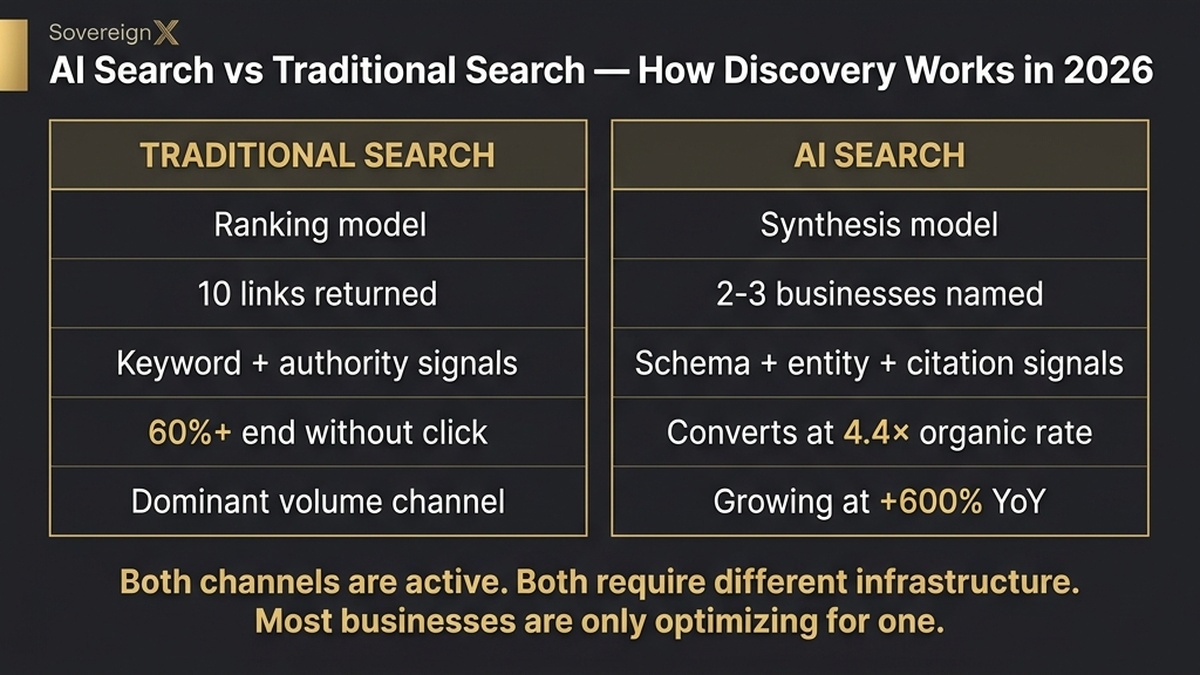
Traditional search operates on a ranking model. When you search Google, an algorithm evaluates thousands of websites against your query and returns a ranked list of links, ordered by estimated relevance and authority. The searcher chooses which links to click. The businesses that have invested in SEO — keyword-relevant content, technical optimization, backlink authority — earn higher positions and more clicks.
AI search operates on a synthesis model. When you ask ChatGPT, Perplexity, or Google AI Overviews a question, a large language model synthesizes information from multiple sources — its training data, real-time web access, structured data signals — and generates a direct response. Instead of ten links to evaluate, the user gets one answer with two or three cited sources. The businesses that appear in that answer are the ones the AI system was able to confidently identify, describe, and validate from its available signals.
The structural difference matters enormously: in traditional search, all businesses on the first page compete for attention. In AI search, typically two or three businesses are named — and the rest are invisible.
AI Search Traffic Is Growing At +600% But Traditional Search Still Dominates Volume
AI referral traffic grew over 600% between January 2025 and early 2026. ChatGPT processes 900 million queries per week. Perplexity processed 780 million queries in a single month. Despite this growth, AI search collectively drives under 2% of total website referral traffic — Google's organic search still accounts for the majority of online discovery volume. What is changing is not that traditional search is dying, but that AI search is growing rapidly from a small base and converting at a disproportionately high rate. AI-referred visitors convert at 4.4× the rate of traditional organic search visitors. A business optimizing only for traditional search is optimizing for the larger but lower-converting channel while leaving a growing high-value channel unaddressed.
The Two Channels Use Different Ranking Signals
Traditional Google search weighs: keyword relevance, content depth, page authority, backlink profile, Core Web Vitals performance, mobile optimization, and click-through rate signals. AI search weighs: schema markup and structured entity data (which allow AI to understand what a business is and what it does), NAP consistency across directories (which builds entity confidence), content citability (organized, quotable, direct-answer content), third-party validation (85% of AI citations come from third-party sources rather than the business's own website), and freshness (pages not updated quarterly lose AI citation rates). The overlap between the two signal sets exists — a technically well-optimized, authoritative website helps with both — but the signals that specifically drive AI citation are distinct enough to require dedicated attention.
Zero-click Search Has Changed The Traditional Search Landscape Independently
Even within traditional search, the model has shifted. Over 60% of Google searches now end without a click — meaning Google answers the question directly in the search results page, through featured snippets, AI Overviews, knowledge panels, and People Also Ask boxes. A business that ranks at position 3 for a query where Google's AI Overview appears above the results captures far less traffic than the same position on a query without an AI Overview. AI Overviews appeared for 68% of local searches in Q2 2025. Traditional search is itself being disrupted by the AI layer appearing within it.
AI Search Discovery Is Particularly Strong For Consideration-stage Queries
Traditional search is strongest for navigational queries ("Smith & Sons Plumbing website") and transactional queries ("plumber near me"). AI search is strongest for consideration-stage queries: "what should I look for in a plumber," "how do I choose a contractor for this kind of damage," "which type of professional handles X." These are the queries where a buyer has not yet decided on a provider and is gathering information before making a decision. Appearing in the AI response to those queries positions a business earlier in the buyer journey — before a competitor is even considered.
What You Need For Each Channel Is Distinct
For traditional search: strong website content, consistent GBP optimization, keyword-relevant service pages, backlink authority, and technical performance. For AI search: LocalBusiness or Person schema with correct entity declarations, FAQ schema on service pages, consistent NAP across 30+ directories, citable content with organized headings and quotable language, minimum three authoritative third-party citations, and quarterly content freshness. A business audit that only evaluates traditional search signals is not giving a complete picture of visibility in 2026. The audit needs to evaluate both channels to determine where the gaps are and where the highest-leverage fixes lie.
The Two-Channel Discovery Test
Traditional search: Search your primary service keywords on Google without your name. Note your position and whether you appear in the Maps pack. Check Google Search Console for actual impression and click data.
AI search: Open ChatGPT and Perplexity in fresh sessions. Search: "Best [your service] in [your city]." Note whether you appear, what the AI says about you, and which competitors are named in your place.
Most businesses pass the traditional search test partially and fail the AI search test entirely.
Want to know exactly where your business stands with AI search?
We run the full diagnostic and deliver a findings report in 72 hours. No discovery call. No commitment.
Book the Audit →Related intelligence · selected for this topic
Framework developer and systems thinker specializing in AI implementation and decision architecture. Creator of the AI Council methodology — a structured multi-model framework used to surface deeper insights in complex decisions. The audit intelligence at Sovereign X Audits is built on these same principles.
aicouncilconductor.com →Find out exactly where your business stands.
We audit your digital infrastructure, AI visibility, and brand presence — and show you exactly what it's costing you.