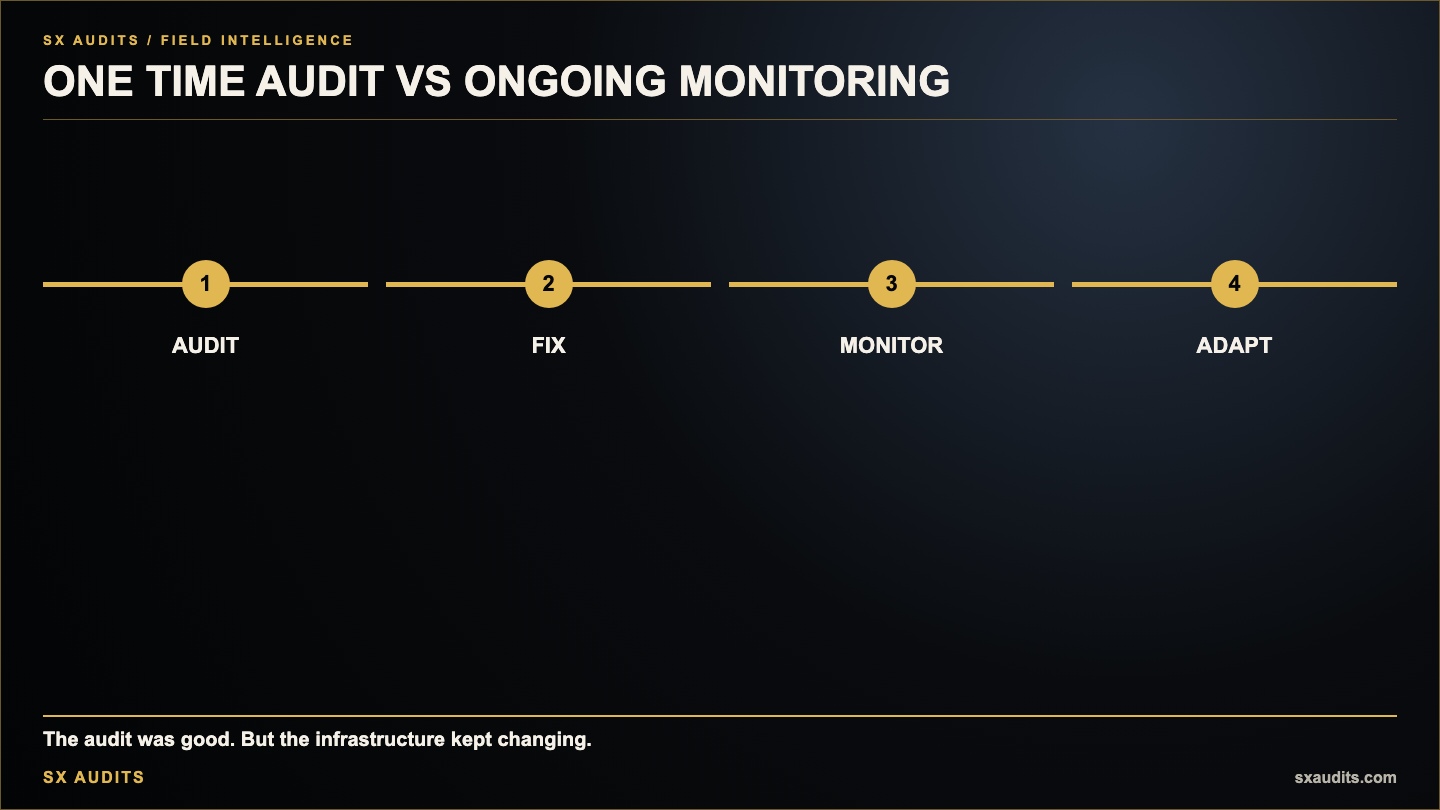
One-Time Audit vs Ongoing Monitoring — Which One Your Business Actually Needs
A real estate attorney in Houston commissioned a digital audit in January. The findings were clear: schema misconfigured, GBP showing the correct category, NAP consistent across 28 of 31 directories, and modest AI visibility across ChatGPT and Perplexity. She implemented the fixes. By March, her AI citation rate had improved and she was appearing in recommendations for her city and specialty.
By July, things had quietly shifted. Google's November 2025 algorithm updates had recalibrated how GBP engagement signals were weighted. A competitor had published a well-structured FAQ page that began earning the category citations she had. A data aggregator had re-introduced an old address variant that undermined three of her corrected directories. One of her AI citations had shifted from accurate to incomplete — listing her without her specialty.
None of these changes showed up anywhere. She had no monitoring in place and no mechanism to know the infrastructure had drifted. She found out in November when she noticed her intake volume had quietly declined.
What Each Approach Is Designed to Do
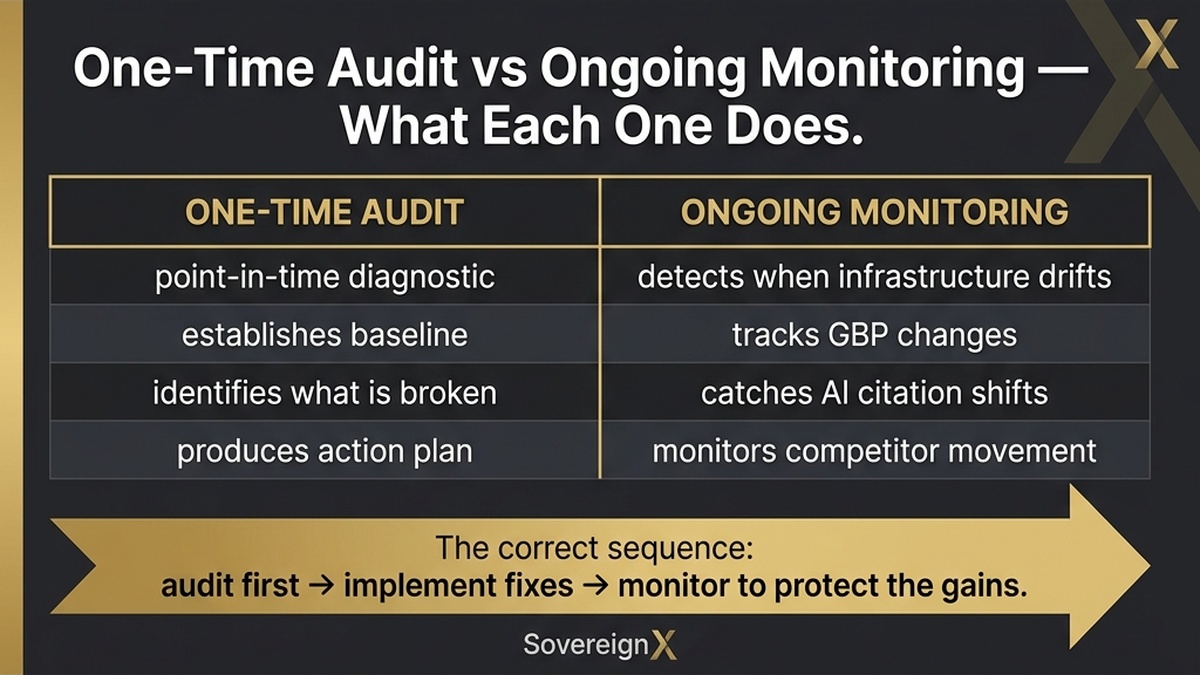
A one-time audit is a point-in-time diagnostic. It evaluates your digital infrastructure against current standards, identifies what is broken or missing, and produces a prioritized action plan. The value of a one-time audit is in establishing a verified baseline — knowing, with specificity and confidence, what is working and what is not as of the date of the audit.
Ongoing monitoring is continuous tracking of whether the infrastructure the one-time audit established is holding. It tracks changes to your GBP status, shifts in your AI citation frequency, NAP drift introduced by data aggregators, competitor movement into your AI recommendation slots, and Google algorithm changes that alter how your signals are weighted.
A one-time audit answers: "Where do I stand right now?" Ongoing monitoring answers: "Has that changed since the audit?"
Digital Infrastructure Is Not Static; It Drifts Without Active Monitoring
Your Google Business Profile can be modified by user-suggested edits without your knowledge. Data aggregators routinely re-introduce outdated NAP variants to directories you previously corrected — months after the correction. Google's local algorithm has made significant updates throughout 2025 and into 2026, with changes to how user engagement signals, content freshness, and location verification quality are weighted. AI platforms like ChatGPT train on data that shifts as third-party sources are added or removed. A business that audited in January and implemented all recommended fixes may have an entirely different AI visibility profile by September — not because they did anything wrong, but because the systems around them kept moving.
A One-time Audit Is The Correct Starting Point
Ongoing monitoring without a prior baseline is tracking drift from an unknown position. A business that starts with continuous monitoring before establishing a verified baseline is collecting data points without a reference. The correct sequence is: one-time audit to establish what is actually true about the current state of the infrastructure, implement the identified fixes, then begin monitoring to detect when that corrected state changes. Companies with strong AI visibility see 23% higher organic traffic growth compared to those with limited AI presence — but maintaining that visibility requires knowing when it erodes.
The Most Common Drift Points Are Predictable
The digital infrastructure elements most likely to drift without active monitoring are: GBP status and accuracy (subject to Google algorithm updates, competitor-suggested edits, and policy enforcement sweeps); NAP consistency (data aggregators re-introduce variants; new directories create inconsistencies); AI citation frequency and accuracy (shifts in third-party source availability, competitor content quality, and AI platform training updates); and Google algorithm signals (weighting of GBP engagement, content freshness, and local ranking factors updates multiple times per year). A monitoring framework that tracks these specific drift points catches the issues before they translate into lead volume decline.
The Lead Impact Of Undetected Drift Is Cumulative And Slow To Notice
The real estate attorney in Houston did not see an immediate drop. AI citation drift and GBP signal erosion do not produce a cliff — they produce a slow downward slope that becomes apparent only after months of accumulation. The average small business loses $126,000 per year from missed calls and inquiries. When the cause is infrastructure drift rather than a specific event, it is particularly difficult to diagnose retrospectively. A business that monitors actively catches a declined AI citation frequency in the second month; a business that audits annually catches the same issue after nine months of lost opportunity.
Some Businesses Need One; Most Competitive Businesses Need Both
A business that has never had a professional digital audit needs to start with a one-time audit — establishing a verified baseline is prerequisite to meaningful monitoring. A business that completed a one-time audit, implemented the recommended fixes, and now operates in a competitive category where AI citation share is actively contested needs ongoing monitoring. The businesses in the most resilient position are those that audit first, fix what the audit finds, and then establish monitoring to defend the gains made. Monitoring without an initial audit is navigating without a map. Auditing without subsequent monitoring is navigating to a destination and then stopping — not accounting for the road continuing to change.
A Simple Decision Framework
Start with a one-time audit if:
- You have not had a professional digital audit
- You are uncertain whether your infrastructure is currently functioning correctly
- You want a verified baseline before investing in campaigns or content strategy
Add ongoing monitoring once:
- Your one-time audit findings have been implemented
- You operate in a competitive category where AI citation share is contested
- You want to detect infrastructure drift before it affects lead volume
Want to know exactly where your business stands with AI search?
We run the full diagnostic and deliver a findings report in 72 hours. No discovery call. No commitment.
Book the Audit →Related intelligence · selected for this topic
Framework developer and systems thinker specializing in AI implementation and decision architecture. Creator of the AI Council methodology — a structured multi-model framework used to surface deeper insights in complex decisions. The audit intelligence at Sovereign X Audits is built on these same principles.
aicouncilconductor.com →Find out exactly where your business stands.
We audit your digital infrastructure, AI visibility, and brand presence — and show you exactly what it's costing you.