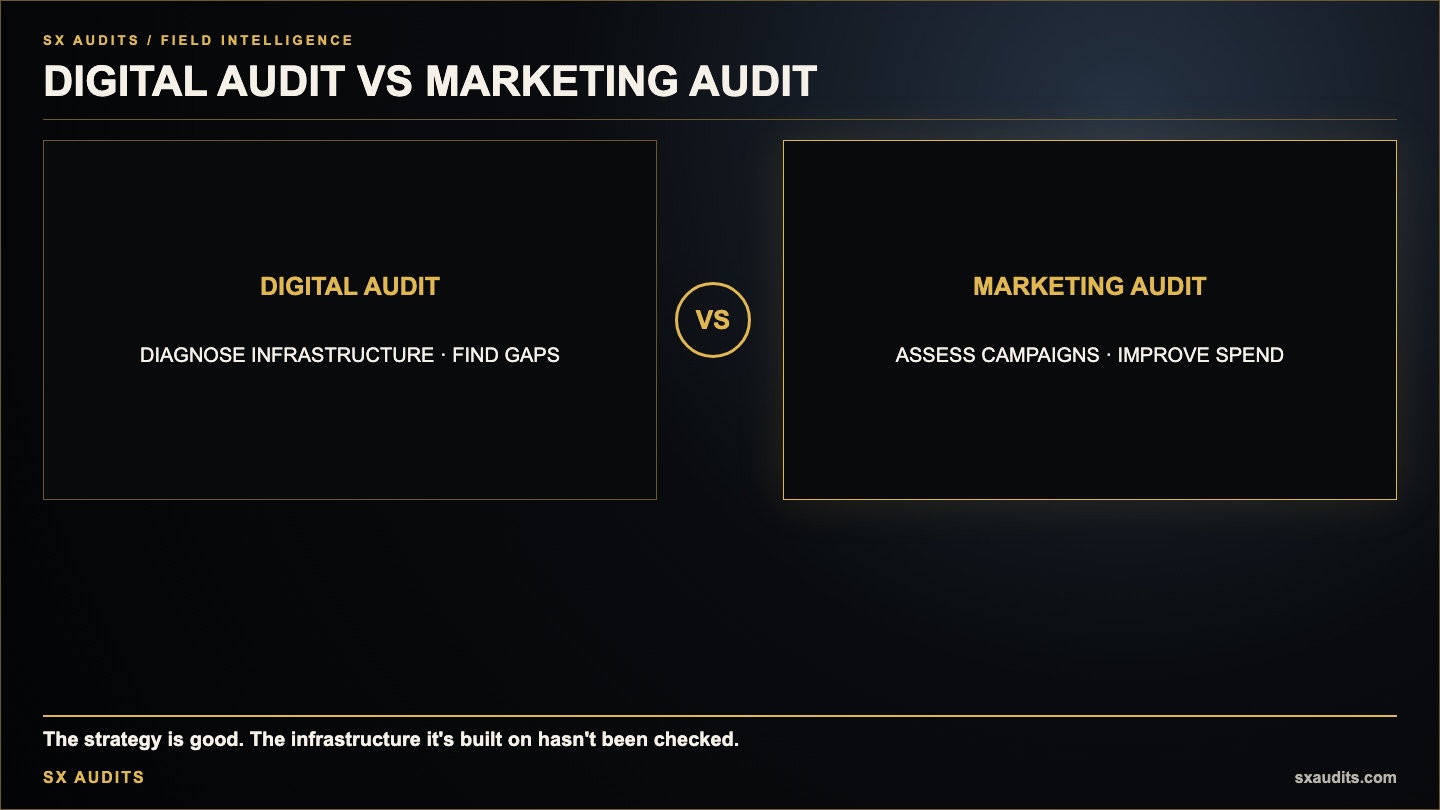
Digital Audit vs Marketing Audit — What's the Difference and Which Comes First
A commercial insurance broker in Dallas had been working with a marketing consultant for six months to develop a content strategy. The consultant had done extensive work: defined the target client profile, mapped the buyer journey, identified the content topics that would resonate with each stage, and built an editorial calendar for the next year.
It was genuinely good strategic work. The problem was that it was built on top of infrastructure the consultant had never checked.
When the broker eventually commissioned a digital audit, the findings were foundational: no schema markup on the website, NAP inconsistent across eight directories, GBP showing the wrong business category, absent from ChatGPT for every query type. The content strategy was sound. It was being published to a platform that couldn't be cited by AI, couldn't be found by a significant portion of the target audience, and had entity confusion that made it harder for both humans and AI systems to verify.
The marketing audit should have come after the digital audit — not before it.
What Each Audit Evaluates
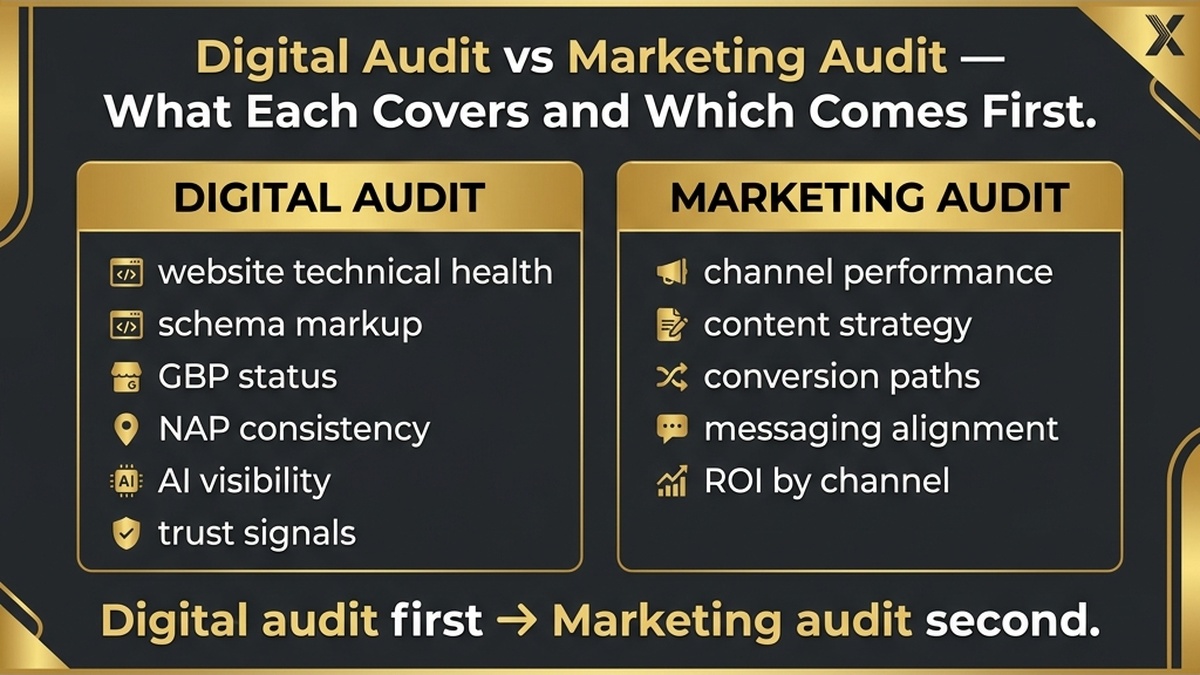
A digital audit evaluates the technical and structural infrastructure of your digital presence. It checks what is actually working, what is broken, and what is missing in the systems that determine how your business is found, verified, and recommended. A digital audit covers: website technical health, schema markup configuration, GBP status and completeness, NAP consistency across directories, AI platform visibility, review profile and trust signals, and the overall accuracy of your first-page digital presence.
A marketing audit evaluates the strategic layer of your digital presence. It examines whether your content, messaging, channels, and campaigns are aligned with business goals and reaching your target audience effectively. A marketing audit covers: channel performance (organic, paid, social, email), content strategy alignment, conversion path effectiveness, messaging consistency, KPI tracking and attribution, and ROI by channel.
The digital audit asks: "Is the infrastructure working?" The marketing audit asks: "Is the strategy working?" These are different questions — and the infrastructure question needs to come first.
A Marketing Audit Built On Broken Infrastructure Produces Wrong Conclusions
If your schema markup is misconfigured, your AI visibility is suppressed regardless of how well-written your content is. If your NAP is inconsistent across directories, your local ranking signals are confused regardless of how much you spend on local advertising. If your GBP is incomplete or showing the wrong category, prospective clients who find your marketing are being sent to a trust gap. A marketing audit that evaluates content performance without auditing the infrastructure the content is being built on is evaluating symptoms without the cause. It can identify that content performance is lower than expected — but it cannot explain why, because the why is in the infrastructure.
Digital Audits Surface The Foundational Issues That Marketing Cannot Fix
A digital audit reveals: that the website loads in 8 seconds on mobile (no amount of content strategy fixes this); that the GBP is showing an outdated business address (no campaign can redirect the leads being lost to this error); that ChatGPT returns a competitor's name for every category recommendation (no newsletter strategy addresses this); that three years of review responses have been left unanswered (no new content changes this impression). These are infrastructure problems. They live below the strategy layer. Addressing them requires a different kind of work than a marketing audit recommends — and they suppress the effectiveness of every marketing effort built on top of them.
A Marketing Audit Is Most Valuable When The Infrastructure Is Sound
The commercial insurance broker's content strategy was good. Once the infrastructure was fixed — schema implemented, GBP corrected, NAP consistent, AI visibility established — that strategy began performing as intended. The content started earning AI citations. The website started converting more of the traffic it was receiving. The marketing consultant's work was not wasted; it was waiting for the foundation to be in place. A marketing audit produces its highest ROI when it is conducted on infrastructure that is verified, working, and capable of supporting what the strategy recommends.
The Sequence That Works Is: Digital Audit First, Marketing Audit Second
The correct order is not universally followed — many businesses commission a marketing strategy engagement as their first step toward improving digital performance. The outcome is predictable: a sound strategy applied to infrastructure that can't support it, followed by disappointing results, followed by the conclusion that the strategy was wrong. In most cases, the strategy was fine. The infrastructure wasn't ready. A digital audit identifies and resolves the foundational issues. A marketing audit then evaluates whether the strategy being applied to that corrected infrastructure is aligned with business goals and performing efficiently.
Some Businesses Need One; Most Businesses Need Both
A business with functioning infrastructure — accurate GBP, schema markup, consistent NAP, reasonable AI visibility — and a question about strategic direction needs a marketing audit. A business with infrastructure problems and a question about strategic direction needs a digital audit first, then a marketing audit. A business with both infrastructure problems and strategic confusion needs both, in order. The most common mistake is commissioning a marketing audit when the actual problem is a digital audit finding — and spending months optimizing strategy while the infrastructure issues remain untouched.
A Simple Diagnostic: Which One Do You Need First?
Digital audit first if you answer yes to any of these:
- You're not sure whether your GBP is complete, verified, and showing the right category
- You don't know how your business appears in ChatGPT or Perplexity
- You've never checked your NAP consistency across major directories
- Your website has never been tested for schema markup
- Your organic traffic or inquiry volume has declined and you can't explain why
Marketing audit first if you can honestly confirm all of these:
- Your digital infrastructure is verified and functioning correctly
- You know your AI visibility score and it's acceptable
- Your GBP is complete, verified, and accurate
- Your NAP is consistent across major directories
- Your traffic is adequate but your conversion or ROI is the specific issue
Want to know exactly where your business stands with AI search?
We run the full diagnostic and deliver a findings report in 72 hours. No discovery call. No commitment.
Book the Audit →Related intelligence · selected for this topic
Framework developer and systems thinker specializing in AI implementation and decision architecture. Creator of the AI Council methodology — a structured multi-model framework used to surface deeper insights in complex decisions. The audit intelligence at Sovereign X Audits is built on these same principles.
aicouncilconductor.com →Find out exactly where your business stands.
We audit your digital infrastructure, AI visibility, and brand presence — and show you exactly what it's costing you.