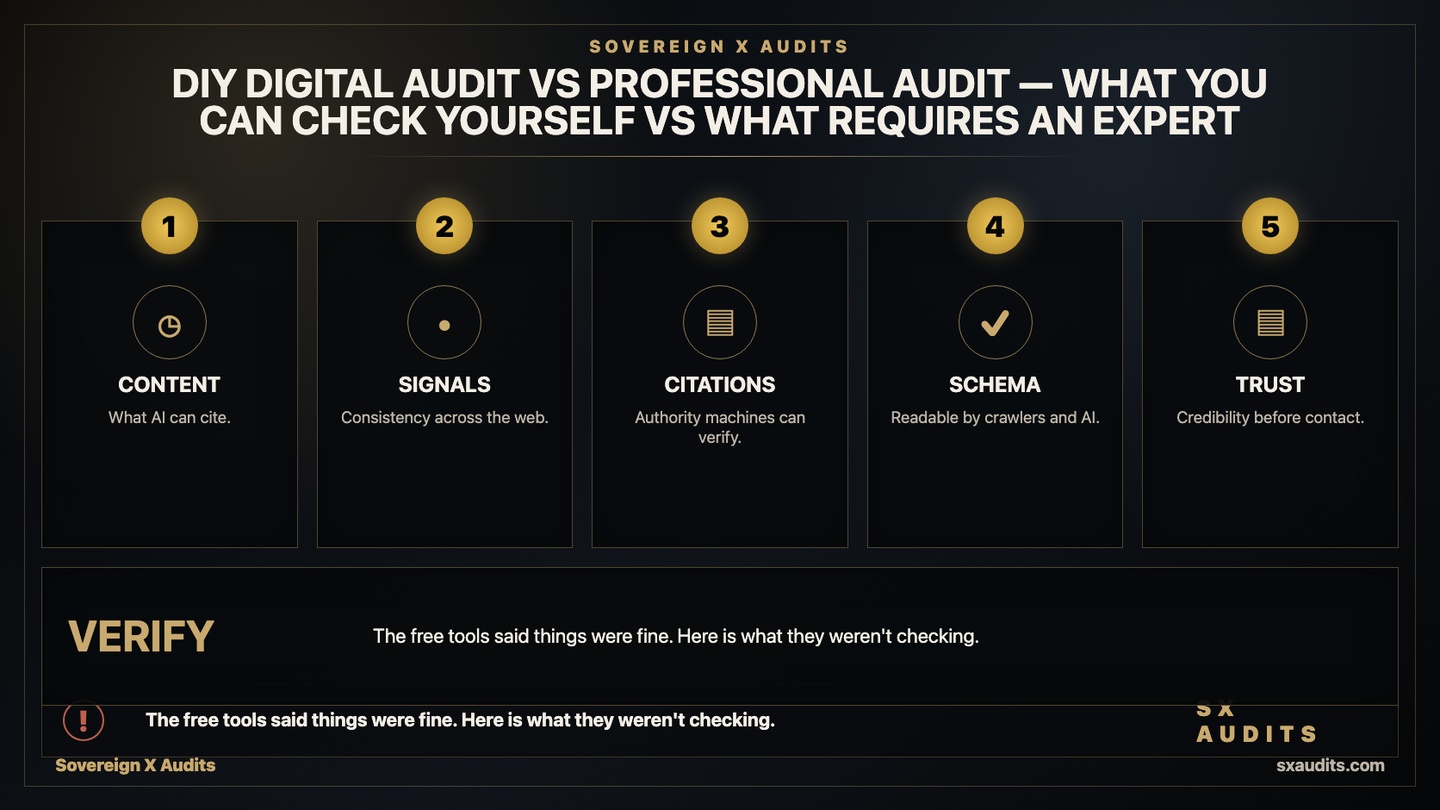
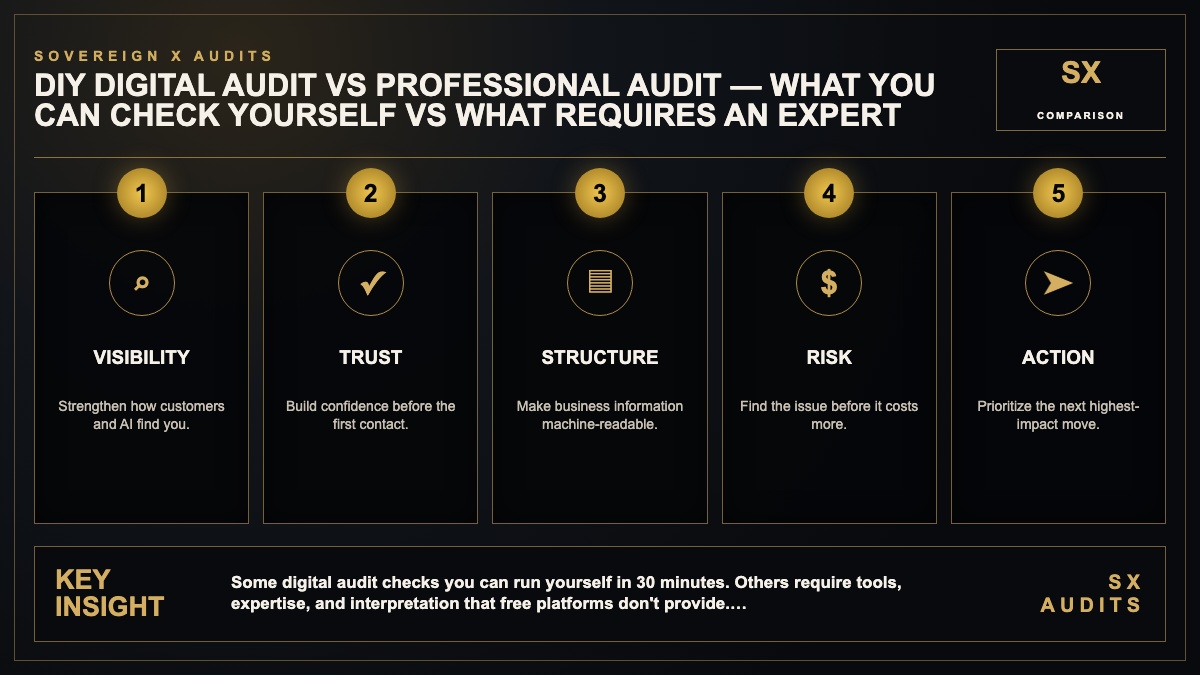
DIY Digital Audit vs Professional Audit — What You Can Check Yourself vs What Requires an Expert
A physical therapist in Phoenix had been running her own digital checks for two years. She used Google Search Console, ran her site through PageSpeed Insights monthly, and kept an eye on her Google Analytics. She felt informed about her digital presence.
When a colleague recommended she run a full audit before investing in a new website, she discovered what her self-monitoring had been missing: her Google Business Profile was showing the wrong specialty category, she had no schema markup on any page, she was absent from ChatGPT and Perplexity for every relevant query type, and her NAP was inconsistent across nine directories — including three that were actively feeding conflicting data to Google's local algorithm.
None of these findings were in Google Search Console. None of them appeared in PageSpeed Insights. None of them showed up in Google Analytics. Her DIY monitoring had been accurate — within the very narrow slice of her digital presence that free tools actually measure.
What You Can Check Yourself
A motivated business owner with basic digital literacy can check the following without professional tools:
Your website loads quickly on mobile and desktop, using free tools like Google PageSpeed Insights or GTmetrix. Your Google Business Profile is claimed, verified, and shows correct hours, address, category, and photos. Your Google Search Console is connected and not showing manual action penalties or critical crawl errors. You appear in Google's organic results for your own name. Your social media profiles are consistent with your website. You have reviews on Google and are responding to them.
These are meaningful checks. They take about 30–45 minutes and they catch obvious issues that a professional audit would also find. If you have not done them, they are worth doing now.
Free Tools Check Technical SEO; They Do Not Check Your Full Digital Presence
Semrush, Ahrefs, and Screaming Frog are powerful tools for evaluating website technical SEO — crawlability, indexation, page speed, broken links, on-page optimization, and backlink profiles. Semrush's Pro plan crawls up to 100,000 URLs per project. Ahrefs checks approximately 100 technical factors. These are legitimate tools that professional SEO agencies use. What they do not check: your Google Business Profile status and category accuracy, your NAP consistency across 30+ directories and data aggregators, how your business appears in ChatGPT or Perplexity recommendations, your schema markup configuration for AI entity recognition, or your third-party citation profile. The tool checks the website. It does not check the full digital presence.
AI Visibility Is Not In Any Free Tool's Default Audit
Fewer than 30% of existing SEO audit checklists include AI readiness checks. Most free tools were built to evaluate traditional Google ranking signals — they were not designed to test how business appears in generative AI responses. Running the AI visibility check yourself requires opening ChatGPT, Perplexity, and Google AI Overviews in fresh sessions, running a standardized set of 15+ queries, recording citation frequency, accuracy, and sentiment, and comparing your results against the businesses that are appearing. This is a manual process. It does not require paid tools — but it does require knowing what to run, how to interpret what appears, and how to diagnose the structural reasons for absence. A business owner running this for the first time typically does not know what schema gaps, NAP signals, or content structure issues are suppressing their citations.
NAP Consistency Across 30+ Directories Cannot Be Audited With Free Tools
Only 30% of small businesses have consistent Name, Address, and Phone information across major directories. NAP inconsistency is one of the highest-impact problems in local digital visibility — it reduces AI citation confidence, suppresses Google Maps rankings, and creates trust gaps for consumers who encounter conflicting information. A thorough NAP audit requires checking 30+ directories and data aggregators: Google, Yelp, Facebook, Bing Places, Apple Maps, Foursquare, Citysearch, Yellow Pages, Superpages, Manta, and the underlying data aggregators that feed dozens of other directories. Free tools flag NAP as a concept. They do not run the 30+ directory check that reveals the actual scope and sources of inconsistency.
Data Without Interpretation Is Not A Diagnosis
Free tools return data. A professional audit returns a diagnosis. Semrush can tell you that your page speed score is 67 out of 100 — it cannot tell you whether that score is actually costing you leads, or whether it is a lower priority than the GBP category mismatch that is sending your traffic to the wrong kind of business. Ahrefs can show your backlink profile — it cannot tell you that the three authoritative third-party citations you're missing are the specific reason you're absent from ChatGPT recommendations for your category. Raw data without prioritized interpretation gives a business owner a list of things that might be problems. A professional audit gives a prioritized action sequence: fix these three things first because they are suppressing your lead volume, then address these five secondary issues.
The Highest-leverage Gaps Are The Ones Free Tools Don't Find
The commercial value of a digital audit is in finding what is suppressing leads, not in confirming that a website loads correctly. For most small businesses, the highest-leverage gaps are not in website technical performance — they are in GBP completeness, schema markup, AI platform visibility, and NAP consistency across directories. These are the dimensions that determine whether a prospective client who asks ChatGPT for a recommendation in your category ever hears your name. Free tools don't audit these dimensions. A business that only conducts DIY audits is optimizing the visible top of the iceberg while the suppressing factors remain underwater.
What Each Approach Covers
| | DIY / Free Tools | Professional Audit | |---|---|---| | Website technical health | ✓ | ✓ | | Page speed | ✓ | ✓ | | Organic keyword rankings | ✓ | ✓ | | Backlink profile | Partial | ✓ | | Schema markup validation | ✗ | ✓ | | Google Business Profile | Basic | ✓ Full | | NAP consistency (30+ directories) | ✗ | ✓ | | AI platform visibility (ChatGPT, Perplexity) | ✗ | ✓ | | Prioritized action sequence | ✗ | ✓ | | Third-party citation analysis | ✗ | ✓ |
Want to know exactly where your business stands with AI search?
We run the full diagnostic and deliver a findings report in 72 hours. No discovery call. No commitment.
Book the Audit →Related intelligence · selected for this topic
Framework developer and systems thinker specializing in AI implementation and decision architecture. Creator of the AI Council methodology — a structured multi-model framework used to surface deeper insights in complex decisions. The audit intelligence at Sovereign X Audits is built on these same principles.
aicouncilconductor.com →Find out exactly where your business stands.
We audit your digital infrastructure, AI visibility, and brand presence — and show you exactly what it's costing you.