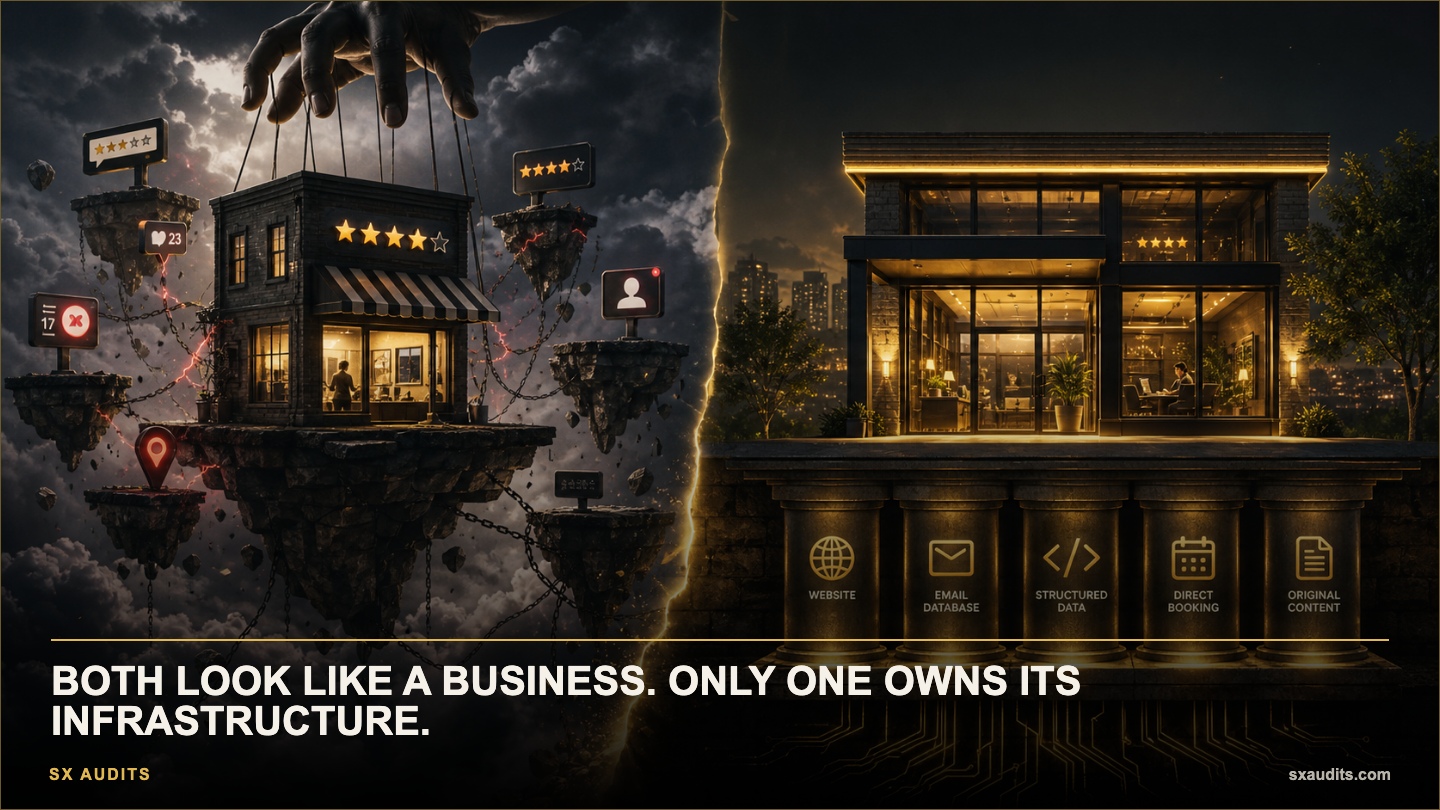
Digital Sovereignty for Small Business: Owning Your Infrastructure in the AI Era
A bakery owner in Austin had spent six years building her business on the back of a strong Instagram presence, a Google Business Profile she optimized carefully, and a Yelp listing that had accumulated over 300 reviews. She had no website beyond a one-page placeholder, no email list, and no schema markup. Her business looked strong online.
Then, in the same week, Instagram's algorithm reduced her organic reach by 70%, her Google Business Profile was suspended during a mass enforcement sweep, and Yelp updated its algorithm in a way that buried her listing in favor of paid advertisers.
Three of her four digital pillars fell simultaneously. Each one was controlled by a platform she did not own.
She had a thriving business. She had almost no owned digital infrastructure.
What Digital Sovereignty Actually Means for Small Business
Digital sovereignty — in the enterprise context — refers to governments and large organizations maintaining control over data, AI systems, and cloud infrastructure rather than ceding that control to foreign or third-party platforms. The sovereign cloud market was valued at $117.53 billion in 2025 and is projected to reach $648.87 billion by 2033.
For small business, the concept translates differently — but the underlying principle is identical.
Digital sovereignty for a small business means owning the infrastructure your visibility, reputation, and customer acquisition depend on. It means not building your business on land you don't own, not entrusting your customer contact data to platforms that can revoke access, and not depending on algorithmic goodwill for discoverability.
In 2026, this is not a philosophical argument. It is an operational risk assessment.
Platform Dependency Is Structural Vulnerability, Not Strategy
Ninety percent of local businesses use social media as part of their marketing strategy. Most have no fallback if that platform changes its rules. Average organic reach for a business Facebook post is under 2% of its following in 2026. Instagram reach has trended comparably downward for years. A business with 10,000 Instagram followers reaches approximately 200 people per post without paying for promotion — and the access to those 200 people is entirely at the platform's discretion. Google Business Profile suspensions increased by over 80% globally between Q1 2023 and Q2 2024, with the trend continuing into 2025 and accelerating through the April 2026 enforcement sweep. Sixty-one percent of affected businesses experienced measurable drops in leads or calls during their suspension. A business built on GBP alone — without a strong owned website to fall back on — loses its primary discovery channel when that suspension occurs.
Owned Infrastructure Generates Compounding Returns; Rented Infrastructure Erodes
Businesses with both a website and social media presence generate 2× more revenue than those with social media alone. This gap is not primarily about traffic volume — it is about the difference between compounding and eroding assets. A website with structured content and schema markup accumulates authority over time and continues generating traffic without active maintenance. An email list retains its value regardless of algorithm changes, platform policies, or enforcement sweeps. Social followers, GBP rankings, and Yelp ratings are accessible only as long as the platform decides to let you access them — and they reset to zero if that access is revoked.
AI Search Has Created A New Sovereignty Layer
The original argument for owned digital infrastructure was about Google, social media, and email. In 2026, a third infrastructure layer has emerged: AI visibility. ChatGPT processes 900 million queries per week. Perplexity processed 780 million queries in a single month. Forty-five percent of U.S. consumers now use AI tools for local business recommendations, up from 6% in early 2025. AI systems build their recommendations from owned infrastructure — website content, schema markup, NAP consistency, and citable third-party mentions. A business without an owned, structured website is not just invisible to traditional search. It is invisible to the fastest-growing discovery channel in history.
Data Sovereignty Is The Often-overlooked Dimension
When you build your business on rented platforms, you don't own the audience data — the platform does. Instagram knows who your followers are, where they live, what they buy, and when they're most active. You don't. Your GBP knows how many people called, got directions, or viewed your photos. Google controls that data. When you own your website and email list, you own the contact information, behavioral data, and engagement history of your audience. That data is yours to analyze, market to, and transfer to whatever CRM or marketing platform you choose — without platform permission.
Digital Sovereignty Is A Stack, Not A Single Asset
The businesses with strong digital sovereignty in 2026 share a consistent architecture: an owned website with schema markup and AI-readable content at the foundation; an email list of customers and prospects they can reach without platform permission; direct booking or CRM infrastructure that doesn't depend on any social platform; consistent NAP across all directories and platforms; and citable original content that AI systems can use to build recommendations confidently. No single asset provides sovereignty. The architecture of owned infrastructure, built across all five layers, is what provides it.
What Sovereign Digital Infrastructure Looks Like
Layer 1 — Foundation (owned and controlled):
- A functioning website with schema markup, structured content, and direct contact capability
- An email list you own and maintain
- Direct booking or inquiry infrastructure that doesn't require a social platform intermediary
Layer 2 — Visibility (maintained and monitored):
- Google Business Profile — essential but rented; must have a website fallback
- NAP consistency across all directories — controlled through owned data
- Schema markup declaring your identity and specialty — lives on your owned website
Layer 3 — Authority (built over time):
- Published original content on your owned website
- Third-party citations and press mentions that validate your expertise
- AI-readable entity signals that allow AI systems to recommend you confidently
What you rent (use, don't build on):
- Instagram, TikTok, Facebook — distribution tools, not foundations
- Google Business Profile, Yelp, industry directories — visibility amplifiers, not primary infrastructure
- Third-party review platforms — credibility signals, not owned assets
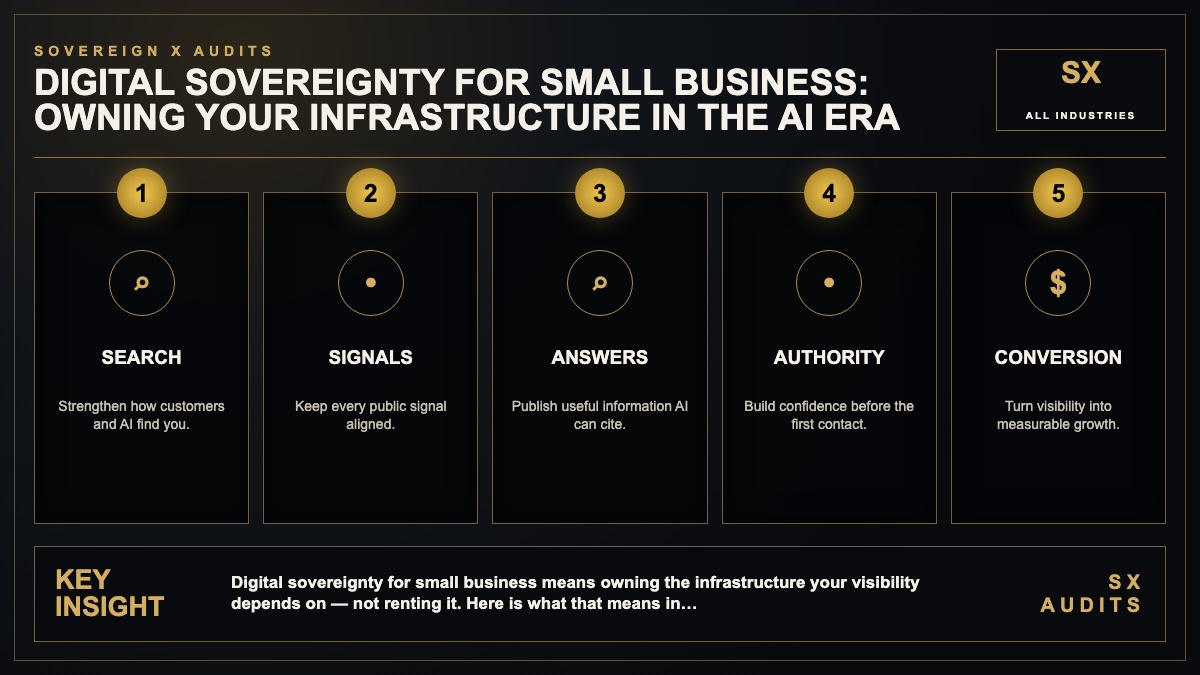
Want to know exactly where your business stands with AI search?
We run the full diagnostic and deliver a findings report in 72 hours. No discovery call. No commitment.
Book the Audit →Related intelligence · selected for this topic
Framework developer and systems thinker specializing in AI implementation and decision architecture. Creator of the AI Council methodology — a structured multi-model framework used to surface deeper insights in complex decisions. The audit intelligence at Sovereign X Audits is built on these same principles.
aicouncilconductor.com →Find out exactly where your business stands.
We audit your digital infrastructure, AI visibility, and brand presence — and show you exactly what it's costing you.