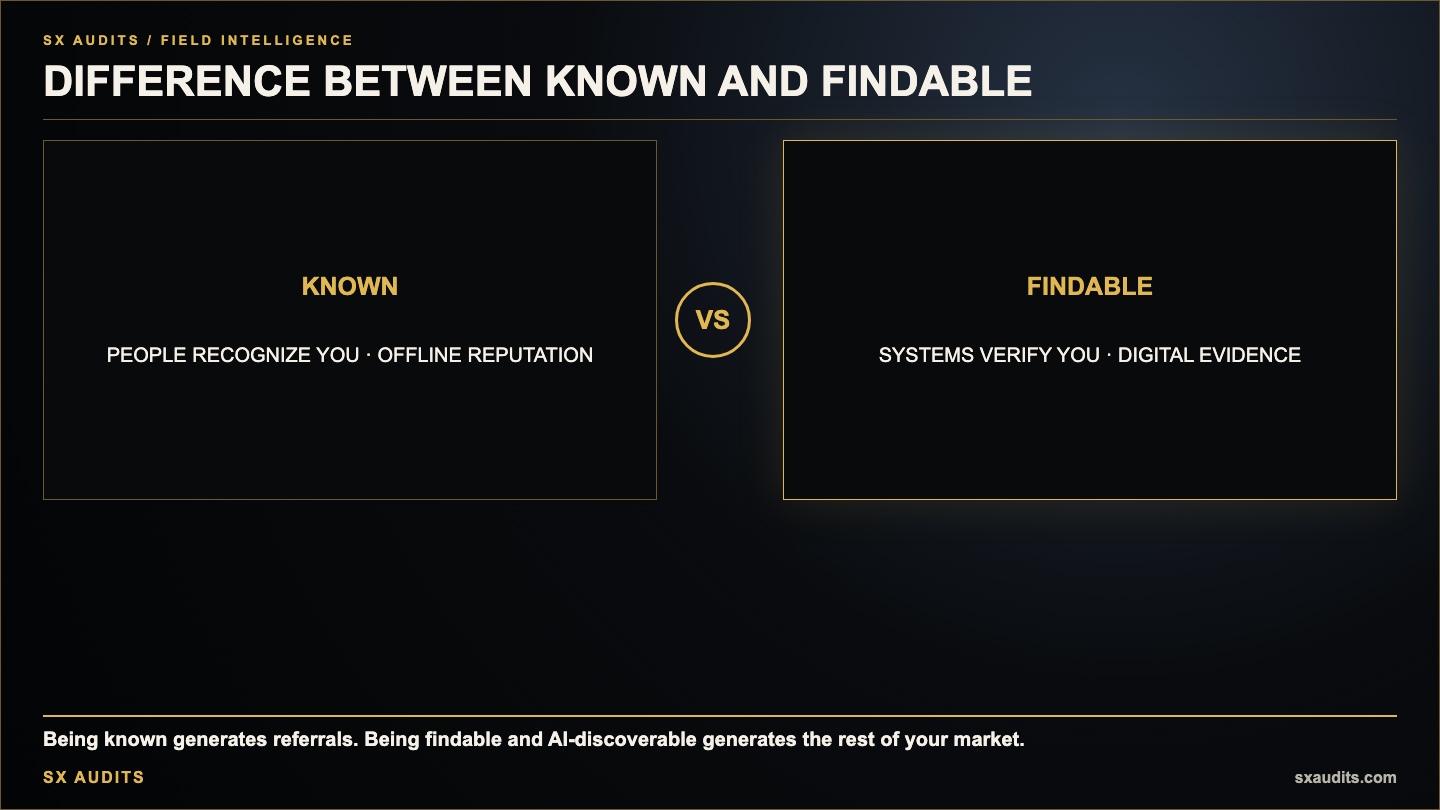
The Difference Between Being Known and Being Findable
A specialty insurance broker in Minneapolis had been in business for sixteen years. He was well-known within his professional network. He attended industry events, maintained active relationships with referral sources, and had strong name recognition among the accountants and attorneys who sent him business.
When a new business owner in his city asked ChatGPT to recommend a commercial insurance broker who specialized in professional liability, his name was not in the response. When she searched Google for "professional liability insurance broker Minneapolis," his website appeared on page two. She found three brokers on the first page, read their Google reviews, scanned their websites, and called the one with the most complete and current presence.
The broker was well-known. He was not findable by anyone who didn't already know him.
His referral network was generating clients from within the circle of people who had already heard his name. The market outside that circle — people with the exact need he served, actively searching for help — was effectively inaccessible to him.
Three Distinct Layers of Business Visibility
There is a meaningful distinction between three states of visibility that most businesses conflate:
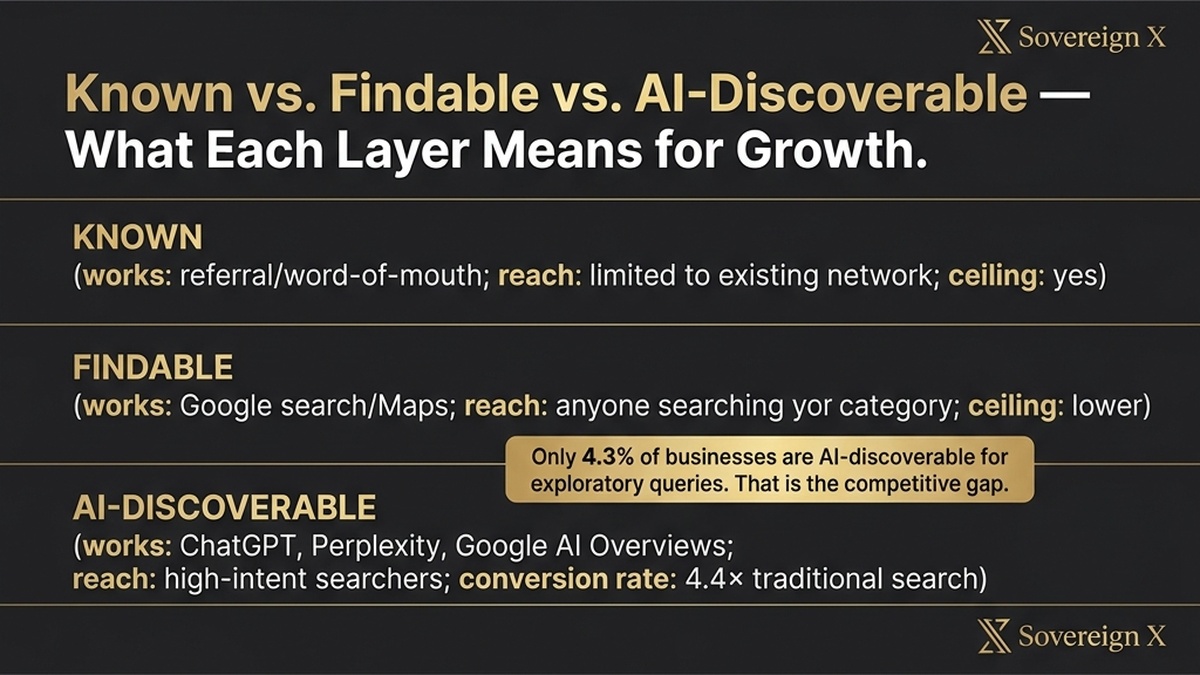
Being known means your name is recognized by people who have already encountered you — through referrals, word of mouth, networking, or prior interactions. Being known is an asset, but it is a closed loop. It generates business only from within the network that already has your name.
Being findable means a person who does not yet know your name can locate your business through an active search — Google, Maps, Yelp, industry directories — when they have a specific need in your category. Being findable opens the loop. It connects you to demand that exists outside your existing network.
Being discoverable by AI is a third, emerging layer: being the business that AI platforms — ChatGPT, Perplexity, Google AI Overviews — surface when a prospective client asks for a recommendation in your category, even if they have never encountered your name before. AI platforms are now the first point of contact for a growing share of new client journeys.
Most established businesses are strong on the first layer and weak on the second and third. Most newer businesses prioritize the second and neglect the third. Very few have optimized all three.
Being Known Generates Only Referral-dependent Growth
A business that is known but not findable is dependent on its referral network for all new client acquisition. Referral networks are valuable — they are the highest-trust channel and tend to produce high-quality clients. But they have structural constraints: they are limited in size, they require active maintenance, and they stop producing new clients when the network stops being actively cultivated. A business that is both known and findable has a second acquisition channel that generates new clients from outside the network — from people who have the problem, are actively searching for a solution, and have no prior relationship with any specific provider.
AI Search Has Created A New Discovery Layer That Operates Separately From Both Reputation And Google Rankings
AI platforms do not recommend businesses based on how well-known they are or how well they rank in Google. They recommend businesses based on structured entity signals: schema markup, NAP consistency, authoritative directory listings, and citable content. A study of local businesses found that only 49.6% of the highest-reviewed operators in their markets appeared in ChatGPT results at all. Eighty percent of AI-cited sources do not appear in Google's top-10 organic results, and only 12% of AI citations overlap with Google's first page. Being known and ranking well on Google are both real assets — but neither one automatically translates into AI discoverability. That layer requires its own infrastructure.
The Market Outside Your Referral Network Is Larger Than The Market Inside It
For most small professional service businesses, the referral network represents a minority of the total available market. The insurance broker in Minneapolis had excellent penetration within the accounting and legal community that knew his name. But the city's total population of businesses in his target category — those with professional liability exposure, new to the market, recently changed advisors, or simply outside the network's reach — was vastly larger. AI-driven discovery and organic search visibility are the channels that connect a business to that larger market: the people who have the need, are actively looking, and have no pre-existing relationship guiding them toward any specific provider.
AI Discoverability Converts At A Higher Rate Than Traditional Search Traffic
Traffic from AI sources converts at 4.4 times the rate of traditional search traffic. The explanation is intent: a consumer who asks ChatGPT "recommend a professional liability insurance broker in Minneapolis for a consulting firm" has a specific, active need, has entered a conversational search that implies readiness to act, and is receiving a curated recommendation rather than a list of options to evaluate. The conversion dynamic is closer to a warm referral than to a cold search. A business that appears in that AI recommendation is being introduced to a high-intent prospect — which is why AI discoverability, while newer and less understood than SEO, generates a disproportionate return relative to the traffic volume it currently represents.
Only 4.3% Of Companies Currently Maintain A Discovery Funnel In AI Search
Research from the Semrush Enterprise AI Visibility Index found that only 4.3% of companies appear in AI answers as both seen and trusted — surfacing for early-stage exploratory queries, not just for brand-name searches. The vast majority of businesses — even well-known, well-ranked ones — appear in AI primarily when someone is already searching for them by name. They are known, not discoverable. The companies that appear in AI recommendations for category-and-location queries, before the searcher has a specific brand in mind, are the businesses that have built AI-specific infrastructure — schema, entity consistency, citable content, third-party validation — not simply the ones with the strongest traditional reputation or Google rankings.
The Three-Layer Visibility Audit
Layer 1 — Am I known? Search your name in Google. Does a clear, professional, accurate presence appear? Do the results confirm the version of your business you would want a prospective client to see? This is the minimum bar.
Layer 2 — Am I findable? Search your category and location in Google without your business name: "professional liability insurance broker Minneapolis," "commercial insurance broker for consulting firms," or whatever the unbranded query looks like for your practice. Does your business appear on the first page of results? Does it appear in the Maps pack? If not, you are not findable by the market that doesn't yet know your name.
Layer 3 — Am I discoverable by AI? Open ChatGPT and Perplexity and search: "Best [your category] in [your city]" and "Recommend a [your specialty] for [your target client type]." Do you appear? If not, you are invisible to the fastest-growing new discovery channel in professional services.
Most established businesses pass layer 1, have partial results at layer 2, and fail layer 3 entirely.
Want to know exactly where your business stands with AI search?
We run the full diagnostic and deliver a findings report in 72 hours. No discovery call. No commitment.
Book the Audit →Related intelligence · selected for this topic
Framework developer and systems thinker specializing in AI implementation and decision architecture. Creator of the AI Council methodology — a structured multi-model framework used to surface deeper insights in complex decisions. The audit intelligence at Sovereign X Audits is built on these same principles.
aicouncilconductor.com →Find out exactly where your business stands.
We audit your digital infrastructure, AI visibility, and brand presence — and show you exactly what it's costing you.