Why Building Your Business on Social Media Alone Is Like Renting Instead of Owning
A personal trainer in Brooklyn built his entire fitness business on Instagram. Seven thousand followers. Strong engagement. A consistent posting schedule he had maintained for three years. New clients found him exclusively through Instagram — he had no website, no email list, no other channel.
In early 2025, Instagram's algorithm changed how it distributed non-Reels content. His reach dropped from 1,400 views per post to under 200. His inquiry rate fell 70% in two weeks.
He hadn't done anything wrong. The platform had changed the rules. He had no fallback because he had built everything on land he never owned.
What You Actually Own on Social Media
When you build a social media following, you are building a relationship with a platform — not an audience. The platform owns the contact data. It controls who sees your content and when. It can change that algorithm at any time, for any reason, with no obligation to inform you in advance.
The account is yours to use. The audience is not yours to own.
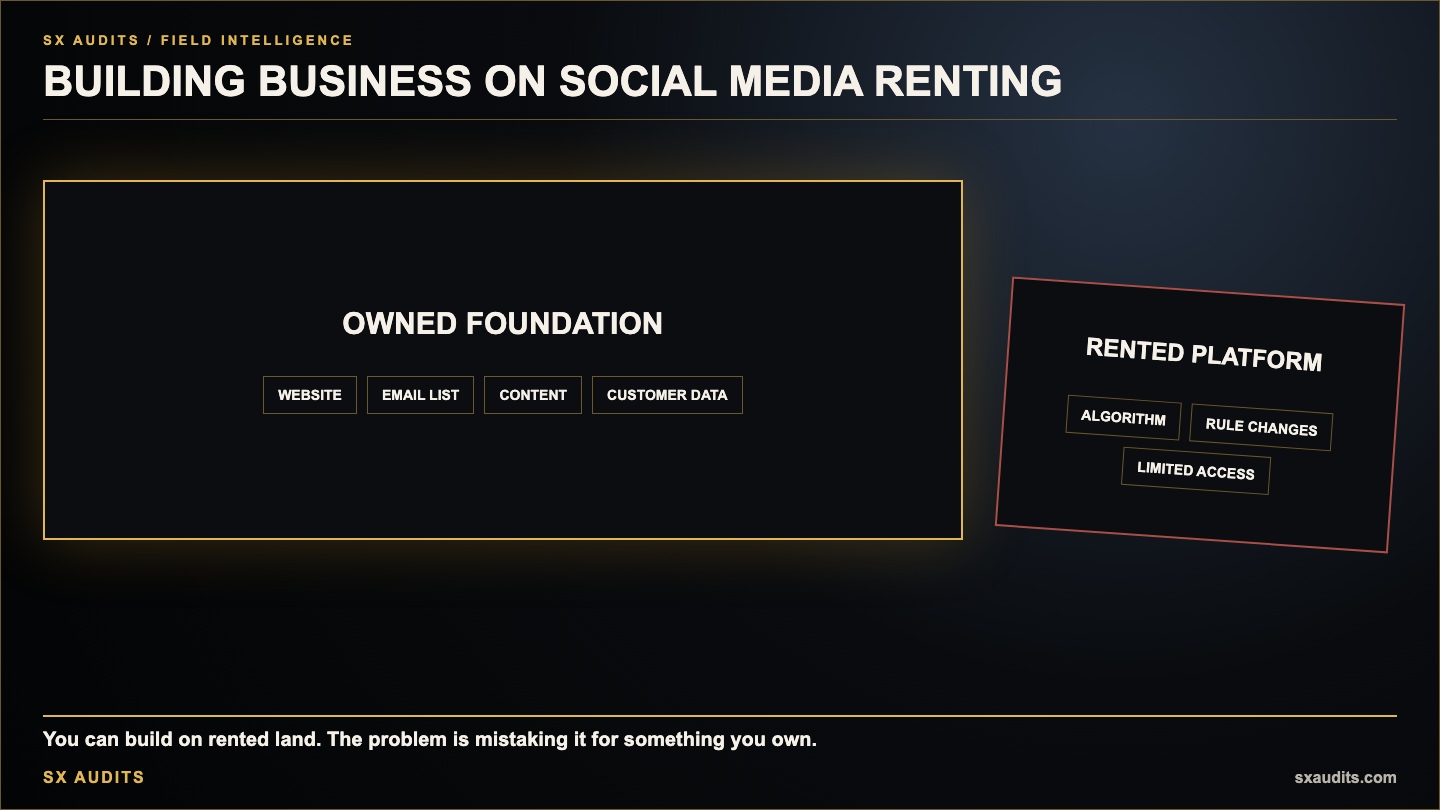
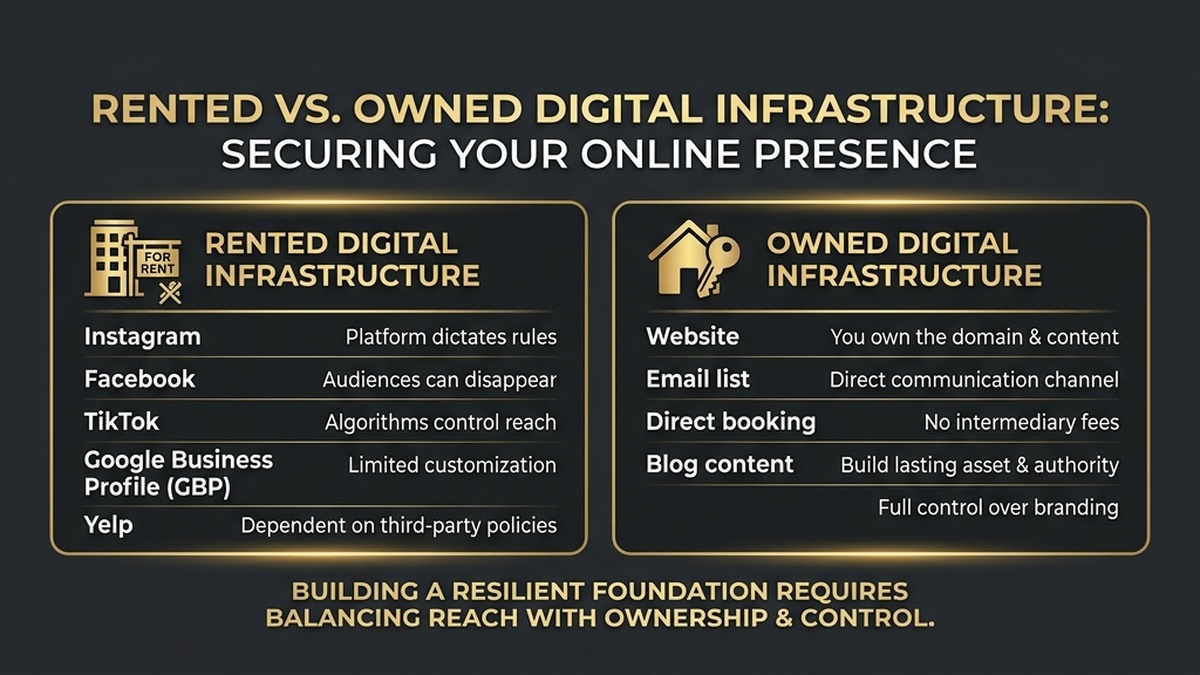
This is the fundamental difference between rented and owned digital infrastructure. A website you control, an email list you maintain, a direct booking system — these are owned assets. An Instagram following, a Facebook page, a TikTok presence — these are rented assets. The value you build in rented spaces is real, but it is entirely dependent on the landlord's continued goodwill and stable rules.
Organic Social Reach Has Effectively Collapsed
Average organic reach for a business Facebook post is under 2% of its follower base in 2026. Instagram is comparable. A business with 10,000 Instagram followers is reaching approximately 200 people per post without paying for promotion. This number has trended consistently downward for years as platforms prioritize paid visibility and watch time for video content. The audience is there. The access to it requires payment.
Platform Rules Change Without Warning
The personal trainer in the opening scenario is not an unusual case — it is the predictable outcome of building on rented land. In 2026, three platform risks compound simultaneously: algorithmic volatility (reach fluctuates unpredictably based on platform priorities), pay-to-play dynamics (organic visibility decreases as platforms favor paid content), and policy enforcement (account suspensions, content restrictions, and link limitations can be applied without advance notice). Ninety percent of local businesses use social media as part of their marketing strategy. Most have no fallback.
The Revenue Gap Between Owned And Rented Channels Is Documented
Businesses with both a website and social media presence generate 2× more revenue than those with only social media. This is not primarily because websites drive more traffic — it is because owned channels compound and rented channels erode. A website with strong SEO continues to generate traffic even when you're not actively posting. An email list retains its value regardless of algorithm changes. Social followers are accessible only as long as the platform decides to let you access them.
Social Media Is Most Valuable As A Distribution Tool For Owned Infrastructure
The businesses using social media most effectively in 2026 are not building on it — they are amplifying through it. They publish original content to their owned website and email list, then distribute it through social media to drive awareness back to the owned channels. Social media works best as a traffic driver to owned infrastructure, not as the infrastructure itself. This sequence preserves the audience relationship regardless of what any individual platform does.
AI Search Is Reducing Social Media's Role In Initial Discovery
AI search is the new first-touch channel for a growing share of purchase decisions. ChatGPT processes 900 million queries per week. Perplexity processed 780 million queries in a single month. Neither platform's recommendations are primarily driven by social media signals — they are driven by website content, schema markup, NAP consistency, and third-party citations. A business without a functioning website and AI-visible infrastructure is not just building on rented land — it is invisible to the fastest-growing discovery channel in history.
What Owning Your Infrastructure Looks Like
Owned assets:
- A website you control with schema markup, content, and direct booking or contact capability
- An email list of actual customers and prospects reachable without platform permission
- Direct booking or CRM infrastructure that doesn't depend on a social platform
Rented assets (use, don't build on):
- Instagram, TikTok, Facebook, LinkedIn — powerful distribution tools; unreliable foundations
- Google Business Profile — essential for local visibility; can be suspended
- Third-party review platforms — important for credibility; rules can change
The strategy is not to abandon social media. It is to stop treating rented channels as the foundation and start treating them as the amplification layer for owned assets.
Want to know exactly where your business stands with AI search?
We run the full diagnostic and deliver a findings report in 72 hours. No discovery call. No commitment.
Book the Audit →Related intelligence · selected for this topic
Framework developer and systems thinker specializing in AI implementation and decision architecture. Creator of the AI Council methodology — a structured multi-model framework used to surface deeper insights in complex decisions. The audit intelligence at Sovereign X Audits is built on these same principles.
aicouncilconductor.com →Find out exactly where your business stands.
We audit your digital infrastructure, AI visibility, and brand presence — and show you exactly what it's costing you.