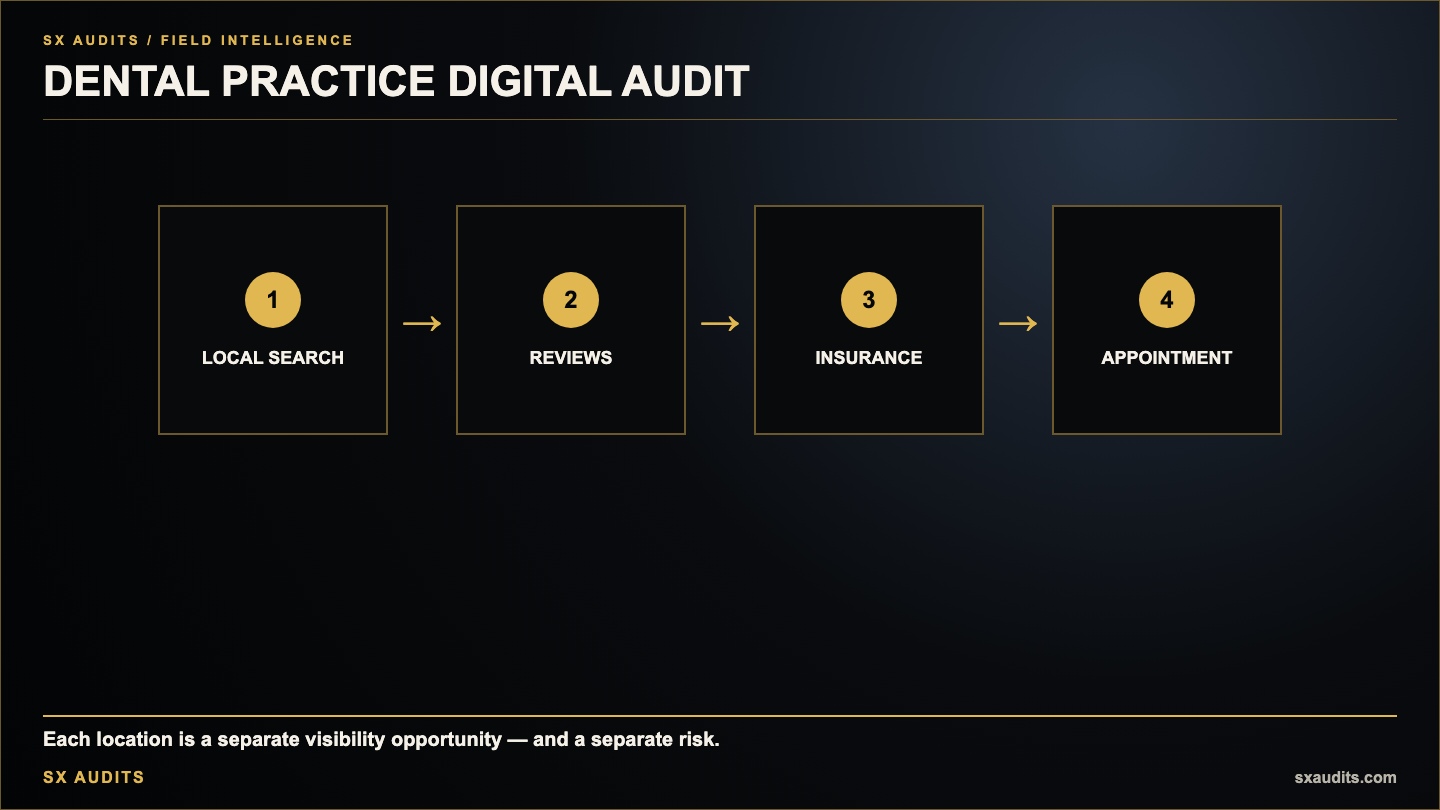
Dental Practice Digital Audit: The New-Patient Visibility Framework
A dental group with four Manhattan locations had been running Google Ads for two years. Cost per lead had increased 40% in twelve months. The practice manager assumed the market had become more competitive and adjusted the budget upward to compensate.
A digital audit found the underlying problem: two of the four GBP listings had outdated addresses. One had hours that didn't match the website. None of the four had LocalBusiness schema. In AI search, the group appeared for its branded name but not for any category queries — while three competitor practices without comparable brand recognition appeared consistently for "dentist near me" and "family dentist [neighborhood]."
They weren't losing to better competitors. They were losing to better infrastructure.
The New Patient Acquisition Reality for Dental Practices
Ninety-three percent of patients search online before booking their first appointment with a dental practice. Eighty-three percent of new patient inquiries now originate from digital channels — local search, social media, and AI platforms. Seventy-four percent of dental practices have recently increased their marketing budgets, with 80% of that budget allocated to digital channels.
The practices winning in this environment are not necessarily spending more. They are spending on a cleaner foundation.
Local Search Dominance Is Winner-take-most
Thirty-eight percent of dental searches trigger the local map pack, and the top three results capture 72% of all clicks from that search. A dental practice in position four receives a fraction of the traffic that position one receives, even with identical quality, ratings, and pricing. Local 3-pack placement for dental is determined by GBP completeness, review velocity, NAP consistency, website authority, and schema markup — in roughly that order.
AI Visibility Is The Emerging New-patient Channel
ChatGPT processes over 900 million queries per week. When a patient asks "who is a good dentist for kids in [neighborhood]?" or "best dental practice in [city] accepting new patients," the AI generates a specific recommendation. Dental practices appearing in those responses are receiving pre-sold referrals from the highest-intent patient segment available. Most dental practices are completely absent from these recommendations because their digital infrastructure doesn't support AI citation.
Review Velocity Determines Local Ranking
The dental practices in the local 3-pack in competitive markets share one consistent characteristic: they generate reviews continuously. The pattern matters more than the count — a practice generating three to five Google reviews per month consistently outperforms one that generated 200 reviews in a three-month campaign two years ago and has been quiet since. Seventy-three percent of consumers don't trust reviews older than a month.
Multi-location Practices Have Compounded Infrastructure Requirements
Each location needs its own GBP listing, location-specific pages on the website, and location-specific NAP entries in all major directories. Multi-location dental groups frequently have inconsistency at the location level: the corporate website lists one phone number while the individual location's GBP lists another; an office that moved six months ago hasn't had its Apple Maps listing updated. Each inconsistency suppresses that location's local search visibility.
After-hours Capture Determines Who Wins Evening Researchers
Dental appointment decisions frequently happen in the evening after the practice is closed. Patients researching at 9 PM who find a competitor's booking system are unlikely to remember to call the next morning. A practice without a real-time booking option or after-hours inquiry capture is losing a significant share of its most conversion-ready patients. Sixty-two percent of small business calls go unanswered — in dental practices, the after-hours gap is one of the most consistently identified revenue leaks in audit findings.
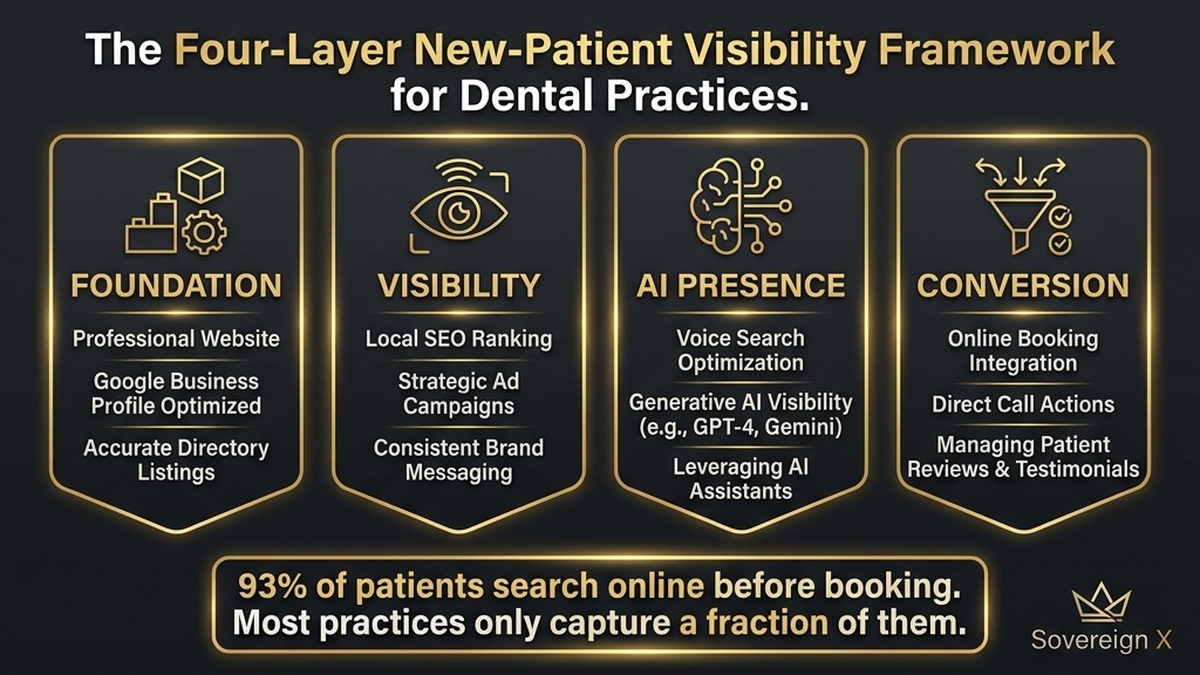
The New-Patient Visibility Framework
Layer 1 — Foundation (determines whether you're findable at all)
- All GBP locations claimed, verified, complete, and consistent with website
- LocalBusiness and MedicalBusiness schema on all location pages
- NAP identical across website, GBPs, Yelp, Healthgrades, and Zocdoc
Layer 2 — Visibility (determines ranking position)
- Local 3-pack position for primary service searches
- Review velocity: minimum three new Google reviews per month per location
- Website domain authority: blog content answering patient questions
Layer 3 — AI Presence (determines AI recommendation rate)
- Test ChatGPT and Perplexity for top five patient queries
- FAQ schema on treatment and FAQ pages
- Original, citable content about specific services and patient experience
Layer 4 — Conversion (determines whether visibility translates to new patients)
- Real-time booking or inquiry capture available 24/7
- Mobile website loads under three seconds
- After-hours call handling — voicemail minimum, AI voice agent preferred
Want to know exactly where your business stands with AI search?
We run the full diagnostic and deliver a findings report in 72 hours. No discovery call. No commitment.
Book the Audit →Related intelligence · selected for this topic
Framework developer and systems thinker specializing in AI implementation and decision architecture. Creator of the AI Council methodology — a structured multi-model framework used to surface deeper insights in complex decisions. The audit intelligence at Sovereign X Audits is built on these same principles.
aicouncilconductor.com →Find out exactly where your business stands.
We audit your digital infrastructure, AI visibility, and brand presence — and show you exactly what it's costing you.